Popular Courses
MCAT
General Course
CHEM 1302A/B
Western University
General Chemistry
University Study Guides
AP Chemistry Exam Prep Course
AP Exam Prep
CHEM 1A03
McMaster University
CHEM 101
University of Alberta
CHEM 112
Queen's University
CHEM 203
University of Calgary
DAT
General Course
Chemistry
General Course
General Chemistry
University Study Guides
CHEM 103
University of Alberta
CHM135H1
University of Toronto
CHEM 154
University of British Columbia
CHEM 120
University of Waterloo
CHEM 123
University of British Columbia
CHY 102
Toronto Metropolitan University
CHEM 205
Concordia University
CHEM 121
Simon Fraser University
CHEM 120
McGill University

0:00 / 0:00
The Ideal Gas Law
The equation below describes ideal gases. Real gases act differently, but act most similarly to ideal gases at high temperatures and low pressures!
P is pressure measured in kPa (or maybe atm Torr, mmHg...)
V is volume measured in L or m3
n is number of moles of the gas
R is the ideal gas constant (will be either 8.314J/mol K OR 0.082 L atm/mol K)
T is temperature measured in K
Wize Tip
Pressure=Force/unit area=N/m2=1 Pa
How to convert different units of pressure:
We mentioned that R (the ideal gas constant) could be either 8.314J/mol K or 0.082 L atm/mol K. How do we know which value to use?
Watch Out!
Using the correct value for R is more important than you might think! Students often make the mistake of using the wrong value of R on an exam and they get the question wrong. Let's see how we can easily prevent that :)
The ideal gas constant appears frequently in chemistry, for this reason, it comes in many forms depending on the context of its use and the units involved:

Example:
Suppose the variables in the ideal gas law equation had the following units:
What should R be in this case? (These terms need to combine correctly to ensure that this equation makes sense!)
R must be 8.314 J/ mol K which is the same as 8.314 kPa L/mol K
0:00 / 0:00
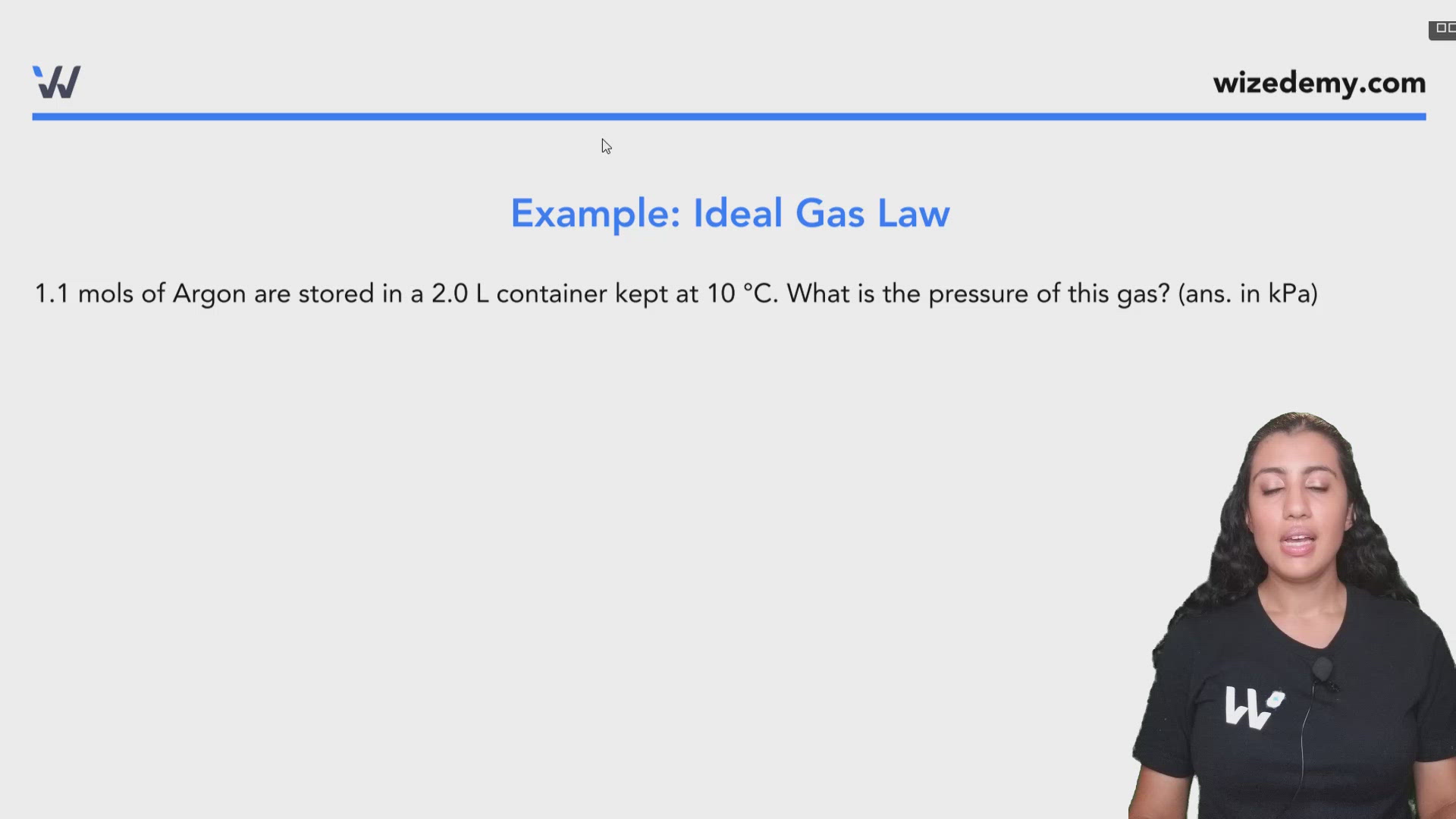
Example: Ideal Gas Law
1.1 mols of Argon are stored in a 2.0 L container kept at 10.0°C. What is the pressure of this gas? (ans. in kPa)
n = 1.1, V = 2 L, T = 10°C, P = ?
Is everything in correct units?
Need to convert T from °C to K → °C + 273 = K So 10°C + 273 = 283 K
PV = nRT
P = nRT/V
P = (1.1 moles)(8.314 kPa L/mol K)(283 K)/2 L
P = 1294 kPa = 1300 kPa (sig figs)
0:00 / 0:00
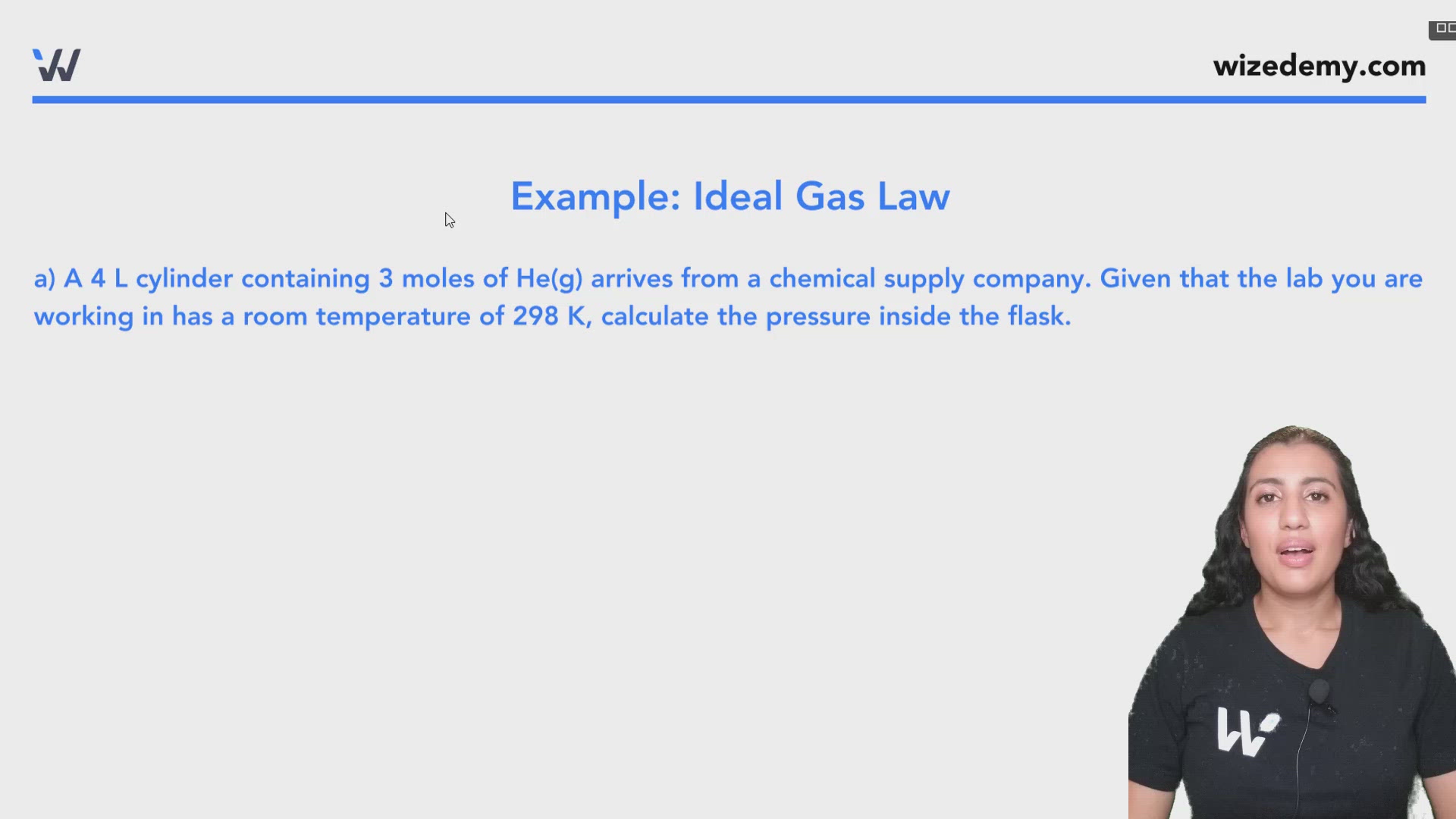
Example: Ideal Gas Law
a) A 4 L cylinder containing 3 moles of He(g) arrives from a chemical supply company. Given that the lab you are working in has a room temperature of 298 K, calculate the pressure inside the flask.
b) At what temperature will the cylinder have an internal pressure of 9 atm?
c) Your lab mate steals some of the gas from your cylinder for a reaction he is doing. He fills a 1 L bulb with 1 atm of your gas at 298 K. If the cylinder is at room temperature, what is the internal pressure of the cylinder once the gas has been removed?
Tank:
Practice: Stoichiometry and the Ideal Gas Law
The combustion of methanol (CH3OH) is shown below. If 16 g of methanol is burned in oxygen, what volume of CO2 is produced if the pressure is 101.3 kPa, T = 25°C, and R = 8.314 kPa L/mol K? Round to the nearest whole number.