Wize University Chemistry Textbook > Gases and their Properties
Kinetic Molecular Theory of Gases
Popular Courses
MCAT
General Course
CHEM 1302A/B
Western University
General Chemistry
University Study Guides
AP Chemistry Exam Prep Course
AP Exam Prep
CHEM 101
University of Alberta
CHEM 112
Queen's University
CHEM 203
University of Calgary
DAT
General Course
Chemistry
General Course
CHEM 103
University of Alberta
General Chemistry
University Study Guides
CHM135H1
University of Toronto
CHEM 154
University of British Columbia
CHEM 120
University of Waterloo
CHY 102
Toronto Metropolitan University
CHEM 205
Concordia University
CHEM 121
Simon Fraser University
CHEM 120
McGill University
SC/CHEM 1000 3.00
York University
APSC 131
Queen's University

0:00 / 0:00
Kinetic Molecular Theory (KMT)
This theory describes the behaviour of ideal gases.
In normal conditions we can apply this to real gases as well...(more on the conditions required for this later)
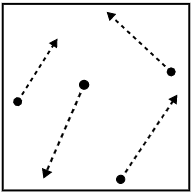
The KMT operates under the following assumptions/simplifications:
Wize Concept
- Ideal gases are in constant, random motion and move in straight lines
- The size of gas particles is negligible compared to the distance between particles. As a result of this, the volume of gas particles is considered to be 0.
- There is constant motion of particles and collisions of gas particles (with other gas particles and with the walls of the container) are completely elastic so that the total kinetic energy is conserved before and after a collision.
- There are no intermolecular forces between gas particles (they don't attract or repel each other).
- Temperature is directly proportional to the average kinetic energy of the gas particles.
- If we increase temperature, do you think the gas molecules would collide with container walls more/less often?Moreoften.
- And with an increase in temperature would the gas particles collide at slower or greater speeds?Greaterspeeds
Watch Out!
T should always be in Kelvins (K) for chemistry calculations :)
T(in K) = T(in °C) + 273
Wize Tip
You can just assume we are dealing with an ideal gas unless stated otherwise in a particular exam question!
Note: to measure pressure( P=F/A), we need to take into consideration the number of collisions and force of those collisions between gas particles and the walls of the container
This can help us understand WHY the KMT says what it does for IDEAL gases:
- If gas particles had volume they would be quite large and would have more/less:moreintermolecular forces/attractions to one another. This would mean that they would interact with the walls of the container more/less:lessand result in a decrease/increase:decreasein pressure.
- If collisions weren't elastic, then over time gas particles would hit the walls of the container with more/less:lessforce and increase/decrease:decreasethe pressure.
- We will explain this concept more when we look at real vs ideal gases!
The KMT for ideal gases helps to keep conditions in the container stable!