Wize AP Biology Textbook > Transcription and Translation
Genes and mRNA
0:00 / 0:00
Genes and mRNA
According to the central dogma, first genes within DNA get transcribed into mRNA. But before we understand more about mRNA, it's important to know the basic components of a gene.
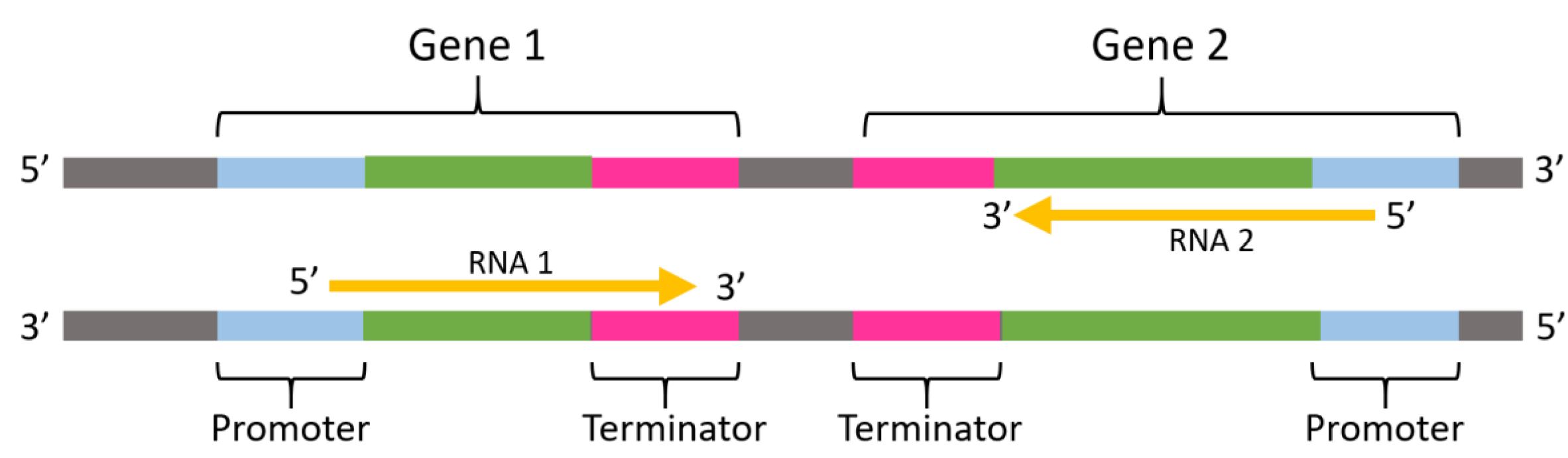
The structure of a gene
A gene generally consists of 3 basic elements:
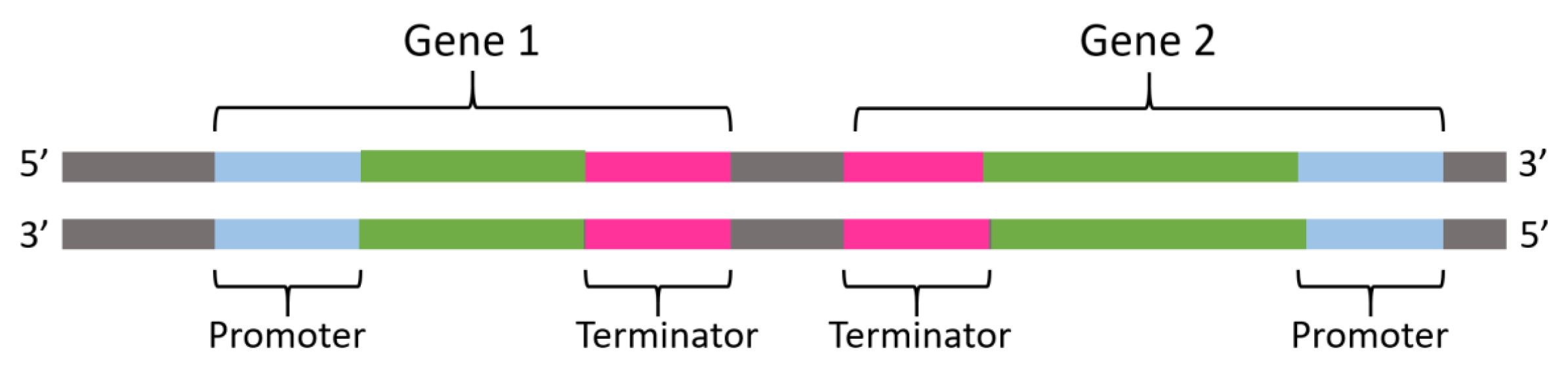
- Promoter: a region of DNA just before a gene (upstream) that initiates transcription. RNA polymerase binds DNA in this region.
- Coding region: the part of the gene that codes for a particular RNA molecule (mRNA, rRNA, tRNA).
- Terminator: a region of DNA just after a gene (downstream) that signals transcription to stop.
- There are a couple of differences between eukaryotes and prokaryotes that will be addressed later.

mRNA Synthesis
Remember, there are many genes on a chromosome. These genes are not always oriented in the same direction.
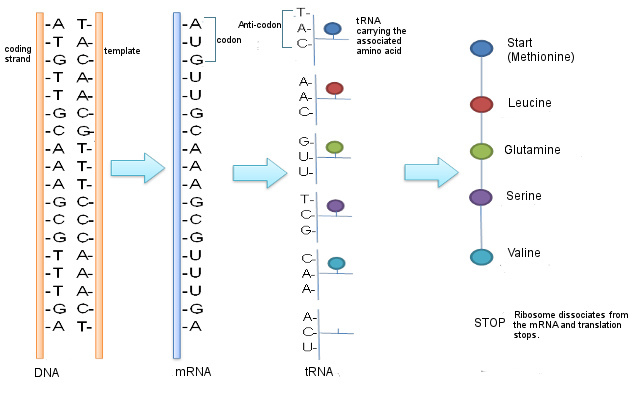
- The DNA strand that is to be transcribed is referred to as the template strand. The complementary strand is known as the coding strand, which is identical to the mRNA that is transcribed (except the Thymines are Uracils in mRNA).
- DNA is read in the 3' to 5' direction, which means that the complementary RNA strand is synthesized in the 5' to 3' direction.
- This is similar to how DNA Polymerase synthesized a new strand of DNA!
The General Structure of mRNA
Bacterial mRNA contains the following elements:
- 5’ untranslated region (UTR): contains the ribosome binding site.
- Start codon: codon at which the ribosome begins translation.
- Stop codon: codon at which the ribosome stops translation.
- 3’ untranslated region (UTR): region downstream of stop codon that is not translated.

Wize Concept
Note that bacterial mRNA is often polycistronic, meaning more than one protein can be encoded in a single strand of mRNA.

0:00 / 0:00
The General Structure of mRNA
Bacterial mRNA contains the following elements:
- 5’ untranslated region (UTR): contains the ribosome binding site.
- Start codon: codon at which the ribosome begins translation.
- Stop codon: codon at which the ribosome stops translation.
- 3’ untranslated region (UTR): region downstream of stop codon that is not translated.
Wize Concept
Note that bacterial mRNA is often polycistronic, meaning more than one protein can be encoded in a single strand of mRNA.

0:00 / 0:00
The Genetic Code
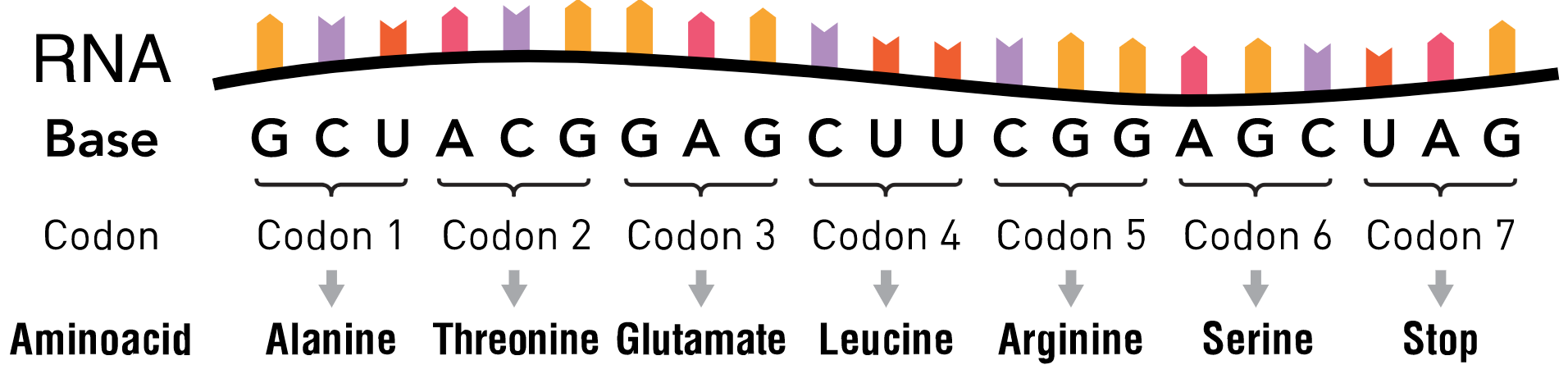
Three consecutive nucleotides on a strand of mRNA represent a codon, which codes for a particular amino acid. The genetic code is said to be redundant or degenerate because more than one codon codes for each amino acid.

- AUG is the codon for the amino acid methionine and is the start codon.
- The reading frame of the RNA strand is set by the start codon.
- Though there's only one start codon, there are three possible stop codons.
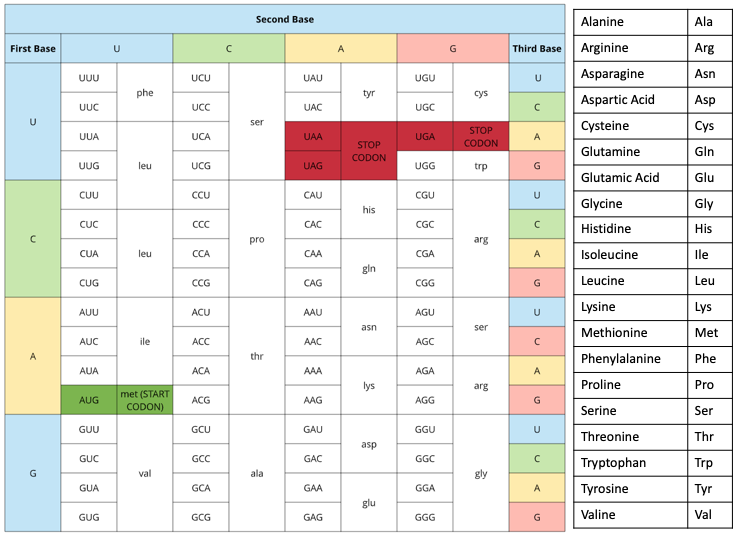
Each mRNA codon is recognized by the complimentary anticodon of a tRNA that carries the corresponding amino acid.
- The enzyme that "loads" the amino acids onto the appropriate matching tRNAs is called aminoacyl tRNA synthetase.
- The mRNA and tRNA interact in an antiparallel orientation via hydrogen bonds.
- There is looser pairing between the 5’ nucleotide of the anticodon and the 3’ nucleotide of the codon, which gives rise to the wobble effect.

What is a reading frame and how is it important?
From start to stop codon, one full protein is made. The sequence between the start codon and the stop codon is called a reading frame.

Usually, a sequence has only one reading frame. If the reading frame is changed, a different polypeptide chain will be made and one of two things will happen:
- A mutated protein will be produced that is nonfunctional: usually occurs because of a deletion or another mutation in the mRNA or in the DNA itself.
- A different functional protein will be made.
Practice: mRNA Synthesis
Write the first 10 nucleotides of the mRNA from the gene sequence given below. Make sure to label the 5’ and 3’ ends. The gene is read left to right. Label the template and coding strands.
5’ – CGGGCTATTGTCATTTGCATGACTCCGTGGA – 3’
3’ – GCCCGATAACAGTAAACGTACTGAGGCACCT – 5’
Practice: Genetic Code Theory
The Genetic Code is said to be universal, redundant, and non-overlapping. What does that mean, and why is it important?
A.
Same code used in all organisms
B.
Each codon codes for only one amino acid
C.
More than one codon for a particular amino acid
Universal
Redundant
Non-overlapping

Mark Yourself Question
- Grab a piece of paper and try this problem yourself.
- When you're done, check the "I have answered this question" box below.
- View the solution and report whether you got it right or wrong.
Practice: DNA to RNA Parts
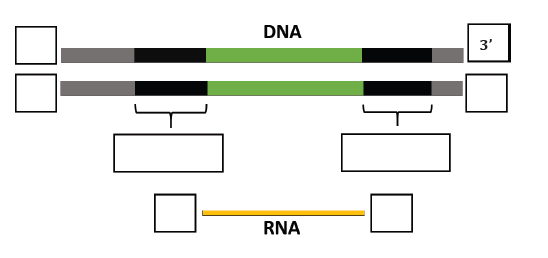
Label the parts of the gene and the resulting RNA in the diagram below. Assume the gene is read left to right.
Practice: tRNA vs mRNA
An anticodon of a tRNA has the sequence 5'-GCA-3'.
a) What amino acid does the tRNA carry?
b) What is a complimentary mRNA codon?
c) What is the DNA sequence encoding the codon in a complimentary mRNA codon?