Wize AP Biology Textbook > Gene Expression & Regulation
Eukaryotic Epigenetic Regulation
Popular Courses
Find My Course
0:00 / 0:00
Epigenetic Gene Regulation
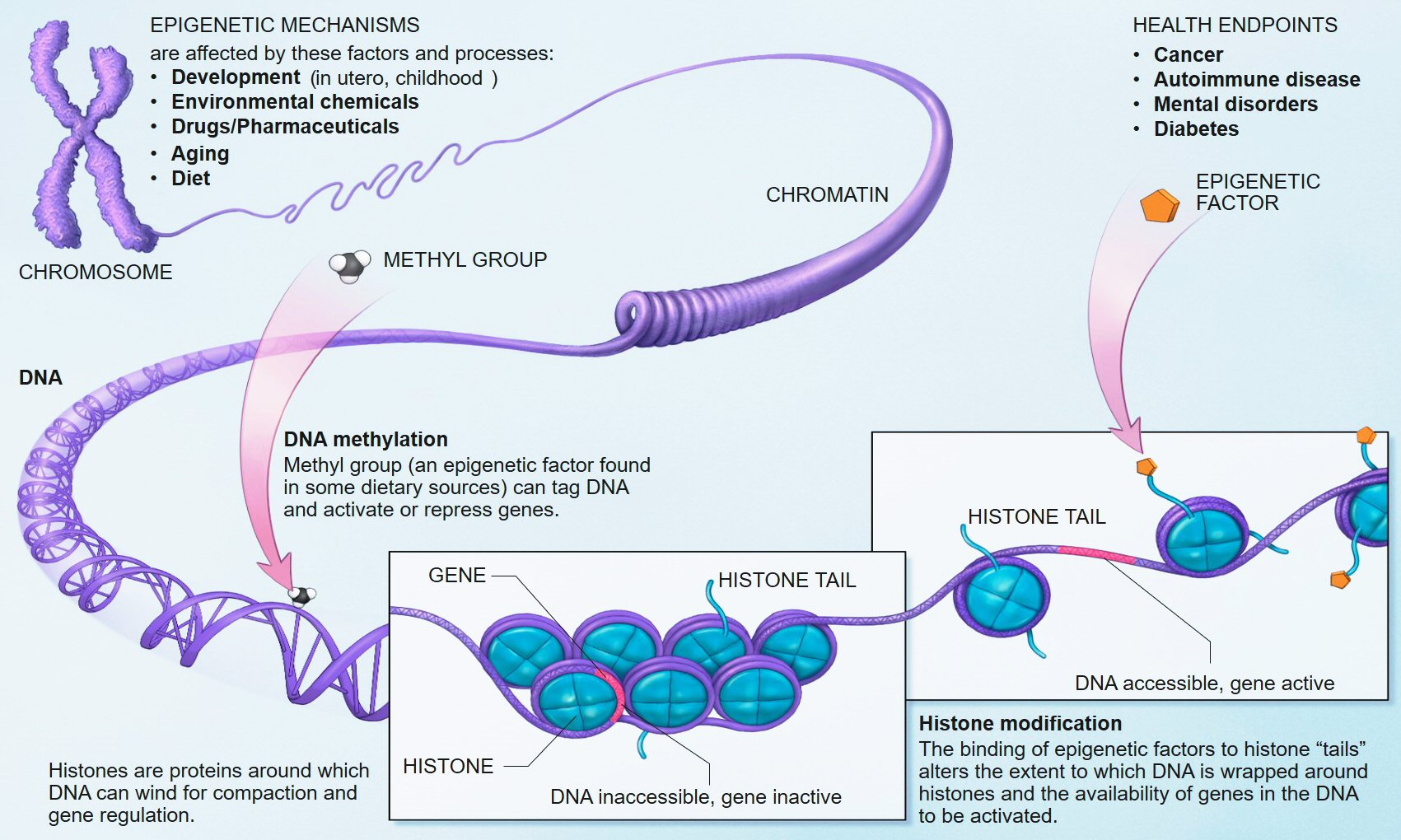
Eukaryotic gene expression regulation is more complex than in prokaryotes. Because eukaryotes have large linear chromosomes that are compacted within cells, accessing the genes that are wrapped around histones is another way in which expression can be regulated. This is epigenetics.
- Acetyl groups or methyl groups can be added to the histone tails (strings of protruding amino acids), affecting how tightly DNA is wrapped around it.
- These modifications usually occur on lysine residues.
- Modifications make up the histone code and can either enhance or repress transcription.
- Histone acetyltransferases (HATs) add acetyl groups to histones.
- Acetylation usually enhances transcription my loosening the DNA-histone binding, making the DNA more accessible to transcriptional machinery.
- Methylation can either enhance (Me) or repress (Me3) transcription.
- Epigenetic modification to the DNA itself also occurs.
- The most common modification is the addition of a methyl group to cytosine nucleotides.
- Cytosine methylation usually occurs in CpG islands, which are clusters of adjacent CG nucleotides located in or near the promoter of a gene.
- CpG methylation states change in response to environmental conditions and is a mechanism for turning on/off genes.
0:00 / 0:00
X-chromosome inactivation
X-chromosome inactivation is a form of epigenetic control in which an entire chromosome is inactivated.
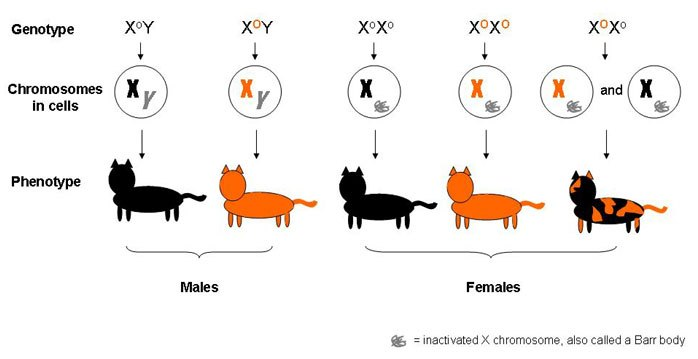
- Females have 2 X-chromosomes: one maternal and one paternal. To avoid over-expression of genes located on the X-chromosome, one becomes inactivated (dosage compensation).
- Which X chromosome is inactivated occurs randomly after the first few rounds of embryonic cell division.
- This leads to a “patchwork” of paternal and maternal genes being expressed.
- The mechanism involves a non-coding RNA called Xist.
- Xist coats the X-chromosome and recruits factors that promote DNA methylation, histone modification, and other changes that repress transcription.

Practice: Examples of Epigenetic Regulation
Which of the following is not an example of epigenetic regulation?
Practice: Epigenetic Modification Effects
Which of the following is true?