Wize University Biology Textbook > Ecology
Population Growth
Popular Courses
AP Biology Exam Prep Course
AP Exam Prep
Biology
General Course
General Biology
University Study Guides
BIOL 211
University of Calgary
Grade 12 Biology
Canada High School
DAT
General Course
High School Biology
US High School
BIOL 103
Queen's University
BIO 1131
University of Ottawa
BIOL 121
University of British Columbia
BIOLOGY 1M03
McMaster University
BIO120H1
University of Toronto
General Biology
University Study Guides
BIOL*1070
University of Guelph
SC/BIOL 1001 3.00
York University
BIOL 1201
Western University
BIOL 1011
Dalhousie University
BIOL 1P91
Brock University
BLG 144
Toronto Metropolitan University
BIOL 1020
University of Manitoba
0:00 / 0:00
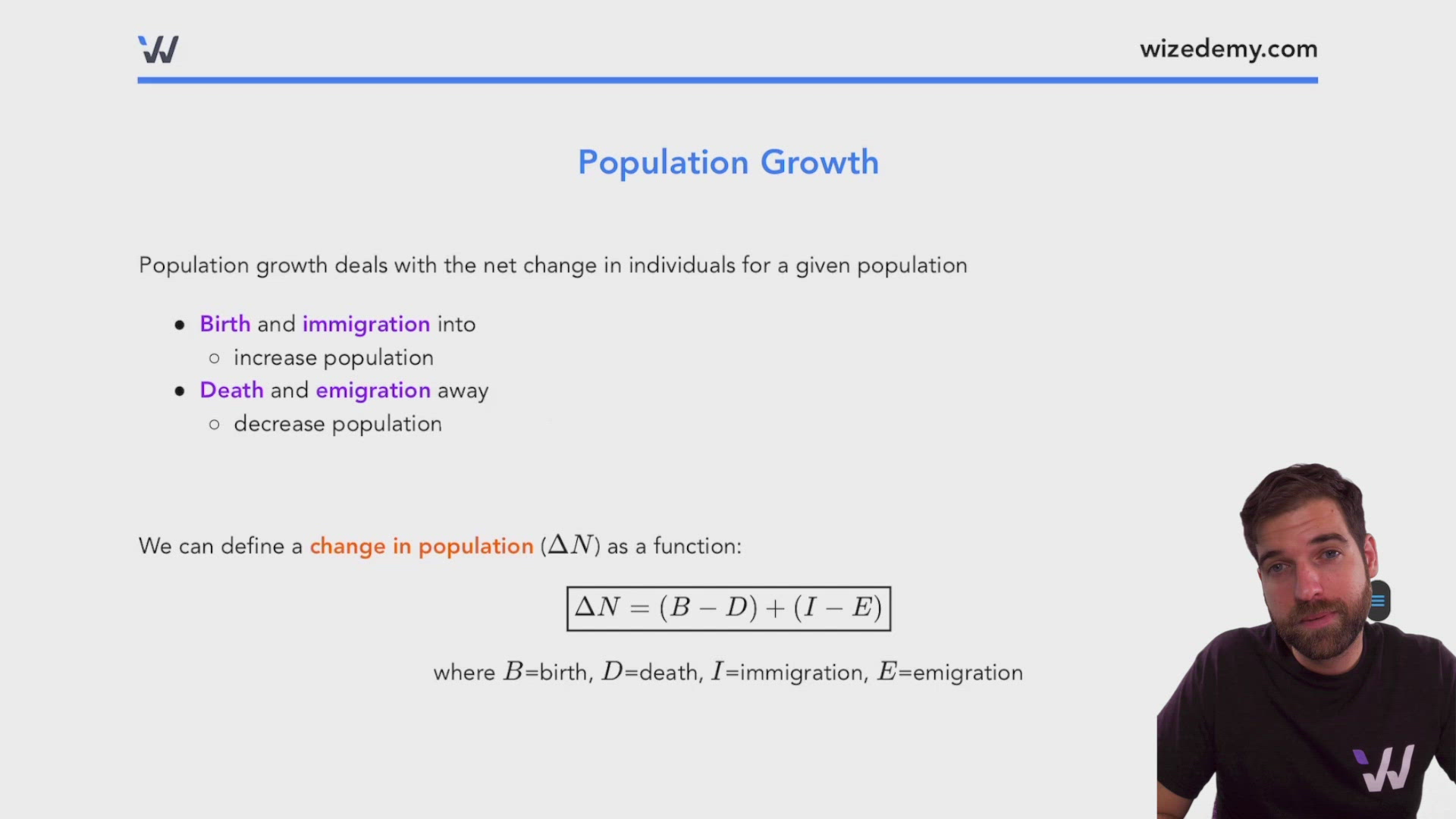
Population Growth
Population growth deals with the net change in individuals for a given population
- Birth and immigration into
- increase population
- Death and emigration away
- decrease population=emigratio
We can define a change in population () as a function:
where =birth, =death, =immigration, =emigration
What if we want to know the rate at which the change in population is occurring?
- We must determine the per capita (intrinsic) growth rate (), which depends on time:
where =change in population, = change in time, =initial population size
- intrinsic growth rate: maximum rate of growth
- no environmental factors limit population increase
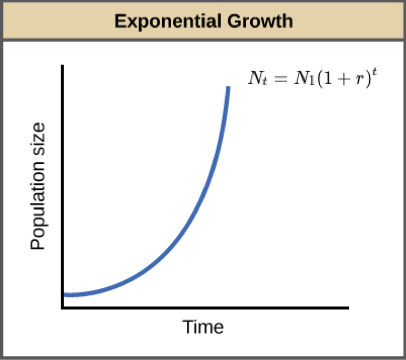
If we want to determine what the population size will be sometime in the future, then we use the following formula:
where = future population, =intrinsic growth rate, =time
- Exponential growth: when the is constant through time
- The number of individuals added to the population at any time is proportional to the size of the population at that tim
0:00 / 0:00
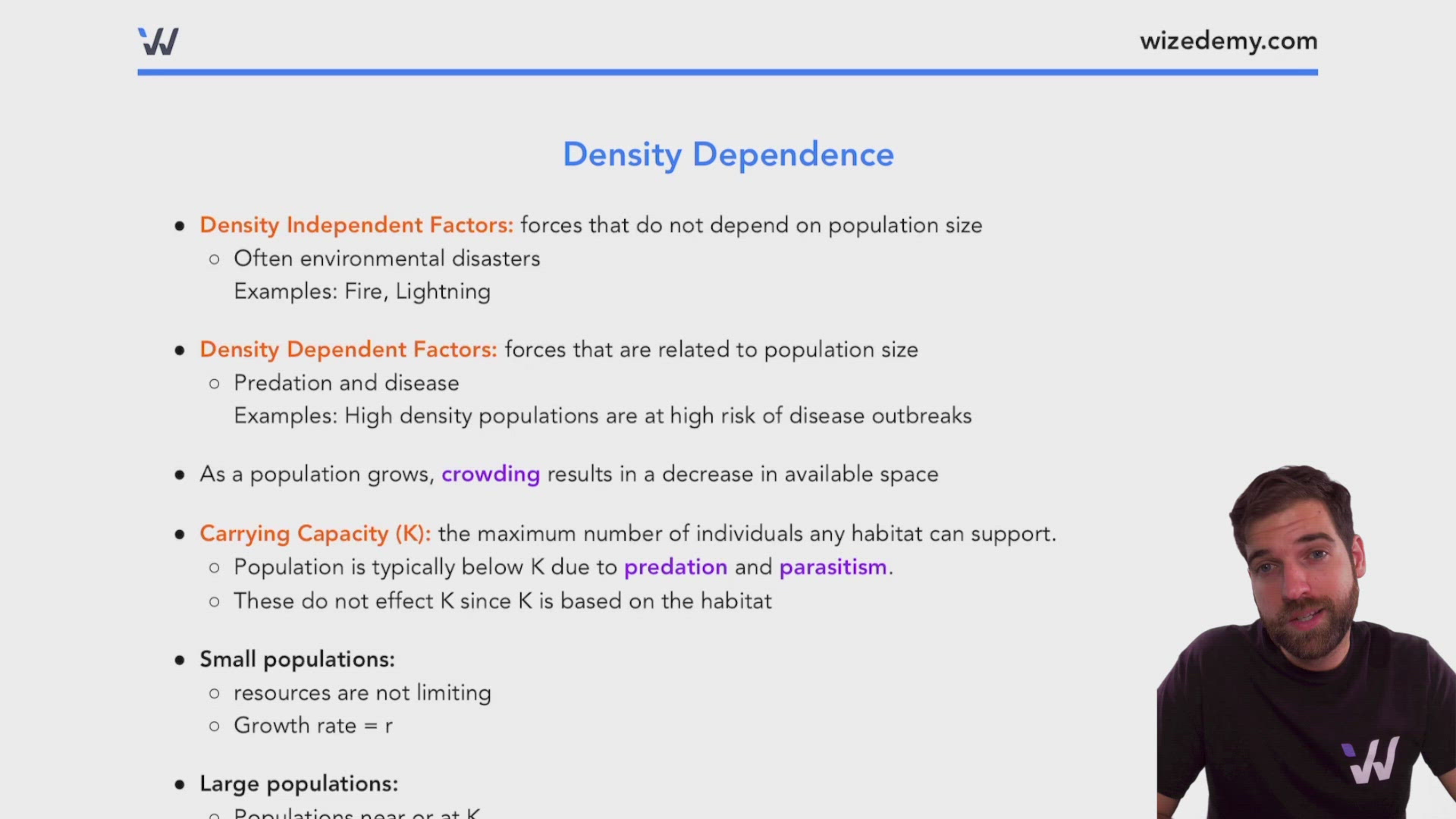
Density Dependence
- Density Independent Factors: forces that do not depend on population size
- Often environmental disasters Examples: Fire, Lightning
- Density Dependent Factors: forces that are related to population size
- Predation and disease Examples: High density populations are at high risk of disease outbreaks
- As a population grows, crowding results in a decrease in available space
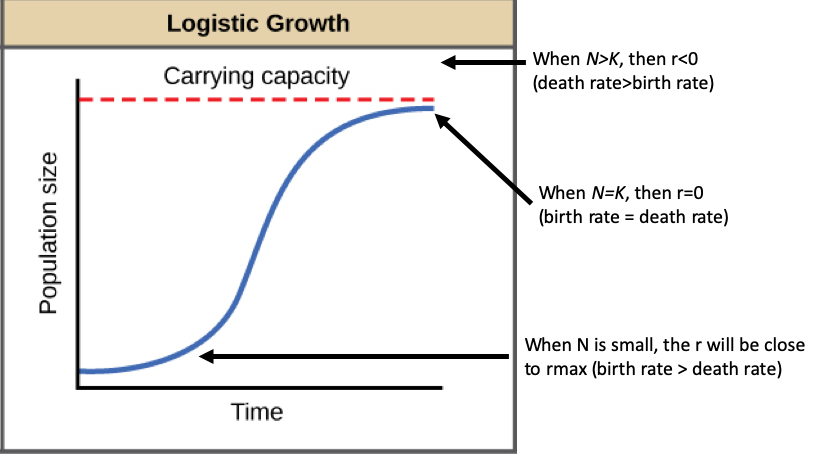
- Carrying Capacity (K): the maximum number of individuals any habitat can support.
- Population is typically below K due to predation and parasitism.
- These do not effect K since K is based on the habitat
- Small populations:
- resources are not limiting
- Growth rate = r
- Large populations:
- Populations near or at K
- Overcrowding reduces available resources
- Growth rate < r
- Determine how close the population is to K:
where K= carrying capacity, N=population number

- Intrinsic growth rate () is also scaled by how close the population is to K:

Mark Yourself Question
- Grab a piece of paper and try this problem yourself.
- When you're done, check the "I have answered this question" box below.
- View the solution and report whether you got it right or wrong.
Calculate the change in population size given that there are:
50 births
35 deaths
10 immigrants
5 emigrants
Mark Yourself Question
- Grab a piece of paper and try this problem yourself.
- When you're done, check the "I have answered this question" box below.
- View the solution and report whether you got it right or wrong.
Calculate the intrinsic growth rate for a population that increased from 100 individuals to 150 individuals in one year.
Mark Yourself Question
- Grab a piece of paper and try this problem yourself.
- When you're done, check the "I have answered this question" box below.
- View the solution and report whether you got it right or wrong.
Given an intrinsic growth rate of 0.5, how much will a population of 100 individuals increase in 5 years?
Mark Yourself Question
- Grab a piece of paper and try this problem yourself.
- When you're done, check the "I have answered this question" box below.
- View the solution and report whether you got it right or wrong.
What will the intrinsic growth rate be for a population of 500 individuals given density dependent factors?
The carrying capacity for the population is 400 individuals and the maximum intrinsic growth rate is 1.2.