Wize University Biology Textbook > Cell Structure
The Cytoskeleton
Popular Courses
MCAT
General Course
AP Biology Exam Prep Course
AP Exam Prep
Biology
General Course
General Biology
University Study Guides
BIOL 107
University of Alberta
BIOL 102
Queen's University
Grade 12 Biology
Canada High School
DAT
General Course
High School Biology
US High School
BIOL*1090
University of Guelph
General Biology
University Study Guides
BIOL 130
University of Waterloo
SC/BIOL 1000 3.00
York University
BIOL 200
University of British Columbia
BIO 1141
University of Ottawa
BLG 143
Toronto Metropolitan University
BIOL 112
McGill University
BIOL 186
University of Victoria
BIOL 1010
Dalhousie University
BIO230H1
University of Toronto
0:00 / 0:00
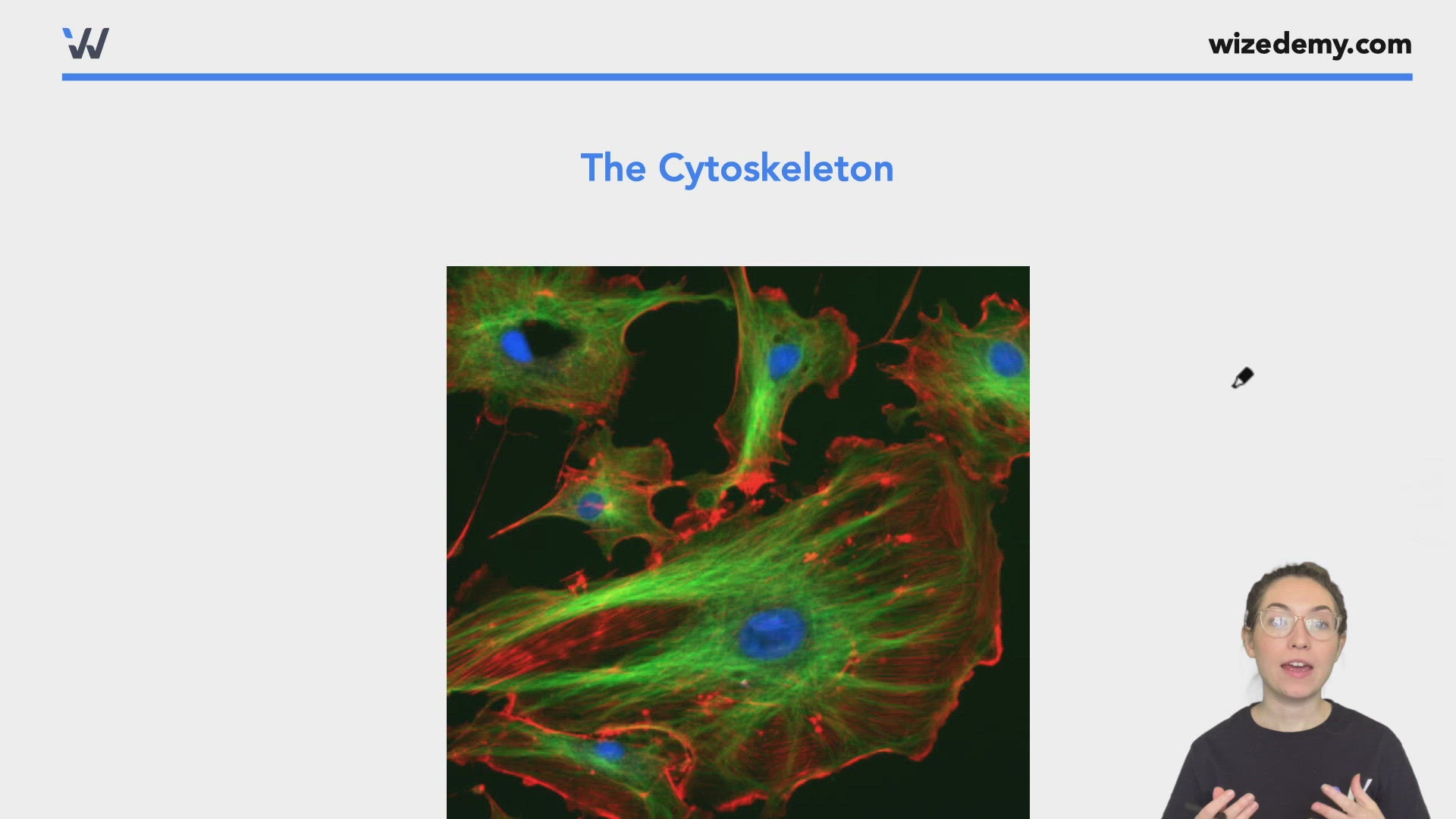
The Cytoskeleton
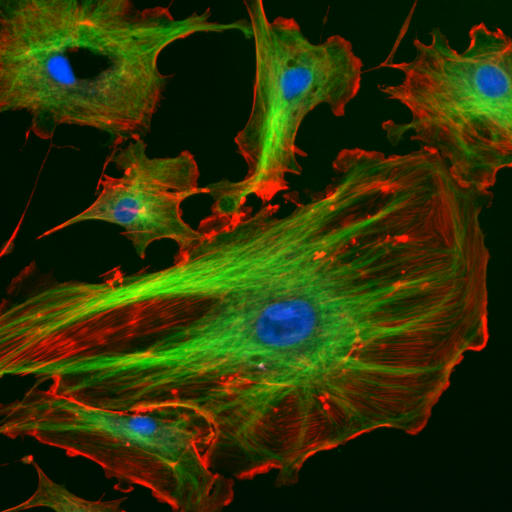
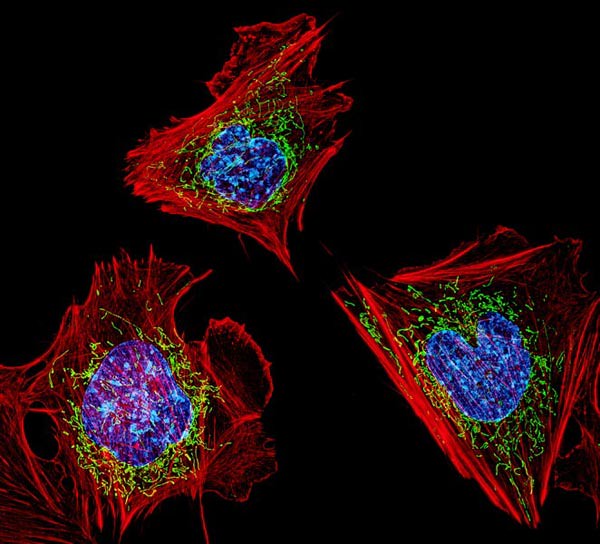
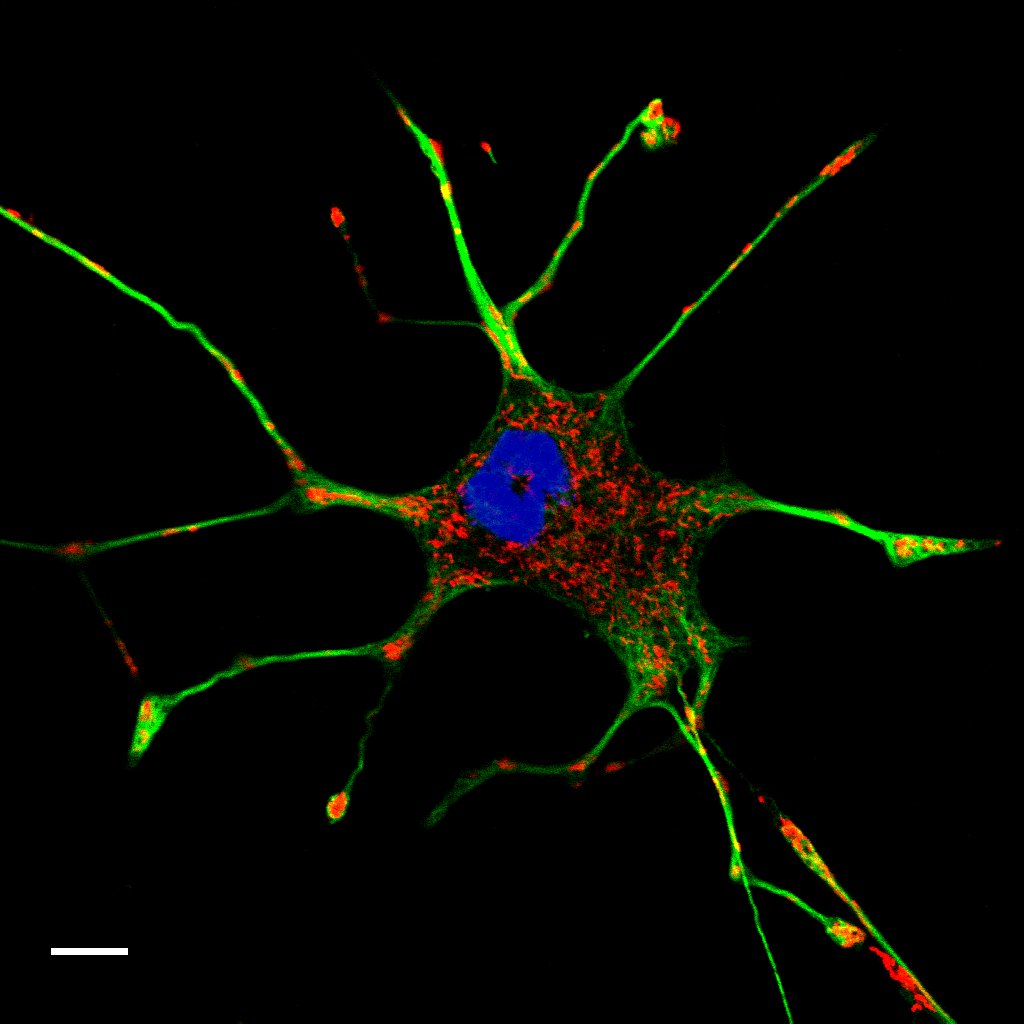
The cytoskeleton is a network of protein filaments that extends throughout the cytoplasm. Cytoskeletal filaments are dynamic, and can re-organize; this allows cells to change shape, interact with the environment, move, and organize cellular compartments.
There are three types of protein filaments in the cytoskeleton, and these are often classified by the size of each filament:
Intermediate filaments: rope-like filaments composed of a family of keratin proteins.
- Provide mechanical strength;
- Named for their intermediate size, relative to actin and microtubules.
Microtubules: hollow cylinders made of tubulin dimers.
- Involved in organization of organelles and vesicles;
- Form the mitotic spindle;
- Major component of flagella and cilia.
Actin Microfilaments: helical polymers of actin protein.
- Involved in cellular movement;
- Involved in skeletal muscle contraction;
- In plants, involved in organization of organelles and vesicles.

0:00 / 0:00
Microtubules
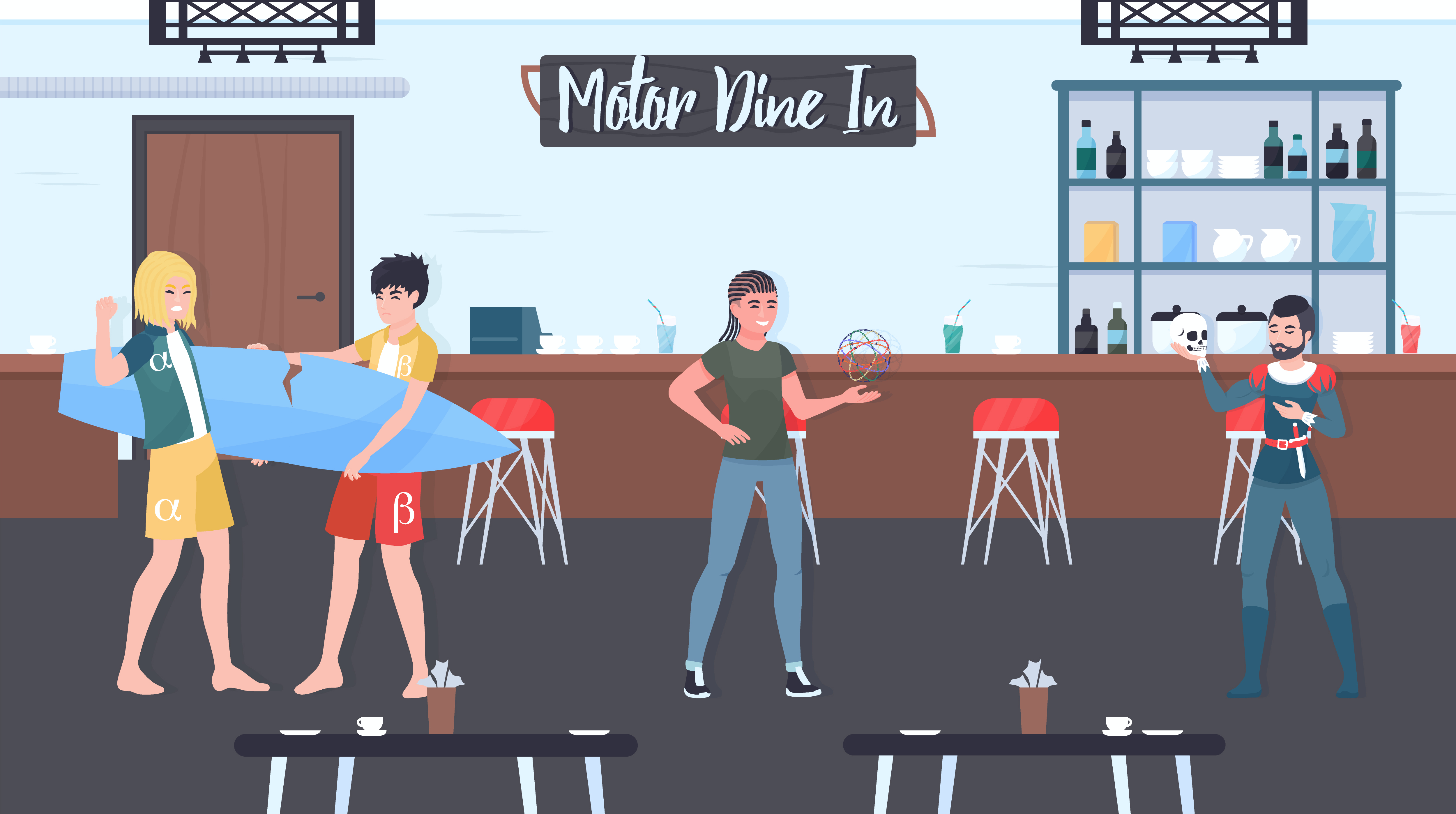
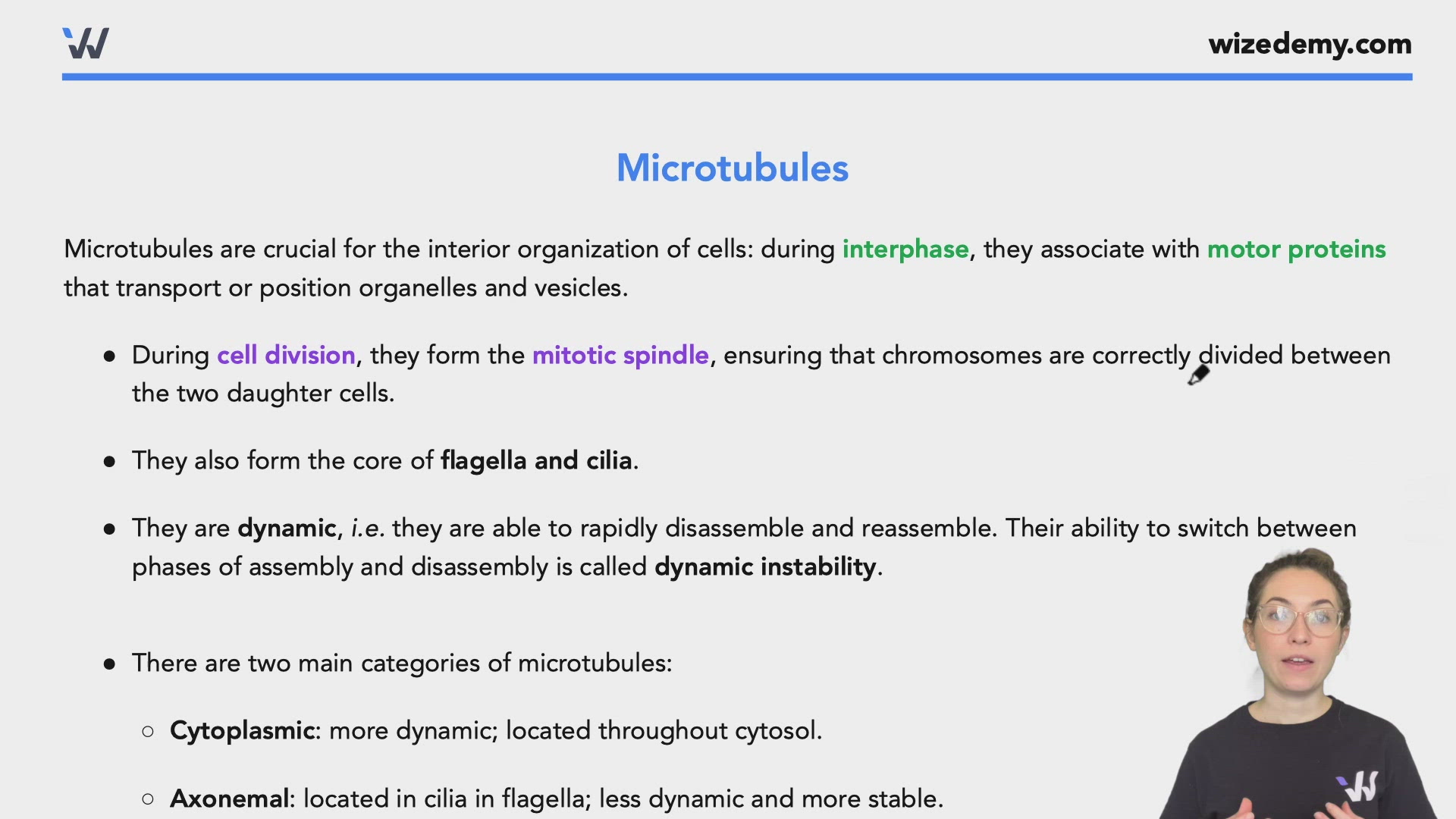
Microtubules are crucial for the interior organization of cells: during interphase, they associate with motor proteins that transport or position organelles and vesicles.
- During cell division, they form the mitotic spindle, ensuring that chromosomes are correctly divided between the two daughter cells.
- They also form the core of flagella and cilia.
- They are dynamic, i.e. they are able to rapidly disassemble and reassemble. Their ability to switch between phases of assembly and disassembly is called dynamic instability.
- There are two main categories of microtubules:
- Cytoplasmic: more dynamic; located throughout cytosol.
- Axonemal: located in cilia in flagella; less dynamic and more stable.
- Microtubules originate/grow outward from microtubule organizing centers (MTOCs):
- Centrosomes are a type of MTOC found in animal cells and are considered cell organelles;
- Consist of a pair of centrioles that are perpendicular to each other, surrounded by various proteins;
- The centrioles are made up of 9 triplets of microtubules.

Microtubule Structure
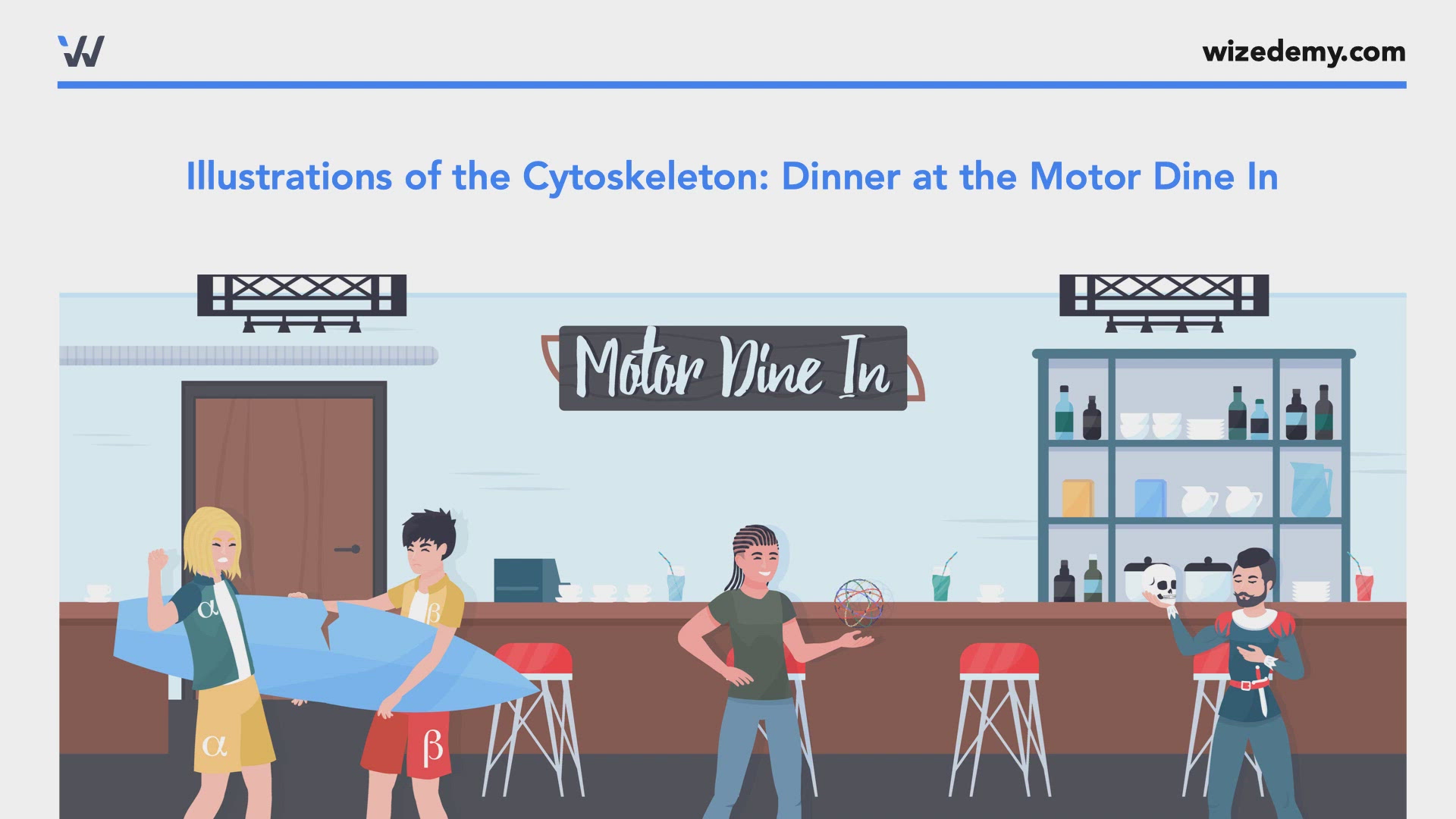
- Protofilament: a single chain of tubulin dimers, alternating between α- and β-tubulin.
- Microtubule: 13 protofilaments bind laterally to form a hollow, tube-like structure (see cross section).
- Larger (~10 - 25 nm) than actin microfilaments and intermediate filaments.

Microtubule Function
- Provide structural support.
- Organization of cytoplasm: positioning of organelles.
- Transport ("roads" for motor proteins).
- Segregation of chromosomes during cell division (mitotic spindle).

Wize Tip
Remember the microtubule as micro-tubular...
- Composed of α- and β-tubulin;
- They split the cell in half by forming the mitotic spindle.

0:00 / 0:00
Actin Microfilaments
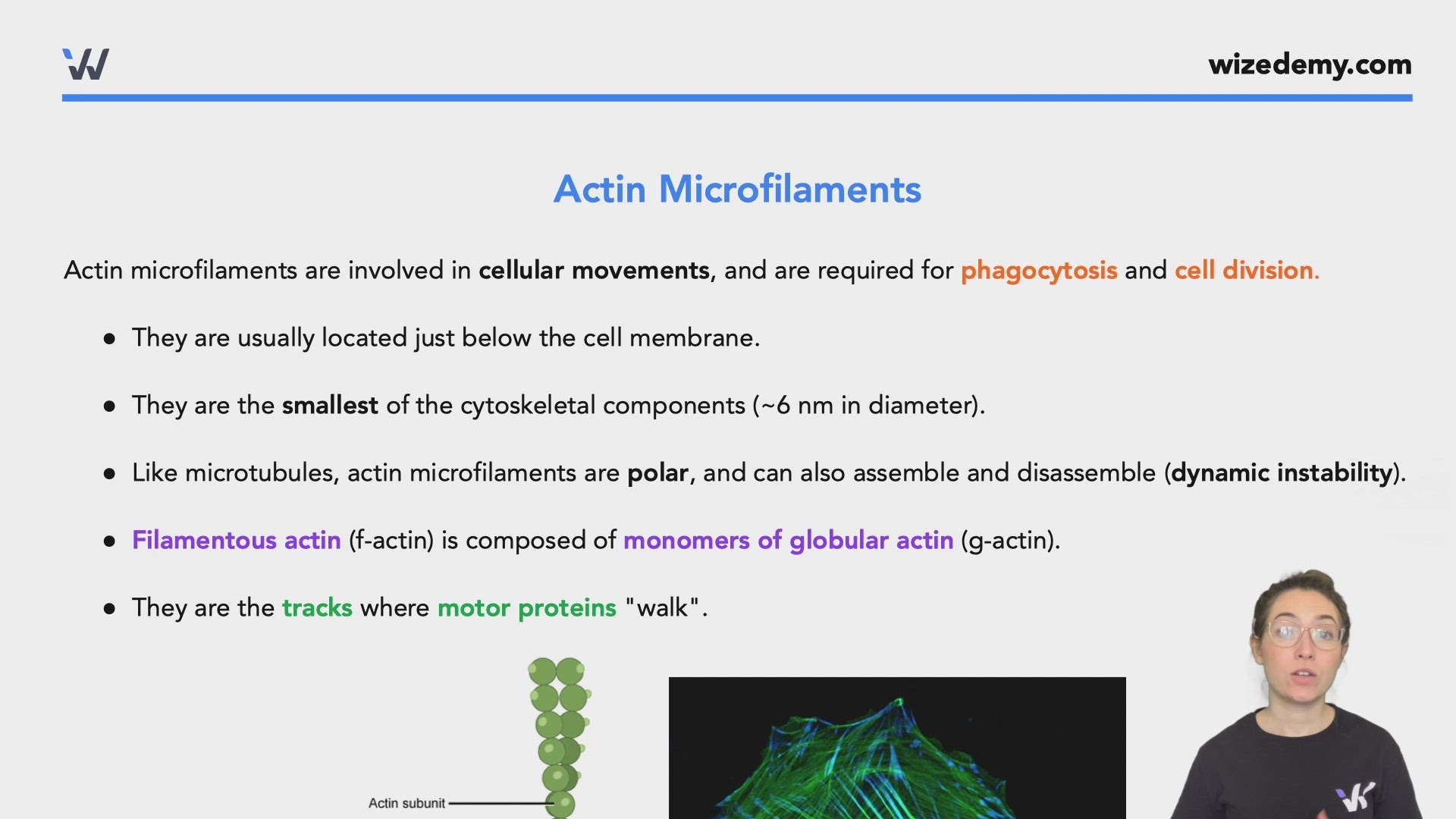
Actin microfilaments are involved in cellular movements, and are required for phagocytosis and cell division.
- They are usually located just below the cell membrane.
- They are the smallest of the cytoskeletal components (~6 nm in diameter).
- Like microtubules, actin microfilaments are polar, and can also assemble and disassemble (dynamic instability).
- Filamentous actin (f-actin) is composed of monomers of globular actin (g-actin).
- They are the tracks where motor proteins "walk".

Actin Filament Functions
- Structural support;
- Movement of organelles and vesicles;
- Cell division;
- Muscle contraction.

Wize Tip
Remember actin as someone who is acting...
- Involved in muscle contraction;
- Forms a contractile ring (belt) around the cells for division.

0:00 / 0:00
Intermediate Filaments
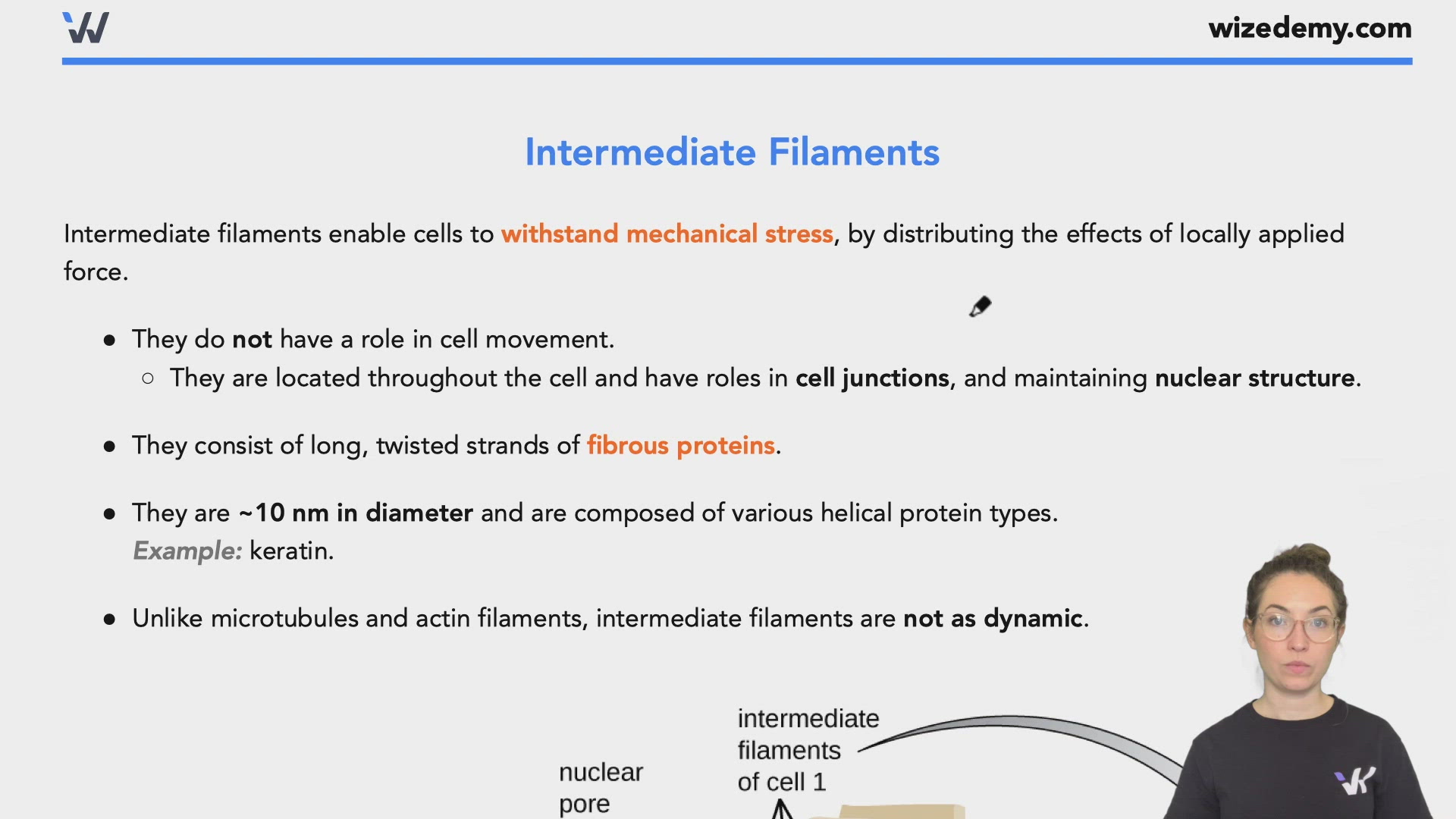
Intermediate filaments enable cells to withstand mechanical stress, by distributing the effects of locally applied force.
- They do not have a role in cell movement.
- They are located throughout the cell and have roles in cell junctions, and maintaining nuclear structure.
- They consist of long, twisted strands of fibrous proteins.
- They are ~10 nm in diameter and are composed of various helical protein types. Example: keratin.
- Unlike microtubules and actin filaments, intermediate filaments are not as dynamic.

Wize Tip
Think of intermediate filaments as someone with twisted braids holding a structure...


Mark Yourself Question
- Grab a piece of paper and try this problem yourself.
- When you're done, check the "I have answered this question" box below.
- View the solution and report whether you got it right or wrong.
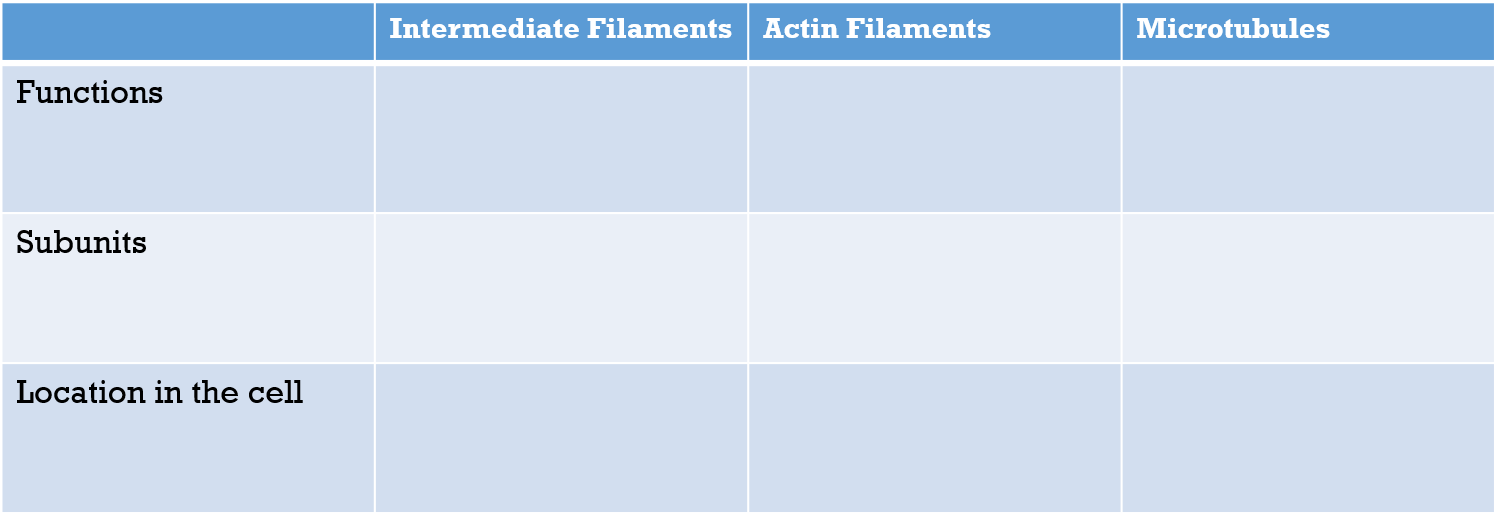
Practice: Cytoskeleton
Complete the following table:
Practice: Intermediate Filaments
Which of the following are true about intermediate filaments:
0:00 / 0:00
Illustrations of the Cytoskeleton: Dinner at the Motor Dine In