Wize University Biology Textbook > Energy & Metabolism
Types of Energy [Potential, Kinetic, Free & Activation]
Popular Courses
MCAT
General Course
AP Biology Exam Prep Course
AP Exam Prep
Biology
General Course
General Biology
University Study Guides
BIOLOGY 1002B
Western University
BIOL 211
University of Calgary
BIOL 102
Queen's University
BIOL 112
University of British Columbia
Grade 12 Biology
Canada High School
DAT
General Course
High School Biology
US High School
General Biology
University Study Guides
BIOL 130
University of Waterloo
SC/BIOL 1000 3.00
York University
BLG 143
Toronto Metropolitan University
BIOL 112
McGill University
BIOL 186
University of Victoria
BIOL-1101
University of Windsor
BIOL 1201
Western University
BISC 101
Simon Fraser University

0:00 / 0:00
Types of Energy
Energy is key in biological systems. There are two basic types or forms of energy: kinetic and potential energy.
- Kinetic energy (KE) is energy due to motion.
- Potential energy (PE) is energy that is stored.
- Untapped energy stored in chemical bonds or excited chlorophyll.
- Energy transduction is the change of one form of energy into another form.

Practice: Kinetic and Potential Energy
Which of the following is not correct?
0:00 / 0:00
Energy in Reactions
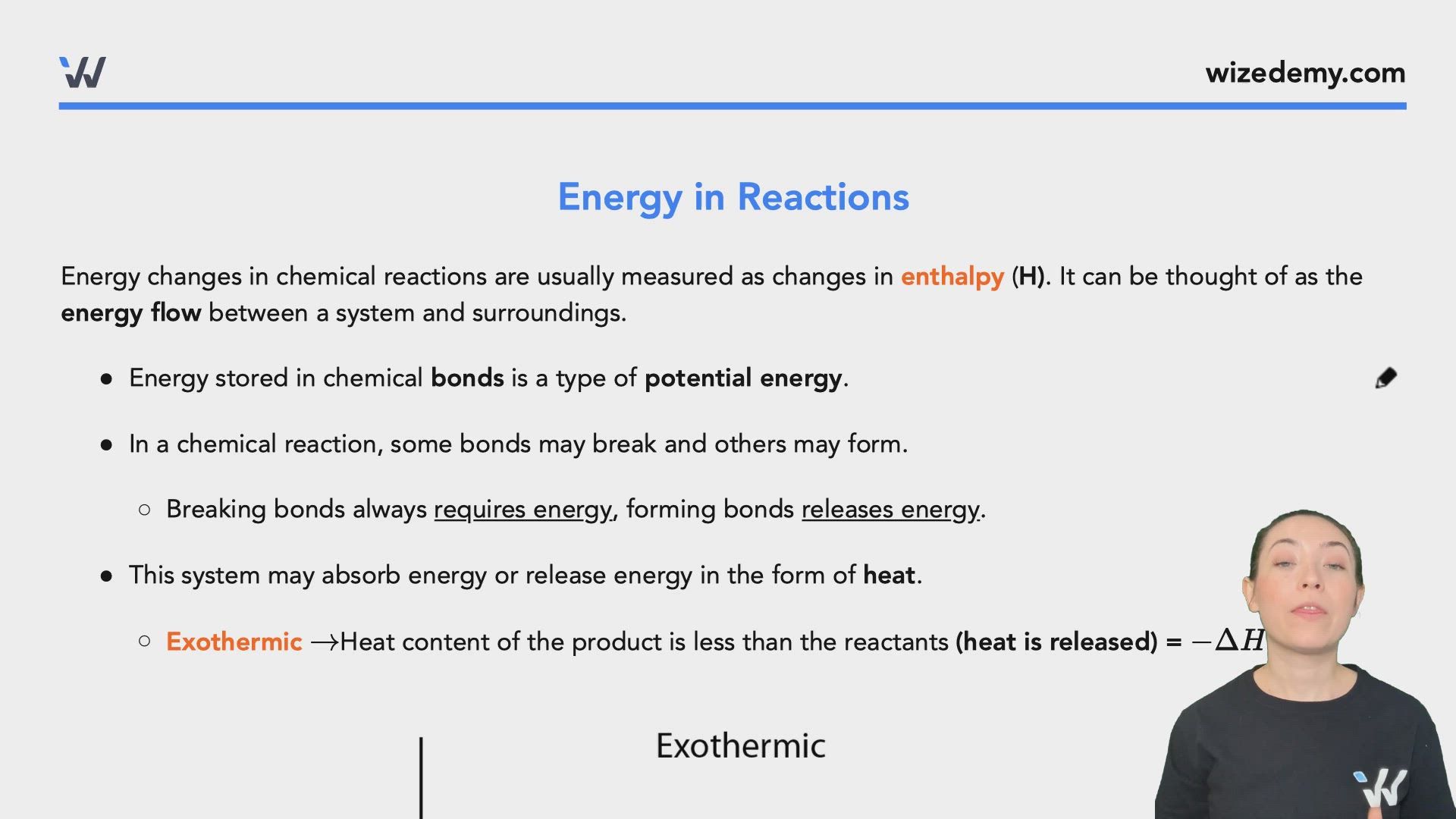
Energy changes in chemical reactions are usually measured as changes in enthalpy (H). It can be thought of as the energy flow between a system and surroundings.
- Energy stored in chemical bonds is a type of potential energy.
- In a chemical reaction, some bonds may break and others may form.
- Breaking bonds always requires energy, forming bonds releases energy.
- This system may absorb energy or release energy in the form of heat.
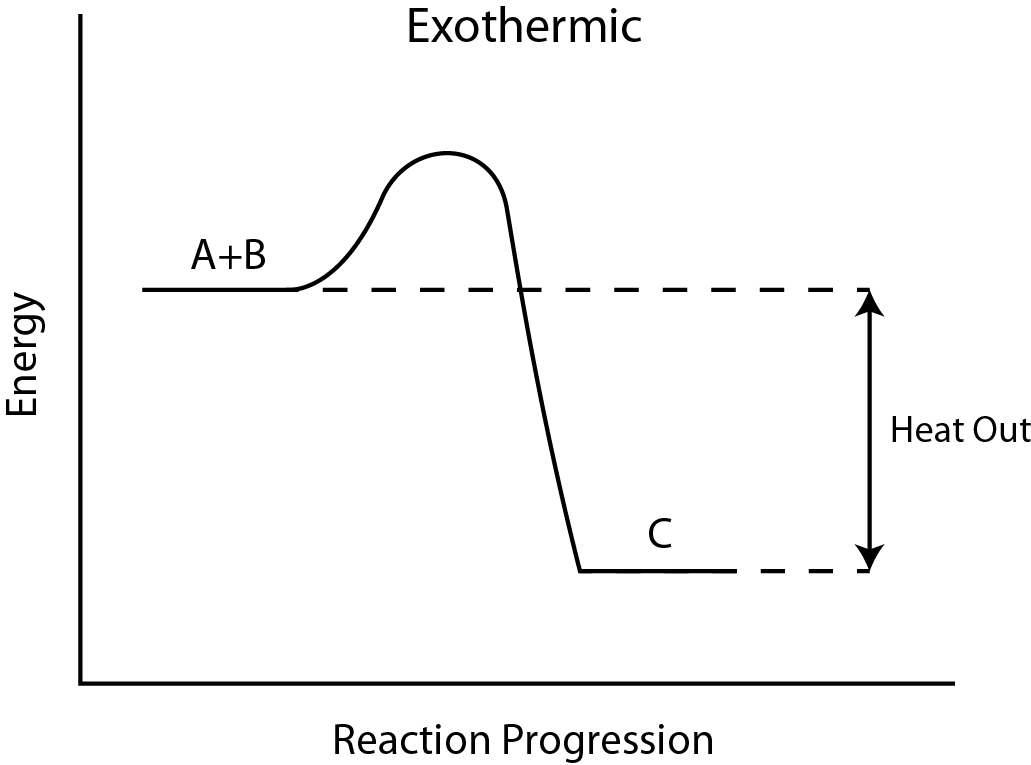
- Exothermic Heat content of the product is less than the reactants (heat is released) = .
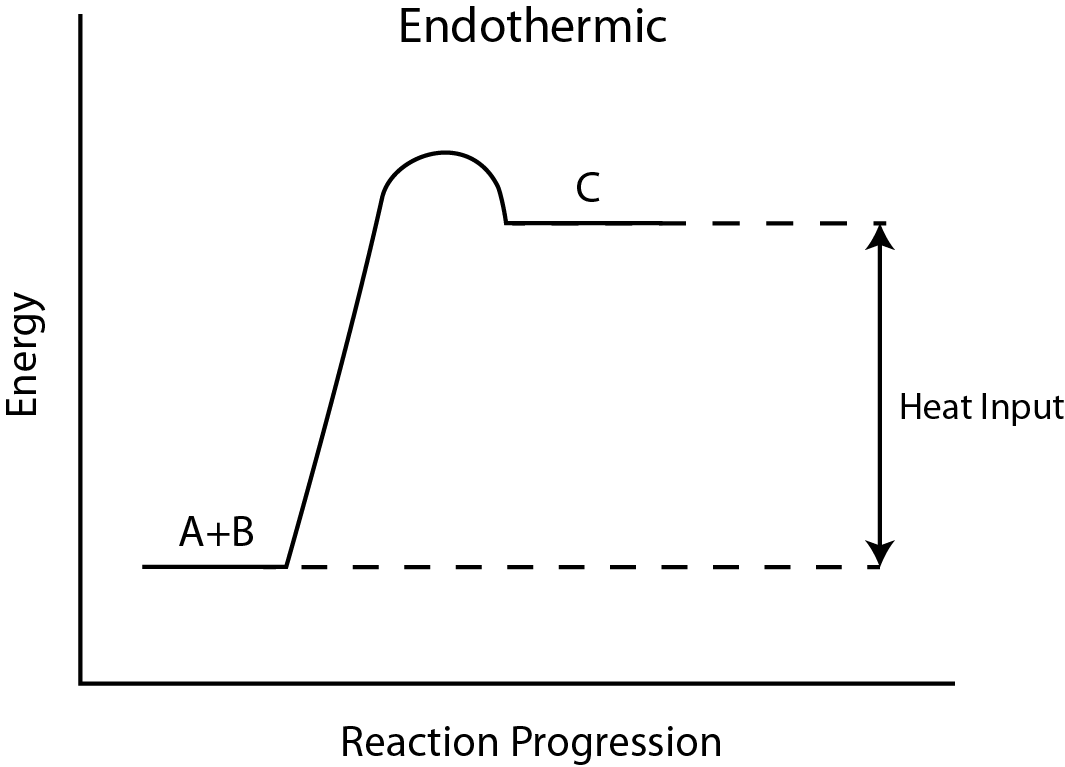
- Endothermic Heat content of the product is more than the reactants (heat is required) = .
Watch Out!
Exothermic ≠ spontaneous!
Spontaneity is measured by Gibbs free energy, not enthalpy.
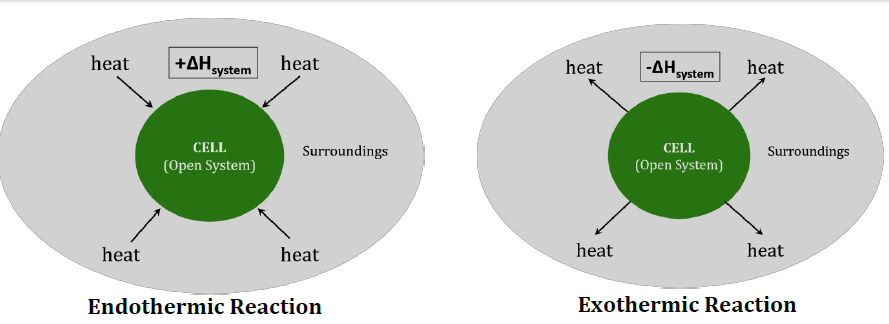
Biological systems are open systems. A negative ΔH means that energy within the system decreased and was released into the surroundings as heat. A positive ΔH means that energy within the system increased and was added from the surroundings as heat.
0:00 / 0:00
Example: Enthalpy of a Reaction
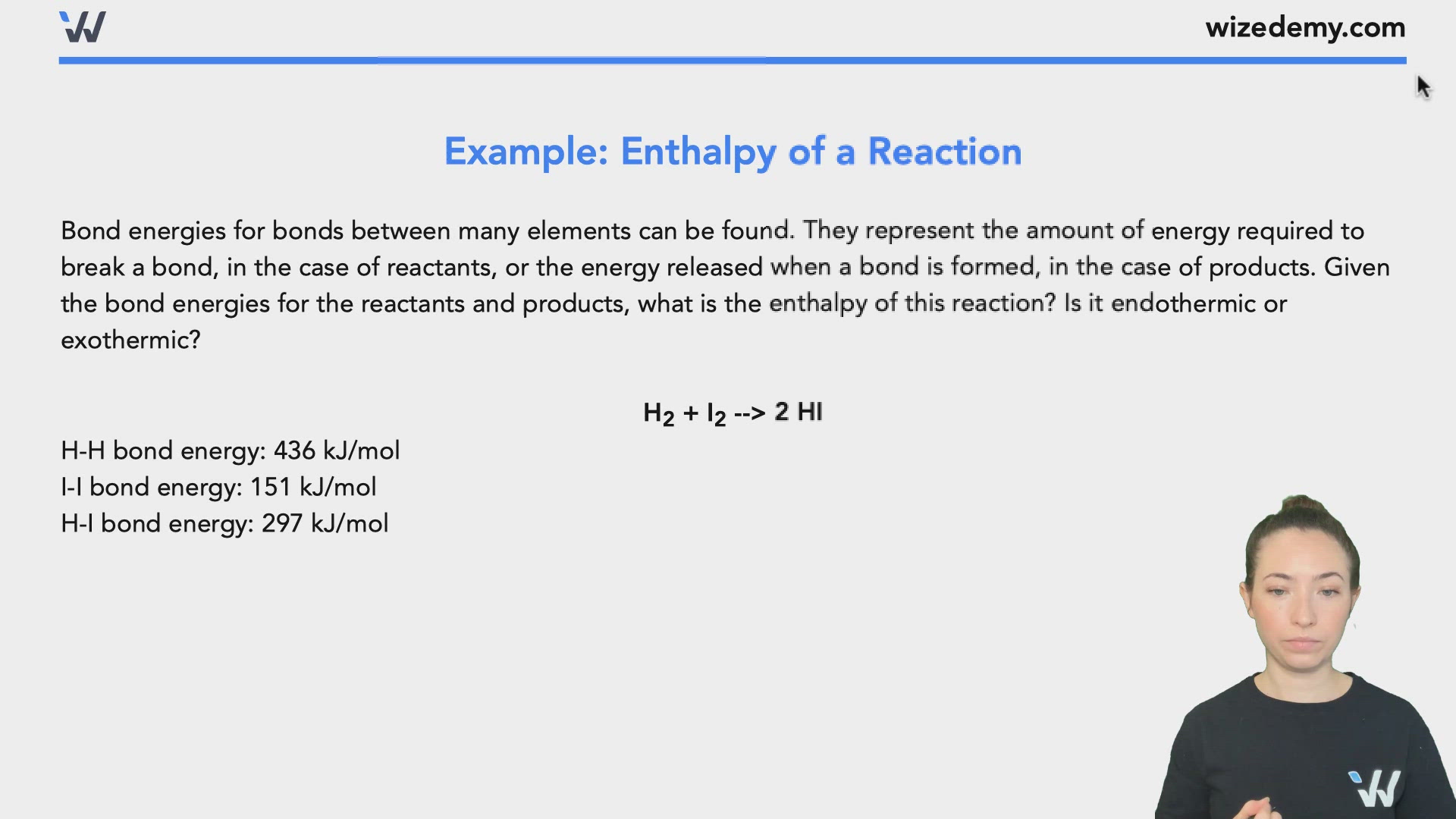
Bond energies for bonds between many elements can be found. They represent the amount of energy required to break a bond, in the case of reactants, or the energy released when a bond is formed, in the case of products. Given the bond energies for the reactants and products, what is the enthalpy of this reaction? Is it endothermic or exothermic?
H2 + I2 --> 2 HI
H-H bond energy: 436 kJ/mol
I-I bond energy: 151 kJ/mol
H-I bond energy: 297 kJ/mol
You are not likely to encounter this type of question on your biology course, but this is a way to illustrate how we relate energy in bonds to enthalpies of a reaction.
In order to make HI, we need to break one H-H bond and one I-I bond. That means, 436 + 151 kJ/mol of energy are required = 587 kJ/mol.
When HI is formed, 297 kJ/mol of energy are released. Because it is released, we will make this number negative. Since we have two moles forming, the total is 2 x - 297 kJ/mol = - 594 kJ/mol.
Note that more energy is released than required for the initial bonds to break. Therefore, overall, energy is released in this process. In fact, 587 kJ/mol - 594 kJ/mol = -7 kJ/mol of energy are released.
So the overall enthalpy of this reaction is ΔH = -7 kJ/mol. Since this number is negative and we were able to see that energy is released, this reaction is exothermic.
0:00 / 0:00
Activation Energy
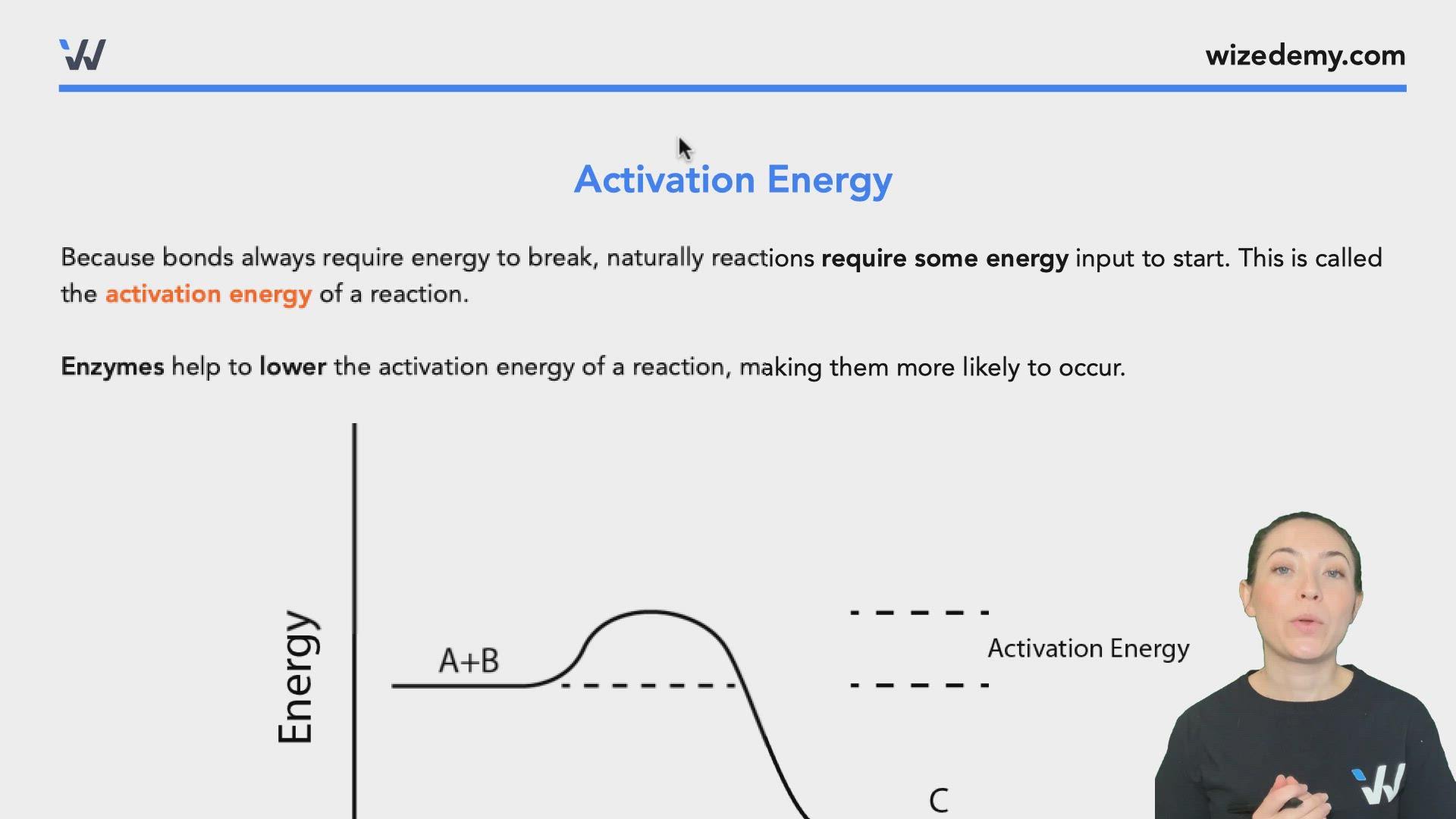
Because bonds always require energy to break, naturally reactions require some energy input to start. This is called the activation energy of a reaction.
Enzymes help to lower the activation energy of a reaction, making them more likely to occur.

Watch Out!
Even exothermic reactions have activation energy barriers!
0:00 / 0:00
Gibbs Free Energy
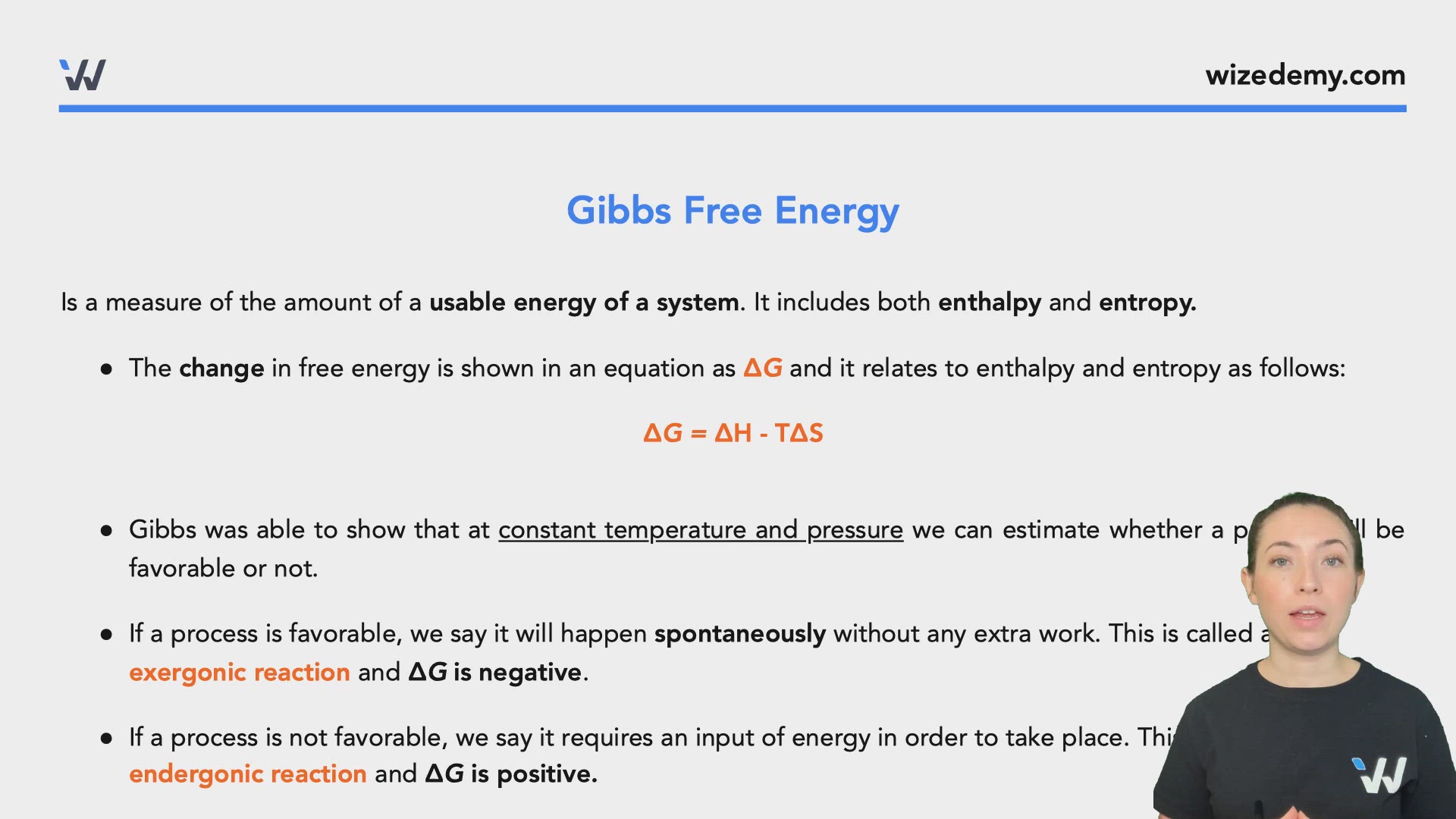
Is a measure of the amount of a usable energy of a system. It includes both enthalpy and entropy.
- The change in free energy is shown in an equation as ΔG and it relates to enthalpy and entropy as follows:
ΔG = ΔH - TΔS
- Gibbs was able to show that at constant temperature and pressure we can estimate whether a process will be favorable or not.
- If a process is favorable, we say it will happen spontaneously without any extra work. This is called an exergonic reaction and ΔG is negative.
- If a process is not favorable, we say it requires an input of energy in order to take place. This is called an endergonic reaction and ΔG is positive.

Standard Free Energy Change (ΔGo) is sometimes used.
- It is the change in free energy under standard conditions (298 K, 1 atm partial pressure of each gas, 1 M concentration of each solute). Note that ΔG which might occur intracellularly, is sometimes different than ΔGo.
Wize Concept
Spontaneous reactions have an overall negative ΔGo. If a reaction is spontaneous, then under the same conditions, it would be non-spontaneous in the reverse direction.
- If ΔG < 0 the process is irreversible (exergonic) and proceeds forward.
- If ΔG > 0 the process is (endergonic) which means it will proceed "backwards".
- If ΔG = 0 the process is reversible and can go in either direction.
Practice: Types of Energy
Select the correct statement: