Wize University Biology Textbook > Photosynthesis
Calvin Cycle [Carbon Fixation] [detailed]
Popular Courses
AP Biology Exam Prep Course
AP Exam Prep
Biology
General Course
General Biology
University Study Guides
BIOLOGY 1002B
Western University
BIOL 211
University of Calgary
BIOL 107
University of Alberta
BIOL 102
Queen's University
BIOL 112
University of British Columbia
Grade 12 Biology
Canada High School
DAT
General Course
High School Biology
US High School
General Biology
University Study Guides
SC/BIOL 1000 3.00
York University
BLG 143
Toronto Metropolitan University
BIOL 112
McGill University
BIOL 186
University of Victoria
BIOL-1101
University of Windsor
BIOL 1201
Western University
BISC 101
Simon Fraser University
BIOL 1011
Dalhousie University

0:00 / 0:00
Calvin Cycle
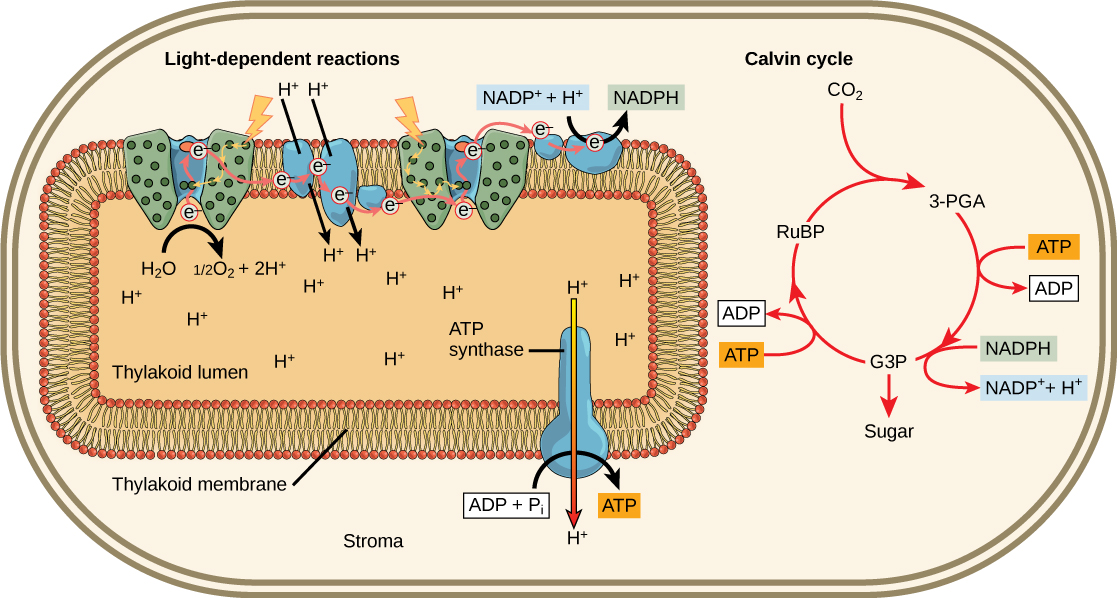
A series of reactions occurring in the stroma of plant cells which results in the production of sugar (glyceraldehyde-3-phosphate) from atmospheric CO2.

Watch Out!
To start off, we should note that for every one molecule of G3P that leaves the Calvin cycle, 5 remain in the cycle. Therefore, in order to get 6 molecules of G3P, 3 turns of the cycle are required. This is why you will see the reactions multiplied by 3!
ANALOGY: Imagine you take a revolving door that will only allow you to exit if you go through it 3 times.
Phase 1: Carbon Fixation
- The central enzyme of the Calvin cycle is Ribulose Bisphosphate Carboxylase (RuBisCo).
- Catalyzes the reaction between atmospheric CO2 and Ribulose 1,5-bisphosphate.
- Ribulose 1,5-Bisphosphate is replenished by using the energy and reductive power of ATP.

Phase 2: Reduction
- Energy from ATP and NADPH are used to convert six 3PGA into six glyceraldehyde 3-phosphate (G3P).
- ATP becomes ADP and NADPH becomes NADP+ (can return to light-dependent reactions!).
- Note that 6 ATP and 6 NADPH are used in total.

Phase 3: Regeneration
- Only one G3P leaves the cycle to take part in other compounds.
- Five continue in the cycle and regenerate other compounds within.
- Another 3 molecules of ATP (3 turns of the cycle) are used in this process.

Wize Tip
NET USAGE: 9 ATP and 6 NADPH
The fate of the sugar produced from the Calvin cycle depends on the current conditions:
- Day (excess photosynthetic activity) G3P is stored as starch or fat in the stroma.
- Night (No photosynthetic activity) Stored starch and fat are broken down to sugars and fatty acids and exported to the cytosol to be metabolized.
Photosynthesis Reactions Summary
Watch Out!
G3P is a three carbon molecule, so in order to make glucose, two G3P must leave the cycle. That means that the cycle must proceed SIX TIMES to make 12 molecules of G3P such that 2 can leave and make one glucose.
ANALOGY: Turns out you had a friend with you when you went through that revolving door. Even though you got through it after 3 turns, you still have to wait for your friend to go through his 3 turns for both of you to leave.
0:00 / 0:00
Example: Turns Required for Glucose
How many turns of the Calvin cycle does it take to make one molecule of glucose?
One way to think about this is to look at the overall balanced chemical reaction for photosynthesis:
6 H2O + 6 CO2 -> C6H12O6 + 6 O2
This reaction tells you that six molecules of CO2 are required to make one glucose. Typically, one carbon dioxide enters the cycle at a time, so six turns are required for 6 CO2 to be used.
Another way to think about it:
Note that in the Calvin cycle, every one molecule of CO2 combines with one molecule of RuBP to make two molecules of 3-PGA and then two molecules of G3P (3-carbon sugar). However, at least 6 molecules of G3P must be made in order for one to leave (5 stay to regenerate the cycle). Since one turn of the cycle makes two G3P molecules, naturally three turns are required to make six G3P's. If G3P was the final molecule we were looking for, the answer would be 3! However, two molecules of G3P are required for one glucose, so we need to double that number. Again, we reach the answer of 6 turns.
Practice: Calvin Cycle Variations
An expedition to planet X makes the discovery that plants there use 12-carbon sugars as their main source of energy. Everything else about the plants on planet X is the same as the ones on Earth with respect to the light-dependent reactions and the Calvin cycle. How many turns of the Calvin cycle does it take to make one molecule of sugar that plants can use for energy on planet X?
Practice: Calvin Cycle Molecules
Which of the following is true about the Calvin cycle?