Wize University Biology Textbook > Cellular Respiration
Glycolysis [detailed]
Popular Courses
MCAT
General Course
AP Biology Exam Prep Course
AP Exam Prep
Biology
General Course
General Biology
University Study Guides
BIOLOGY 1002B
Western University
BIOL 211
University of Calgary
BIOL 107
University of Alberta
BIOL 112
University of British Columbia
Grade 12 Biology
Canada High School
DAT
General Course
High School Biology
US High School
General Biology
University Study Guides
SC/BIOL 1000 3.00
York University
BIOL 111
McGill University
BIO 1141
University of Ottawa
BLG 143
Toronto Metropolitan University
BIOL 112
McGill University
BIOL 186
University of Victoria
BIOL 1201
Western University
BIOL 1P91
Brock University
0:00 / 0:00
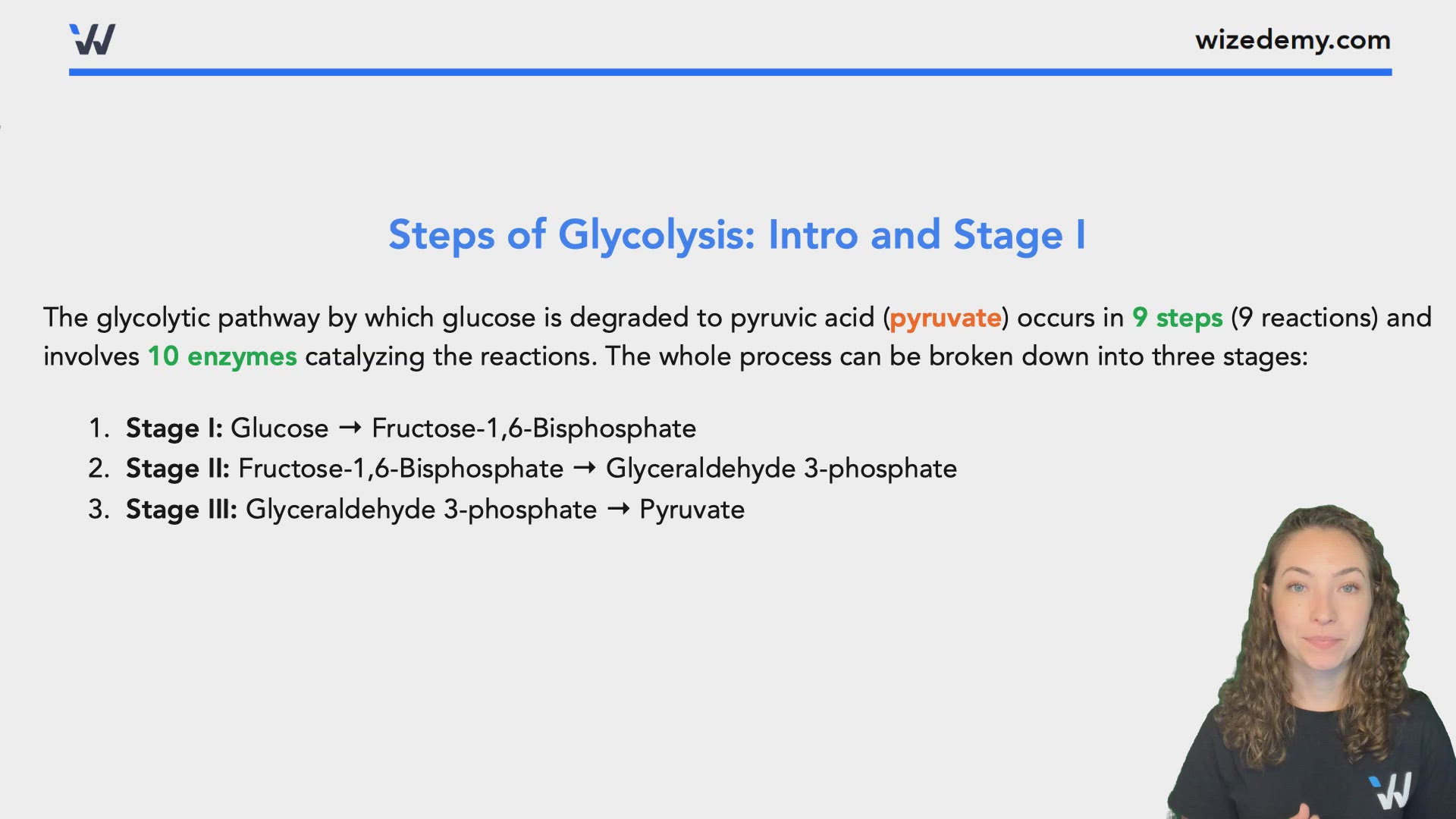
Steps of Glycolysis: Intro and Stage I
The glycolytic pathway by which glucose is degraded to pyruvic acid (pyruvate) occurs in 9 steps (9 reactions) and involves 10 enzymes catalyzing the reactions. The whole process can be broken down into three stages:
- Stage I: Glucose → Fructose-1,6-Bisphosphate
- Stage II: Fructose-1,6-Bisphosphate → Glyceraldehyde 3-phosphate
- Stage III: Glyceraldehyde 3-phosphate → Pyruvate
Stage I: Glucose → Fructose-1,6-Bisphosphate
In the first stage of glycolysis, glucose is converted from an aldose sugar to a ketose fructose sugar.
- Energy is consumed in this part of glycolysis.
- The phosphoryl groups of ATP are transferred to the hydroxyl groups on the sugar.
- This transfer is mediated by 2 kinases (phosphate transfer enzymes).

Wize Tip
The suffix -ase generally refers to enzymes.
Kinases are enzymes that add phosphates.
Phosphatases are enzymes that remove phosphates.
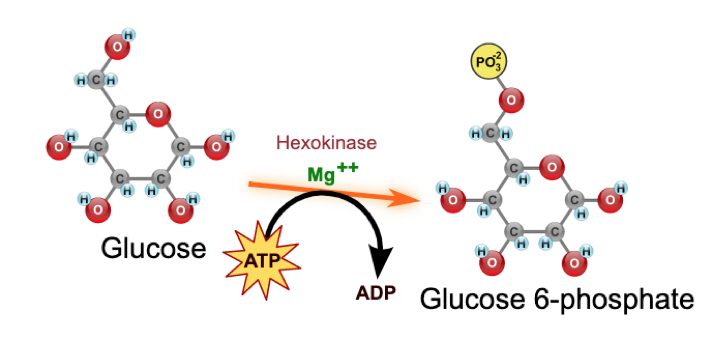
1st step: Glucose → Glucose-6-phosphate (G6P)
- Hexokinase transfers a phosphate from ATP to glucose;
- The hexokinase reaction traps glucose inside the cell;
- This reaction is considered irreversible.
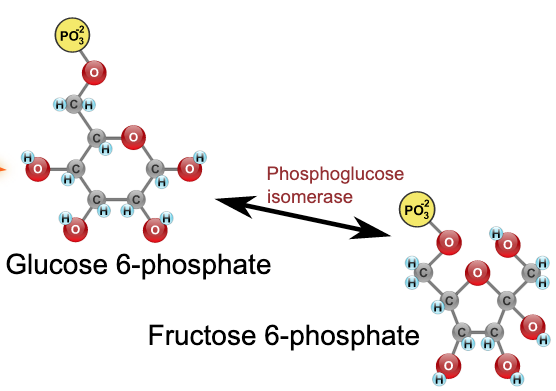
2nd step: Interconversion to Fructose-6-phosphate (F6P)
- Conformational change (rearrangement) of G6P → F6P is catalyzed by phosphoglucose isomerase.
- An isomerase is an enzyme that catalyzes the change of a molecule into its isomer.
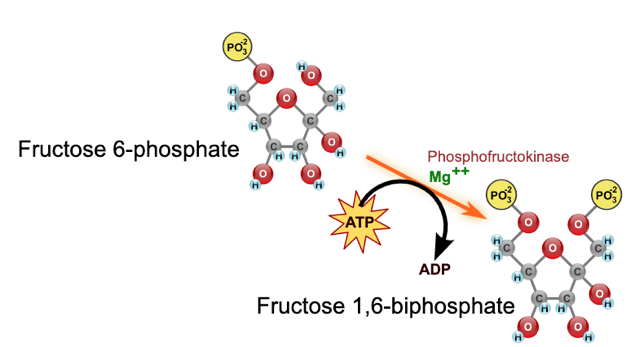
3rd step: Fructose-6-phosphate (F6P) → Fructose-1,6-Bisphosphate (F-1,6-BP)
- Phosphofructokinase transfers a phosphate from ATP to F6P.
- The product is fructose-1,6-bisphosphate (F-1,6-BP).
- Phosphofructokinase activity is highly regulated (considered a “rate limiting enzyme”).
- Less active when ADP is low and ATP is high (no need to make more ATP!).
- This reaction is also considered irreversible.
0:00 / 0:00
Steps of Glycolysis: Stages II and III

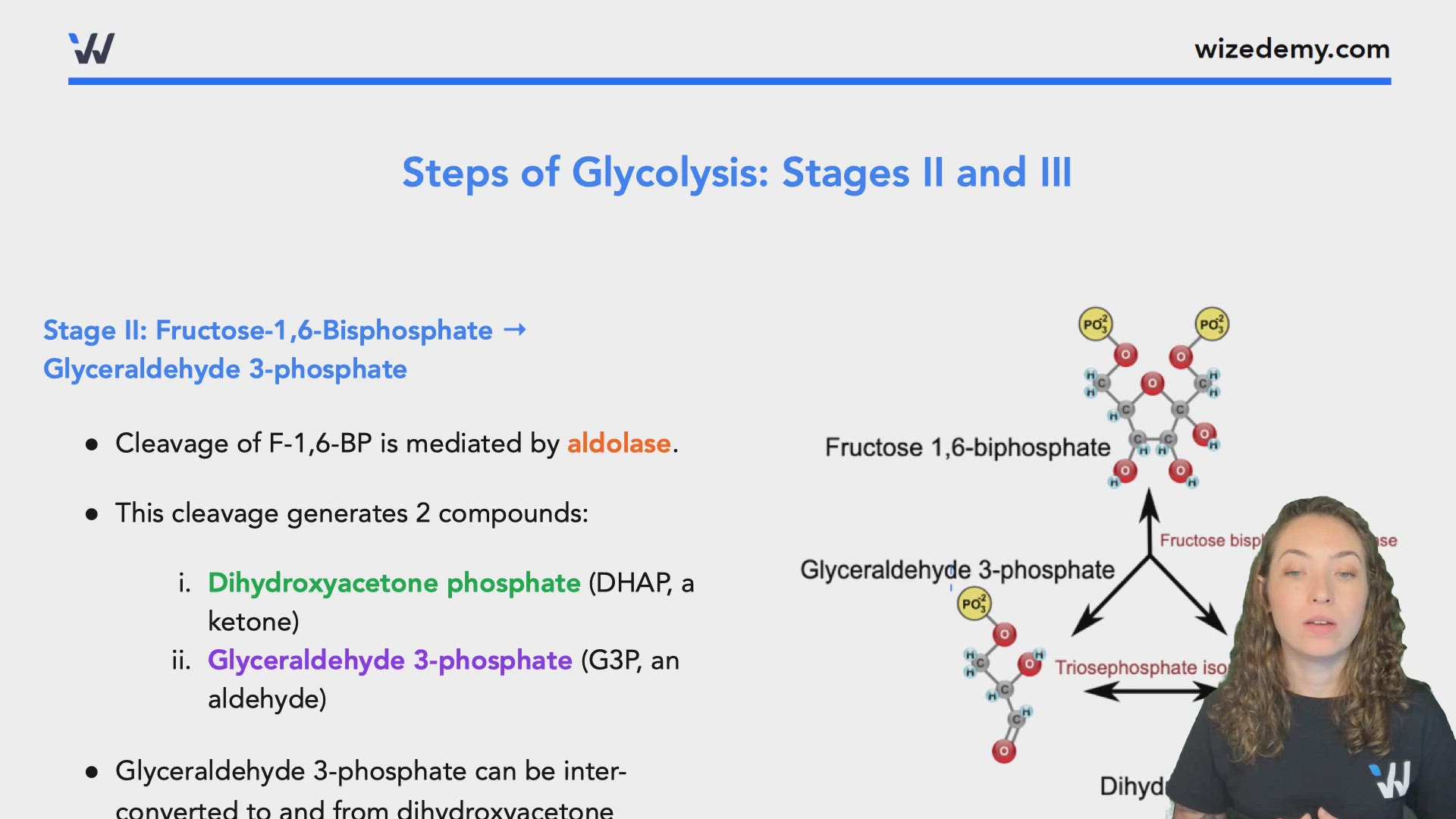
Stage II: Fructose-1,6-Bisphosphate → Glyceraldehyde 3-phosphate
- Cleavage of F-1,6-BP is mediated by aldolase.
- This cleavage generates 2 compounds:
- Dihydroxyacetone phosphate (DHAP, a ketone)
- Glyceraldehyde 3-phosphate (G3P, an aldehyde)
- Glyceraldehyde 3-phosphate can be inter-converted to and from dihydroxyacetone phosphate by triose phosphate isomerase.
- The interconversion is in equilibrium (therefore reversible);
- Only G3P can be used in glycolysis.
Stage III: Glyceraldehyde 3-phosphate → Pyruvate
- Happens twice for every glucose molecule (1 glucose makes 2 G3P).
- Produces 2 molecules of ATP per G3P.
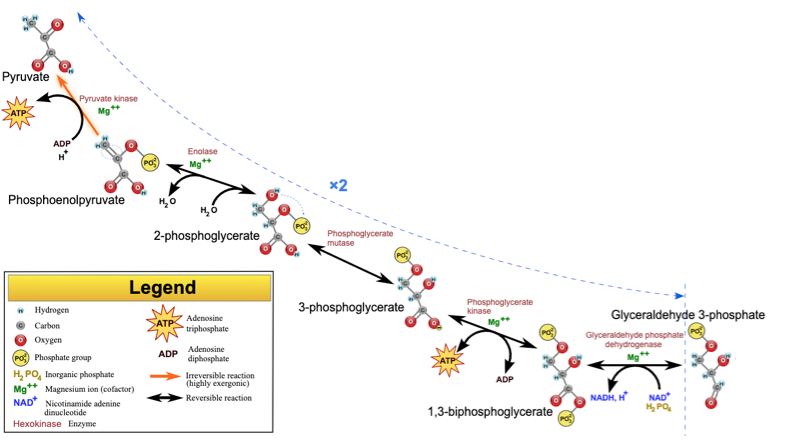
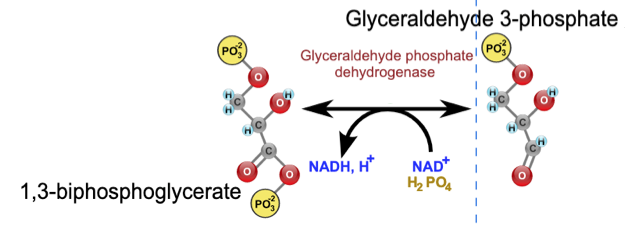
1st step: Glyceraldehyde 3-phosphate → 1,3-Bisphosphoglycerate
- Catalyzed by glyceraldehyde 3-phosphate dehydrogenase.
- Aldehyde group is oxidized. During oxidation, electrons are transferred to Pi, NAD+ to form NADH and H+.
- This is a potentially limiting step as NAD+ must be always regenerated to form NADH.
- A phosphate group also gets transferred to glyceraldehyde.

2nd step: Formation of ATP and 3-Phosphoglycerate
- Catalyzed by phosphoglycerate kinase.
- 1,3-biphosphoglycerate transfers phosphate group to ADP, generating ATP.

3rd step: Formation of 2-Phosphoglycerate
- Catalyzed by phosphoglycerate mutase.
- Mutase is an enzyme that catalyzes the transfer of a phosphoryl group from one hydroxyl group to another.
- The phosphate is moved to the 2nd carbon.
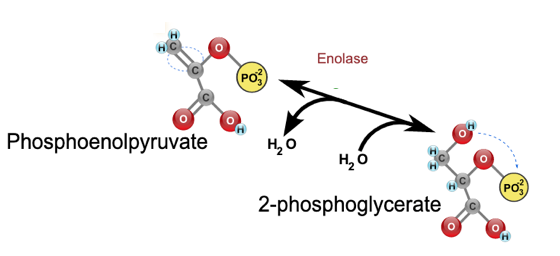
4th step: Formation of Phosphoenolpyruvate (PEP)
- Catalyzed by enolase.
- Enolase carries out the dehydration of the C3 and a double bond is formed.
- This double bond increases the potential energy of the molecule, making PEP the highest energy phosphate bond found in living things.
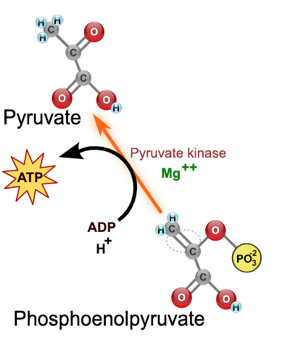
5th step: Formation of Pyruvate
- Pyruvate kinase catalyzes the transfer of the phosphoryl group from PEP to ADP to form ATP and pyruvate.
- Silly mnemonic: pyruvate is a quiet molecule, it doesn't say a PEeP!
Write it Down
There's no better way to memorize this in detail than to get a blank sheet of paper and write this all out on your own! Try to recall as much as possible without looking at the lesson.
Practice: Consumption of ATP in Glycolysis
Which of these enzymes requires ATP to be consumed?
Practice: Last Step of Glycolysis
Which enzyme catalyzes the last step of glycolysis?
Practice: Overall Yield of Glycolysis
What is the overall yield of glycolysis and the key steps involved?
Practice: Generation of NADH in Glycolysis
Which enzyme is responsible for generating NADH in glycolysis and how many NADH are produced per one molecule of glucose?