Wize University Biology Textbook > Cellular Respiration
Glycolysis Regulation
Popular Courses
MCAT
General Course
AP Biology Exam Prep Course
AP Exam Prep
Biology
General Course
General Biology
University Study Guides
BIOLOGY 1002B
Western University
BIOL 211
University of Calgary
BIOL 107
University of Alberta
BIOL 112
University of British Columbia
DAT
General Course
Grade 12 Biology
Canada High School
High School Biology
US High School
General Biology
University Study Guides
SC/BIOL 1000 3.00
York University
BIOL 111
McGill University
BIO 1141
University of Ottawa
BLG 143
Toronto Metropolitan University
BIOL 112
McGill University
BIOL 186
University of Victoria
BIOL-1101
University of Windsor
BIOL 1201
Western University
0:00 / 0:00
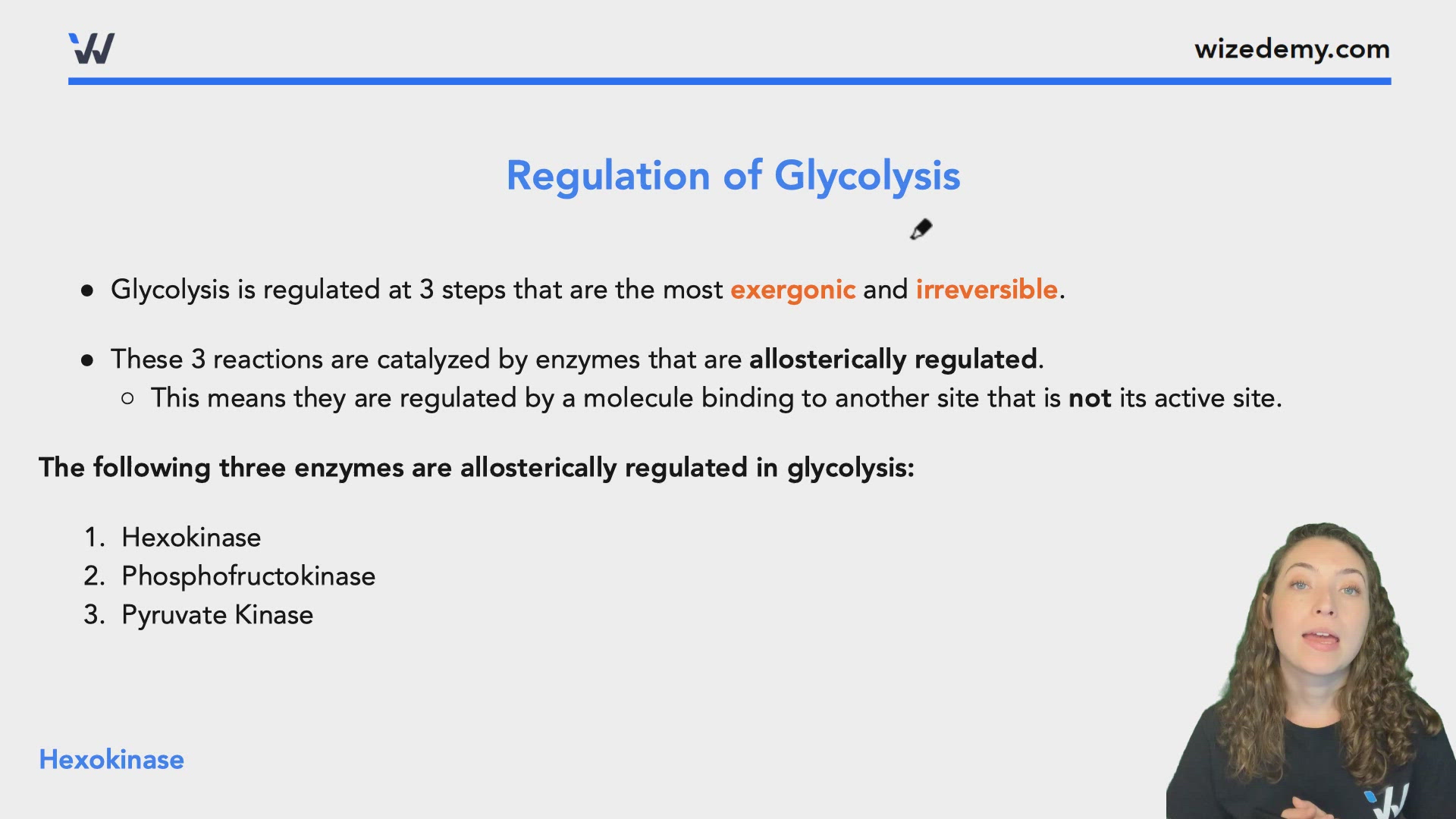
Regulation of Glycolysis
- Glycolysis is regulated at 3 steps that are the most exergonic and irreversible.
- These 3 reactions are catalyzed by enzymes that are allosterically regulated.
- This means they are regulated by a molecule binding to another site that is not its active site.
The following three enzymes are allosterically regulated in glycolysis:
- Hexokinase
- Phosphofructokinase
- Pyruvate Kinase
Hexokinase
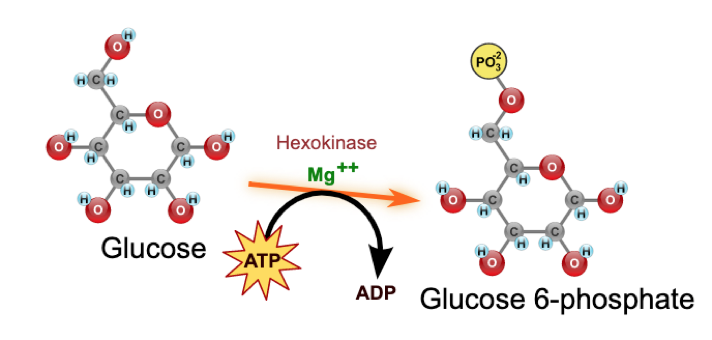
- Inhibited by the product it makes: G6P.
- Enzyme active when G6P levels are low (when glycolysis is active).
- Enzyme inhibited when G6P levels are high (when glycolysis slows down).
Phosphofructokinase (PFK)

- The key regulator of carbohydrate metabolism in the cell.
- PFK inhibitors:
- High levels of ATP
- When too much ATP is present, it can bind to the regulatory site on the enzyme and lower its affinity for the substrate.
- High levels of citrate
- As citrate builds up form TCA cycle, it causes glycolysis to slow down by inhibiting PFK.
- Protons (H+)
- Prevents excessive formation of lactic acid.
- Low pH (acidic conditions) will inhibit PFK.
- PFK activators:
- High levels of AMP
- AMP competes with ATP for binding the PFK regulatory site.
- AMP binding at the regulatory site prevents ATP binding → no inhibition of PFK by ATP.
- Think about it like this: if there's a lot of AMP, there's low ATP. Therefore, we need more glycolysis.
- High levels of Fructose-2,6-Bisphosphate (F-2,6-BP)
- Enhances PFK activity by increasing the affinity of PFK to its substrate F6P.
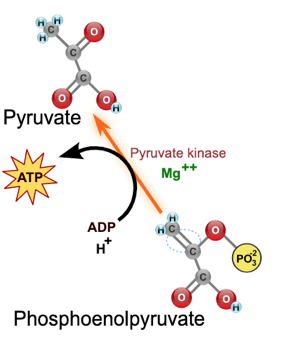
Pyruvate Kinase
- Main function is to produce pyruvate + ATP.
- Pyruvate kinase inhibitors:
- High levels of ATP
- The amino acid alanine
- Pyruvate kinase activators:
- High levels of Fructose-1,6-Bisphosphate (F-1,6-BP)
Practice: PFK regulation
What effect does Fructose-2,6-bisphosphate have on glycolysis?
Practice: Regulation of PFK-1
Which statement is FALSE about the PFK-1 reaction in glycolysis?