Wize University Microeconomics Textbook > Gains from Trade
Absolute & Comparative Advantage
Popular Courses
ECON 201
Concordia University
Microeconomics
University Study Guides
ECON 201
University of Calgary
ECON 101
University of British Columbia
ECON 1B03
McMaster University
Macroeconomics
University Study Guides
ECON*1050
University of Guelph
ECON 101
University of Alberta
Microeconomics
General Course
ECO101H1
University of Toronto
Microeconomics
University Study Guides
ECON 208
McGill University
ECONOMIC 1022A/B
Western University
Macroeconomics
General Course
ECON 101
University of Waterloo
ECON*1100
University of Guelph
Macroeconomics
University Study Guides
ECON 110A
Queen's University
ECON 203
University of Calgary
ECO 1104
University of Ottawa

0:00 / 0:00
Absolute and Comparative Advantage
In this section we see the difference between absolute advantage and comparative advantage to understand why countries benefit from trading with each other.
Absolute Advantage
To have an absolute advantage means the ability to produce a good using fewer inputs (less time, workers, money) than another producer. It can also be seen as the ability to make more goods in the same amount of time.
CANADA MEXICO
SHOES 40,000 90,000
BOOKS 4,000 6,000
The schedule above shows the maximum amount of two goods that can be made in a year in each country.
- Mexicohas an absolute advantage in shoes because they can make more shoes in the same amount of time.
- Mexicohas an absolute advantage in books because they can make more books in the same amount of time.
Production Possibility Curve (PPC)
- Production Possibility Curve (PPC) - a line that shows the different combinations of two products that can be produced
- Consumption Possibility Curve (CPC) - the same as the PPC but it shows the combinations of two products that can be consumed with trade.

Opportunity Cost
The opportunity cost is how much of one good must be given up to make one more unit of another good.
Opportunity Cost for Canada
- In the diagram above, the opportunity cost of making one book for Canada is40000/4000 = 10shoes.
- The opportunity cost of making one shoe for Canada is4000/40000 = 0.1books.
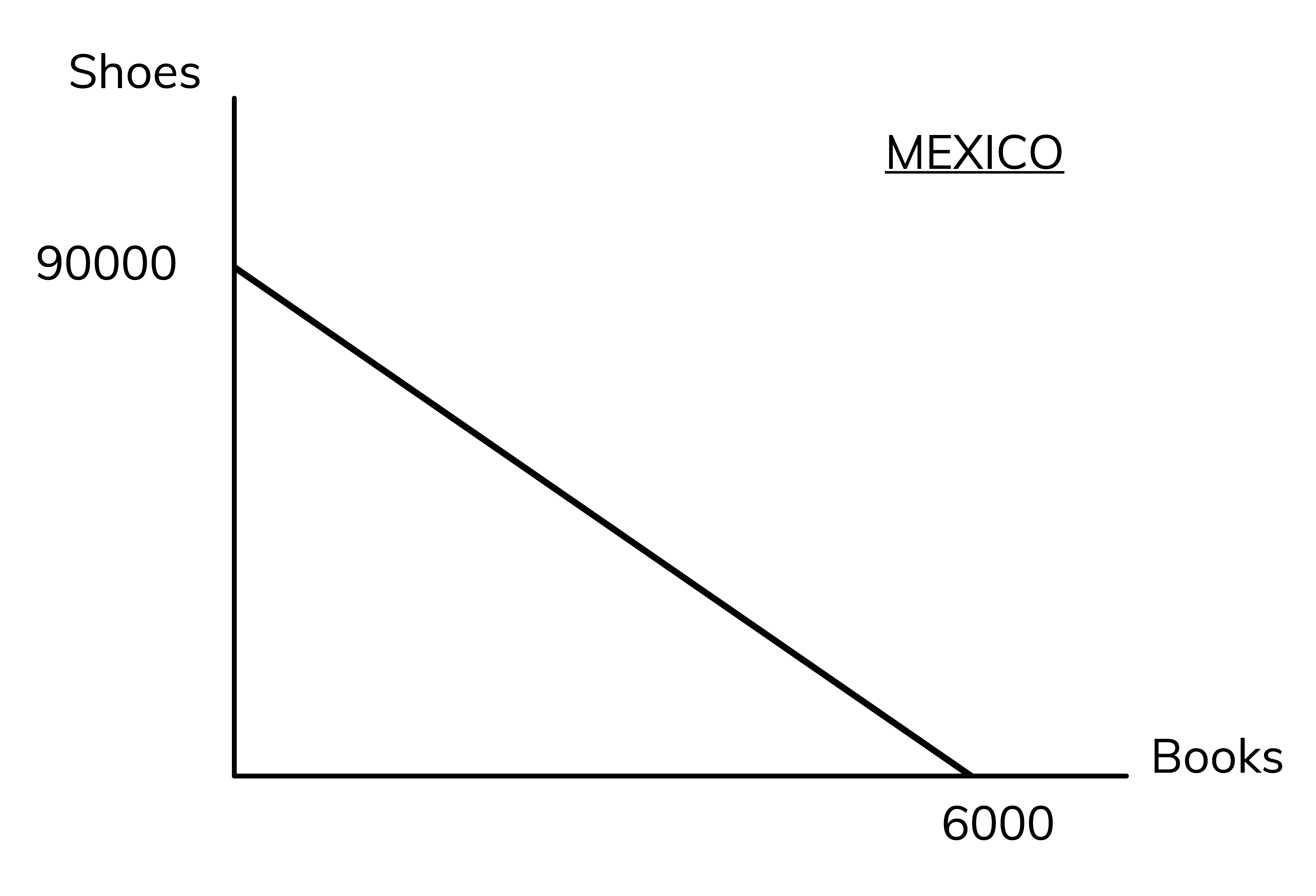
Opportunity Cost for Mexico
- The opportunity cost of making one book for Mexico is90000/6000 = 15shoes.
- The opportunity cost of making one shoe for Mexico is6000/90000 = 0.067books.
Comparative Advantage
- Comparative Advantage – this is when you have a lower opportunity cost of producing a product.
- Canadahas a comparative advantage in books because they have a lower opportunity cost of making books.
- Mexicohas a comparative advantage in shoes because they have a lower opportunity cost of making shoes.
- This means Canada will specialize all their time in making books and thenexportbooks to Mexico andimportshoes from Mexico

0:00 / 0:00
Example: Absolute and Comparative Advantage
Suppose you are provided with the per unit cost of production below:
Germany (Euros) France (Euros)
Generators 10,000 15,000
Wine 10 30
Germany
has an absolute advantage in GeneratorsGermany
has an absolute advantage in WineFrance
has a comparative advantage in GeneratorsGermany
has a comparative advantage in Wine Practice: Absolute and Comparative Advantage
Cotton Cocoa Beans
Peru 2 4
Brazil 1 6
Refer to the table above that shows the amount of each product that the two countries can produce with one worker. Compared with Peru, Brazil has: