Popular Courses
ECON 201
Concordia University
Microeconomics
University Study Guides
ECON 201
University of Calgary
ECON 101
University of British Columbia
Macroeconomics
University Study Guides
ECON*1050
University of Guelph
ECON 101
University of Alberta
Microeconomics
General Course
ECO101H1
University of Toronto
Microeconomics
University Study Guides
ECON 208
McGill University
ECONOMIC 1022A/B
Western University
Macroeconomics
General Course
ECON*1100
University of Guelph
Macroeconomics
University Study Guides
ECON 110A
Queen's University
ECON 203
University of Calgary
ECO 1104
University of Ottawa
EC120
Wilfrid Laurier University
ECON 102
University of Alberta
0:00 / 0:00
Imports
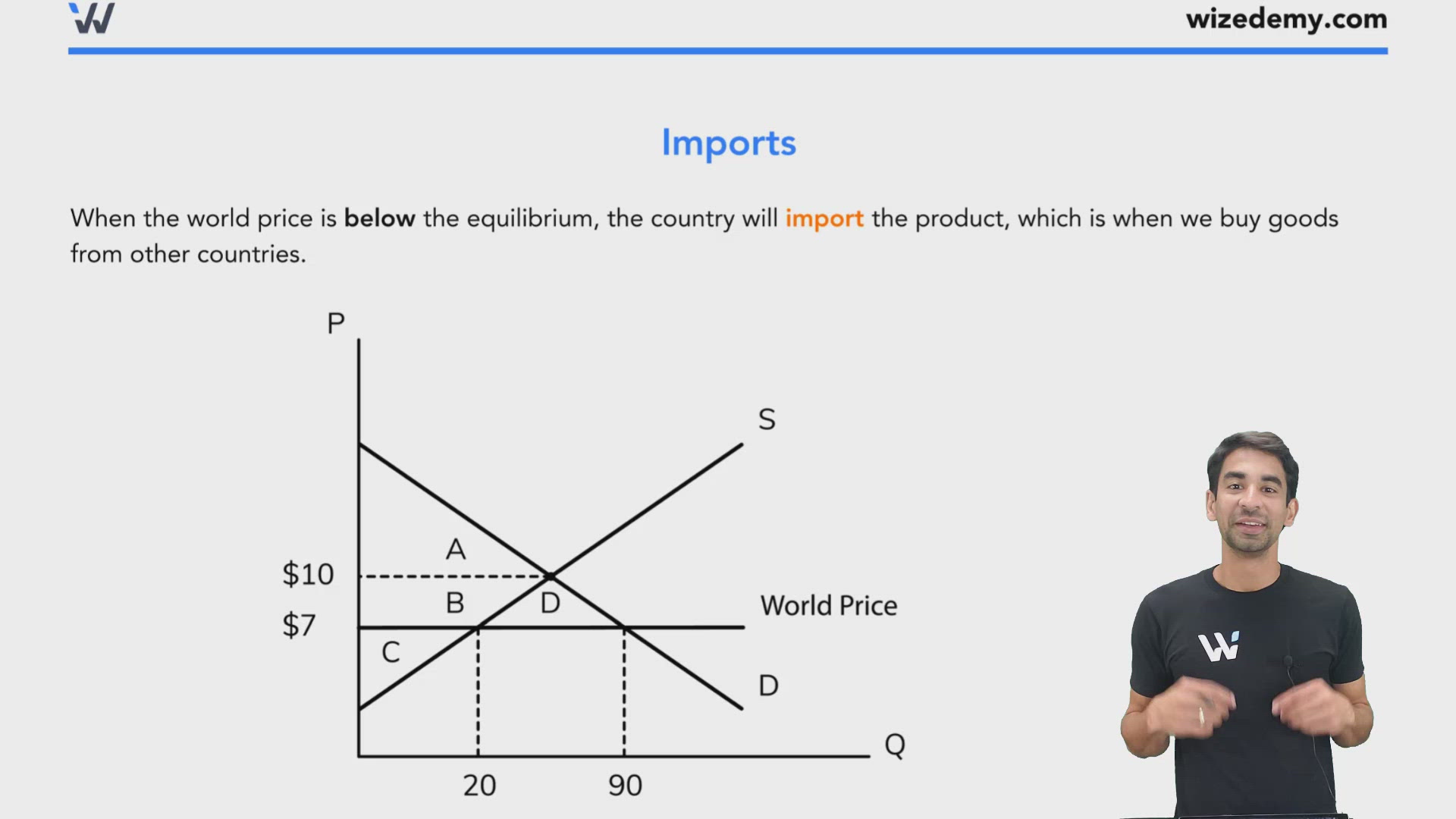
When the world price is below the equilibrium, the country will import the product, which is when we buy goods from other countries.

Wize Tip
When the world price is above the equilibrium, that country will export the good. When the world price is below the equilibrium, that country will import the good.
- At the world price of $7 the domestic demand is90units and domestic supply is20units.
- The imports are equal to the excessdemand
- In the diagram above, the imports =90 - 20 = 70units.
- With trade, the consumer surplus is everything above the price but below the demand until the quantity of 90 since that is the quantity consumers are getting in total. This is the triangle A + B + D.
- With trade, producer surplus is everything below the price but above the supply until a quantity of 20 because that's all the domestic producers are selling. This is the triangle C.
Before Trade After Trade Change
Consumer Surplus
A
A + B + D
+ B + D
Producer Surplus
B + C
C
- B
Total Surplus
A + B + C
A + B + C + D
+ D
0:00 / 0:00
Imports with Tariff
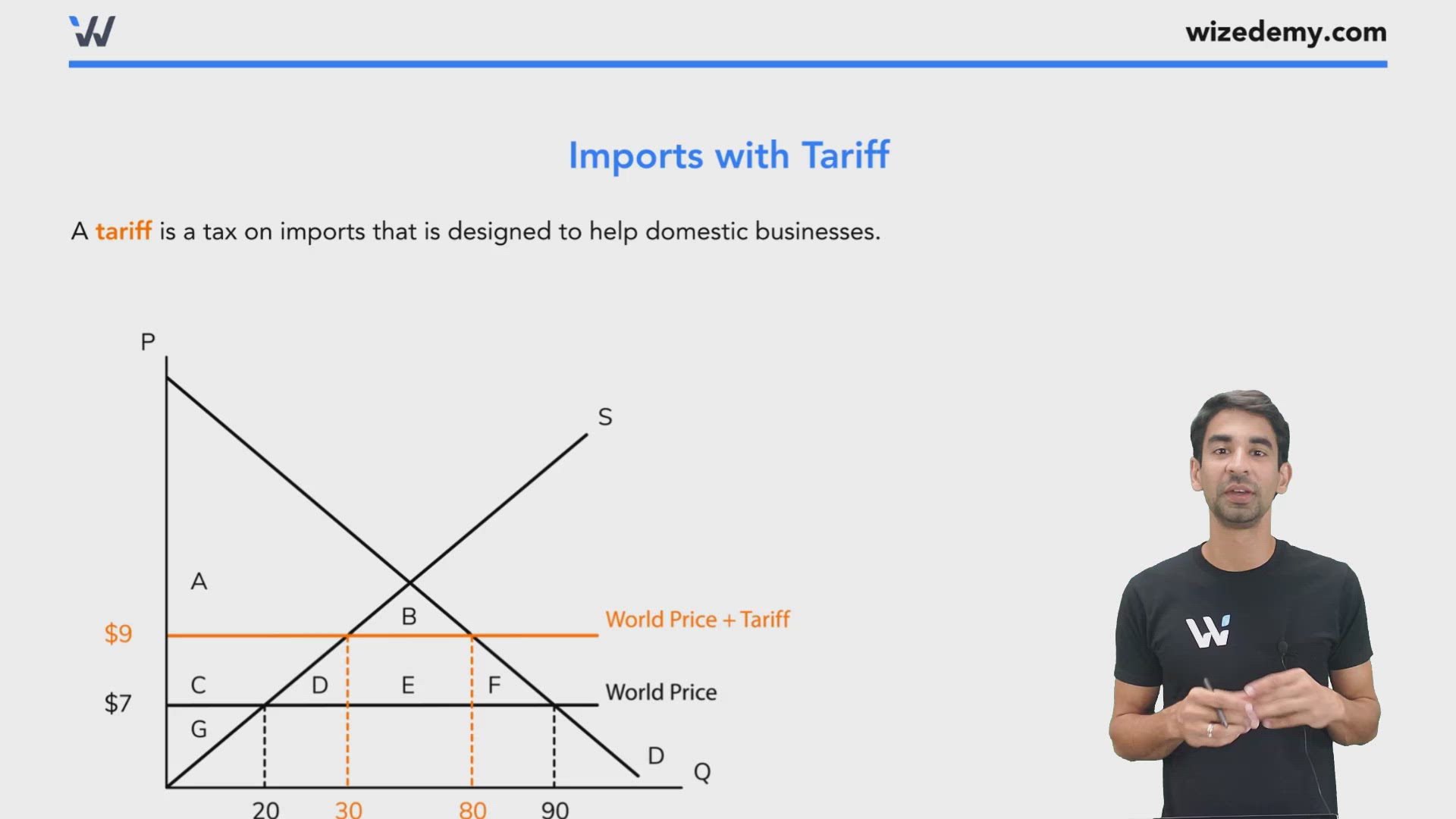
A tariff is a tax on imports that is designed to help domestic businesses.

- In the diagram above, the world price was $7 with free trade and then the government put a $2 tariff that raises the price to $9.
- With a tariff, the quantity demanded is80units and the domestic supply is30units so the imports are80 - 30 = 50units.
- The consumer surplus is everything above the price of $9 but below the demand until a quantity of 80 (since that is the quantity consumers are getting in total) which is the triangle A + B.
- The producer surplus is everything below the price of $9 but above the supply until a quantity of 30 (since that is the quantity domestic producers are selling) which is the triangle C + G.
- The government tariff revenue is the tariff multiplied by the imports (because the government doesn't tax the domestic businesses). This would be2 * 50 = $100which is the rectangle E. These areas can be summarized below:
Before Tariff (Free Trade) After Tariff Change
Consumer Surplus
A + B + C + D + E + F
A + B
- C - D - E - F
Producer Surplus
G
C + G
+ C
Government Revenue
None
E
+ E
Total Surplus
A + B + C + D + E + F + G
A + B + C + E + G
- D - F
0:00 / 0:00
Example: Tariff
The domestic demand is given by P = 72 - 0.3Q and domestic supply is given by P = 9 + 0.4Q. The world price is P = 30.
a) What is price and output if no trade is allowed?
This is just regular equilibrium:
72 - 0.3Q = 9 + 0.4Q
63 = 0.7Q
Q = 90
P = 9 + 0.4(90) = 45
b) What is the consumer and producer surplus with free trade?
Plug 30 as the price in to both demand and supply equations
Supply:
30 = 9 + 0.4Q
0.4Q = 21
Q = 52.5
Demand:
30 = 72 - 0.3Q
0.3Q = 42
Q = 140
Consumer surplus = 140 * (72 - 30) * 1/2 = $2940
Producer surplus = 52.5 * (30 - 9) * 1/2 = $551.25
c) What is consumer surplus, producer surplus, tariff revenue and deadweight loss if there is a $3 tariff?
New price will be 30 + 3 = 33
Plug 33 in demand and supply as the price
Supply:
33 = 9 + 0.4Q
0.4Q = 24
Q = 60
Demand:
33 = 72 - 0.3Q
0.3Q = 39
Q = 130
Consumer surplus = 130 * (72 - 33) * 1/2 = $2535
Producer surplus = 60 * (33 - 9) * 1/2 = $720
Imports = 130 - 60 = 70
Tariff Revenue = tariff * imports = $3 * 70 = $210
DWL = (7.5 * 3 * 1/2) + (10 * 3 * 1/2) = $26.25
Practice: Tariff
When a country places a tariff on goods it imports from other countries, it will increase: