Wize University Microeconomics Textbook > Economic Concepts
Opportunity Cost and the PPF
Popular Courses
ECON 201
Concordia University
ECONOMIC 1021A/B
Western University
Microeconomics
University Study Guides
ECON 201
University of Calgary
ECON 101
University of British Columbia
ECON 1B03
McMaster University
ECON*1050
University of Guelph
ECON 101
University of Alberta
Microeconomics
General Course
ECO101H1
University of Toronto
Microeconomics
University Study Guides
ECON 208
McGill University
ECON 101
University of Waterloo
ECN 104
Toronto Metropolitan University
ECON 110A
Queen's University
ECO 1104
University of Ottawa
EC120
Wilfrid Laurier University
AP/ECON 1000 3.00
York University
ECON 103
University of Victoria
ECON 1101
Dalhousie University
0:00 / 0:00
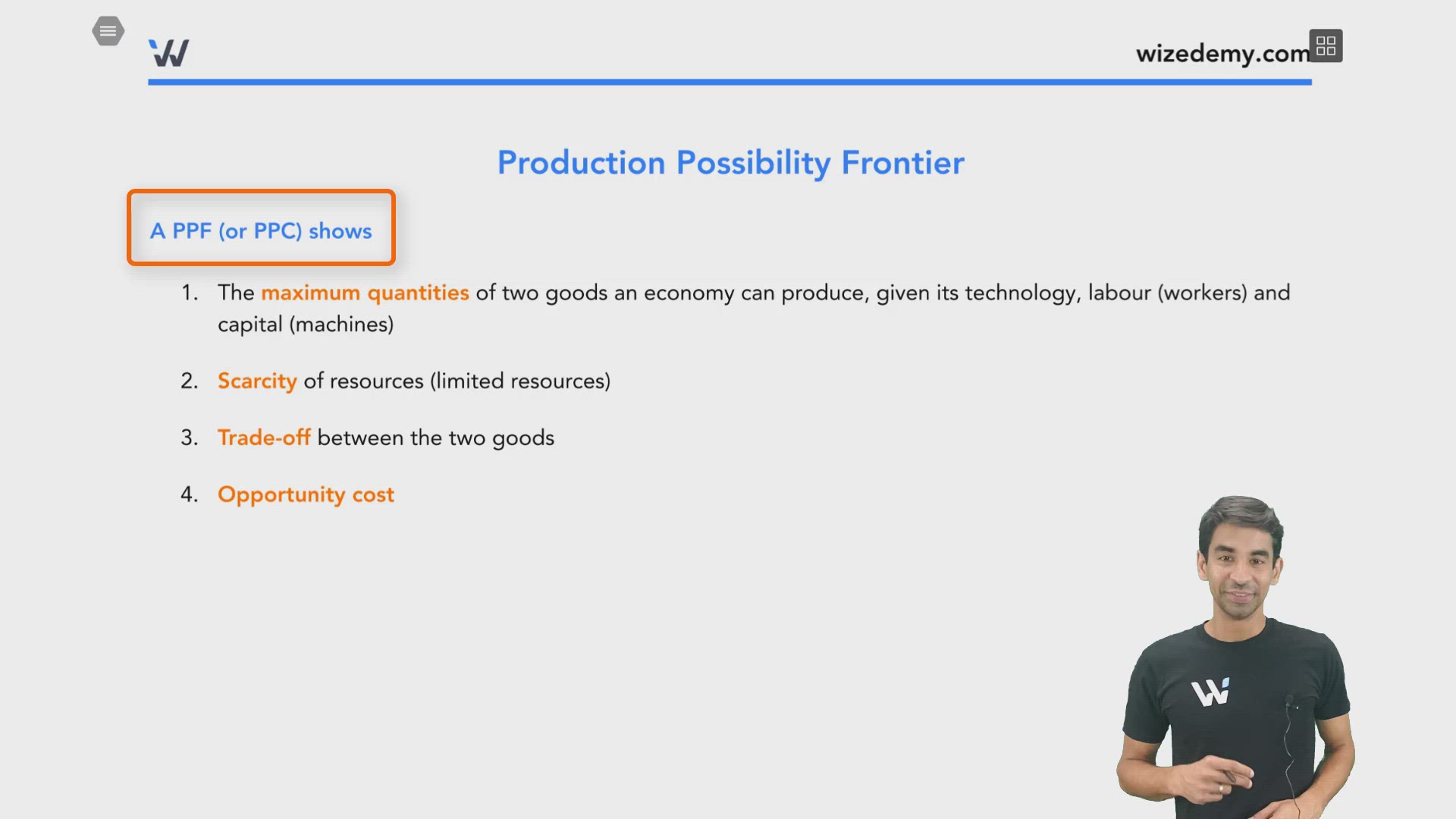
Production Possibility Frontier
A PPF (or PPC) shows
- The maximum quantities of two goods an economy can produce, given its technology, labour (workers) and capital (machines)
- Scarcity of resources (limited resources)
- Trade-off between the two goods
- Opportunity cost
A PPF that is Concave (Bowed Outward)

- Points inside the PPF areinefficient.
- Points outside the PPF areunattainable.
- Points on the PPF itself areefficient.
Factors that Shift the PPF Outward (to the Right)
- More resources Example: More immigration or more land
- Better resources Example: Improvements in technology or better education
Factors that Shift the PPF Inward (to the Left)
- A reduction in resources Example: Hurricanes and floods
What About Unemployment?
Q: Would high unemployment shift the PPF to the left or to the right?
A:
Neither
Watch Out!
Unemployment does not shift the PPF! It would only lead to a point inside the PPF (inefficient).
The graph below shows an improvement in the technology of making only
cars

The graph below shows an improvement in the technology of making only
bikes

Opportunity Cost with the PPF

- From point A to B the opportunity cost of making one extra car is 900 - 800 = 100 bikes
- From point B to C the opportunity cost of making one extra car is 800 - 500 = 300 bikes
- As we go to the right and produce more cars, the opportunity cost of making cars getsbigger (increasing opportunity cost)

0:00 / 0:00
Straight Line PPF (Linear PPF)

- As we go from point A to point B the opportunity cost of making one more car is2bikes
- As we go from point B to point C the opportunity cost of making one more car is2bikes
- As we produce more cars the opportunity cost isconstant
- As we go from point C to point B the opportunity cost of making one more bike is0.5cars
- As we go from point B to point A the opportunity cost of making one more bike is0.5cars

0:00 / 0:00
Example: PPF and Opportunity Cost
The principle of increasing opportunity cost leads to:
a) a production possibilities frontier (PPF) that is bowed inward from the origin.
b) a production possibilities frontier (PPF) that is bowed outward from the origin.
c) an inward shift of the production possibilities frontier (PPF).
d) an outward shift of the production possibilities frontier (PPF).
e) both b & d are correct.
B. Remember that a PPF that is concave (bowed outward from the origin) is flat on the left side, which means a smaller opportunity cost. As you go to the right it gets steeper which means bigger opportunity cost. The slope of the PPF is basically the opportunity cost.
0:00 / 0:00
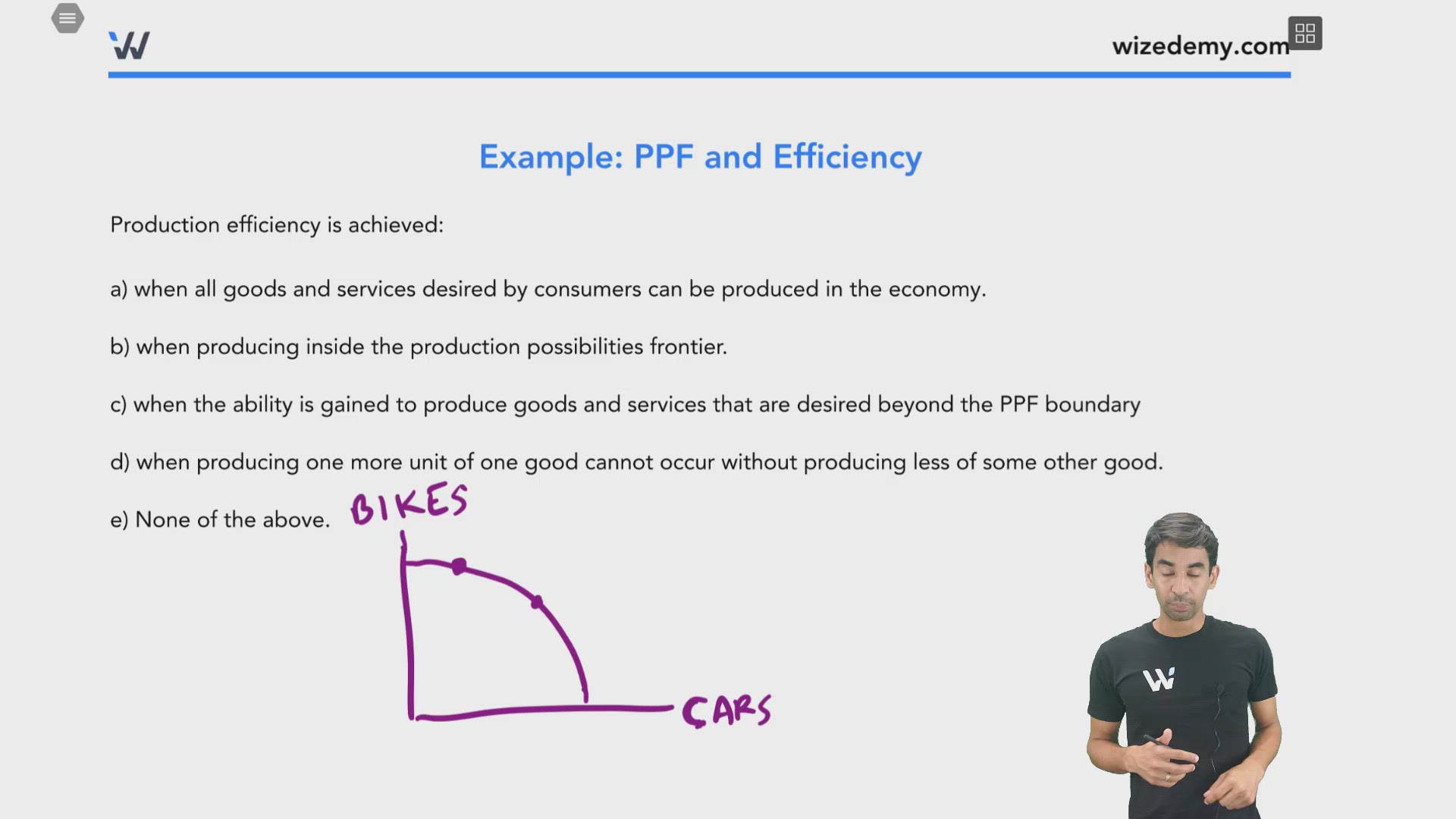
Example: PPF and Efficiency
Production efficiency is achieved:
a) when all goods and services desired by consumers can be produced in the economy.
b) when producing inside the production possibilities frontier.
c) when the ability is gained to produce goods and services that are desired beyond the PPF boundary
d) when producing one more unit of one good cannot occur without producing less of some other good.
e) None of the above.
D. Production efficiency means you are on the PPF. As you go to the right on the PPF, the only way you can make more of one good is by making less of the other good. This also explains why the PPF is always downward (negatively) sloped.
Practice: PPF
Which of the following would not cause the PPF for Canada to shift outward?
Practice: Opportunity Cost
On Saturday morning, you rank your choices for activities in the following order: go to the library, work out at the gym, have breakfast with friends, and sleep late. Suppose you decide to go to the library. Your opportunity cost is: