Wize University Macroeconomics Textbook > Measuring a Nation's Income
Real GDP Per Capita
Popular Courses
ECON 203
Concordia University
ECON 203
Concordia University
Macroeconomics
University Study Guides
AP Macroeconomics Exam Prep Course
AP Exam Prep
ECONOMIC 1022A/B
Western University
Macroeconomics
General Course
ECON 102
University of British Columbia
ECON*1100
University of Guelph
Macroeconomics
University Study Guides
ECON 203
University of Calgary
ECON 102
University of Alberta
ECO102H1
University of Toronto
ECO 1102
University of Ottawa
ECON 209
McGill University
ECON 1BB3
McMaster University
COMM 171
Queen's University
ECON 112
Queen's University
AP/ECON 1010 3.00
York University
ECON 295
McGill University
ECON 110
Queen's University
0:00 / 0:00
Real GDP Per Capita
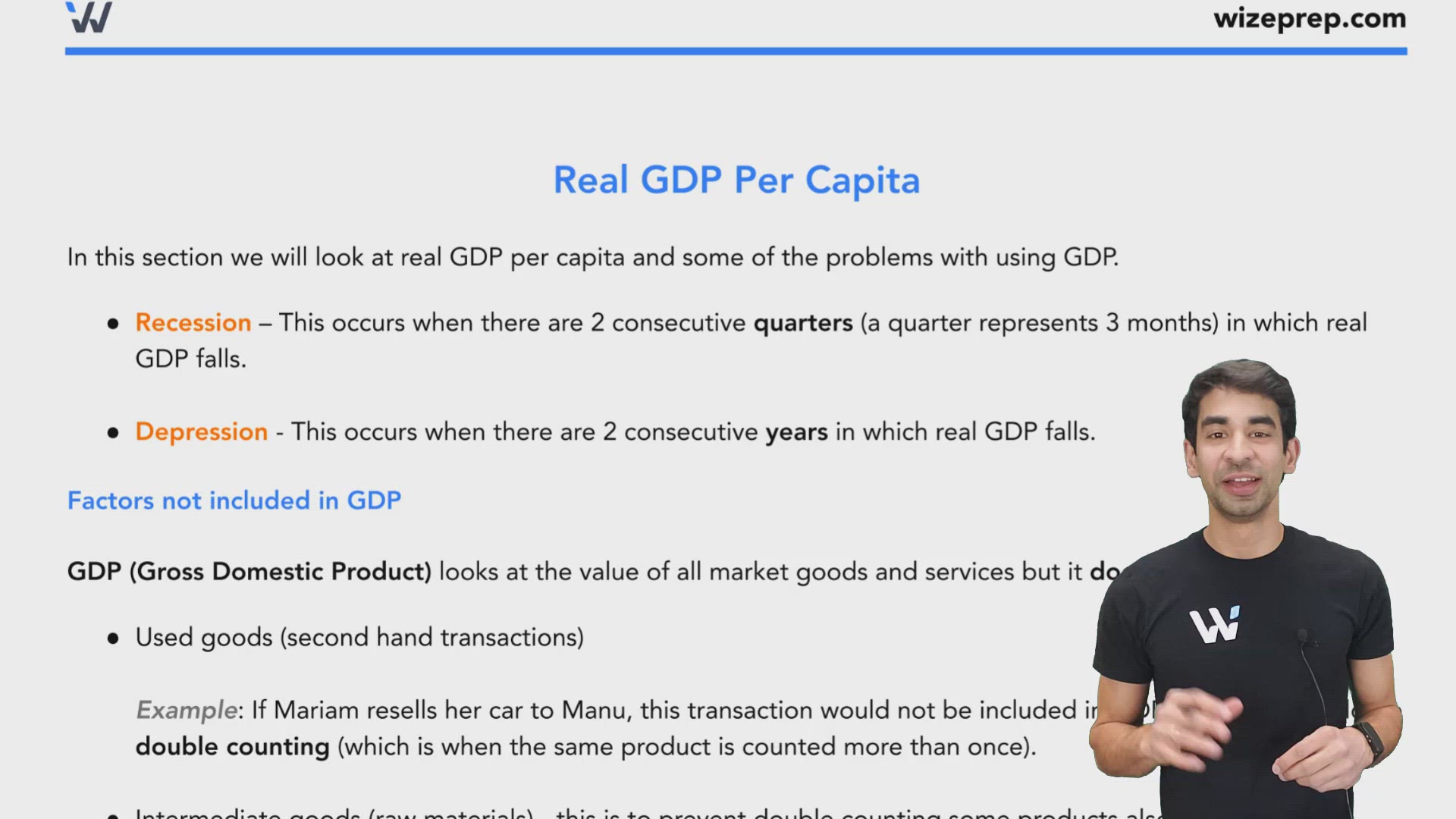
In this section we will look at real GDP per capita and some of the problems with using GDP.
- Recession – This occurs when there are 2 consecutive quarters (a quarter represents 3 months) in which real GDP falls.
- Depression - This occurs when there are 2 consecutive years in which real GDP falls.
Factors not included in GDP
GDP (Gross Domestic Product) looks at the value of all market goods and services but it does not include:
- Used goods (second hand transactions) Example: If Mariam resells her car to Manu, this transaction would not be included in GDP because it would be double counting (which is when the same product is counted more than once).
- Intermediate goods (raw materials) - this is to prevent double counting some products also.
Example: If Toyota buys intermediate goods like tires, windshield and an engine for $20,000 and they sell their car (final good) for $25,000 then the value added is
25000 - 20000 = $5000.
- Financial transactions like buying stocks - this is just transferring ownership. Example: If Melissa buys some Tesla stocks from Mike, then some of ownership in the company is being transferred from Mike to Melissa, but there is no production of a new good or service so it is not included in GDP.
- Illegal or non-market transactions Example: Drugs
Problems with GDP
GDP is generally considered a good measure of the economic well-being of a country but there are some problems with using it:
- It does not take pollution in to consideration Example: China may have a higher GDP than many other countries but it also has a much higher rate of pollution (carbon emissions) than other countries.
- It does not take amount of leisure time in to consideration Example: some countries like Japan and USA have a very high GDP but they are among the highest in the world in terms of hours of work (which leaves them with very little time for leisure).
- It does not look at distribution of income Example: in the USA the top 1% make more than the bottom 50% of the population.
Real GDP Per Capita
- In addition to GDP, we can also measure economic well-being using Real GDP per capita (per person) and the HDI. Example: In 2019, the USA real GDP was approximately $21.43 trillion and their population was roughly 328.2 million so real GDP per capita was around $65,300.
- HDI (Human Development Index) - A commonly used index that includes education, distribution of income, gender equality, and measures of poverty to determine a country's economic well-being. Example: The USA's HDI value for 2017 is 0.92, which was the 13th highest score in the world. Norway had the highest level of the Human Development Index (HDI) worldwide in 2019 with a value of 0.96.
- Spurious correlation - This is when two variables falsely appear to be related to each other. Example: number of car sales in North America are negatively related to the orange sales in South America. Thisisa spurious correlation because there is no real connection between them, it is just a coincidence that they have a negative relationship. However, the GDP per capita and HDI are closely related; thisis nota spurious correlation because they have a real connection.
0:00 / 0:00
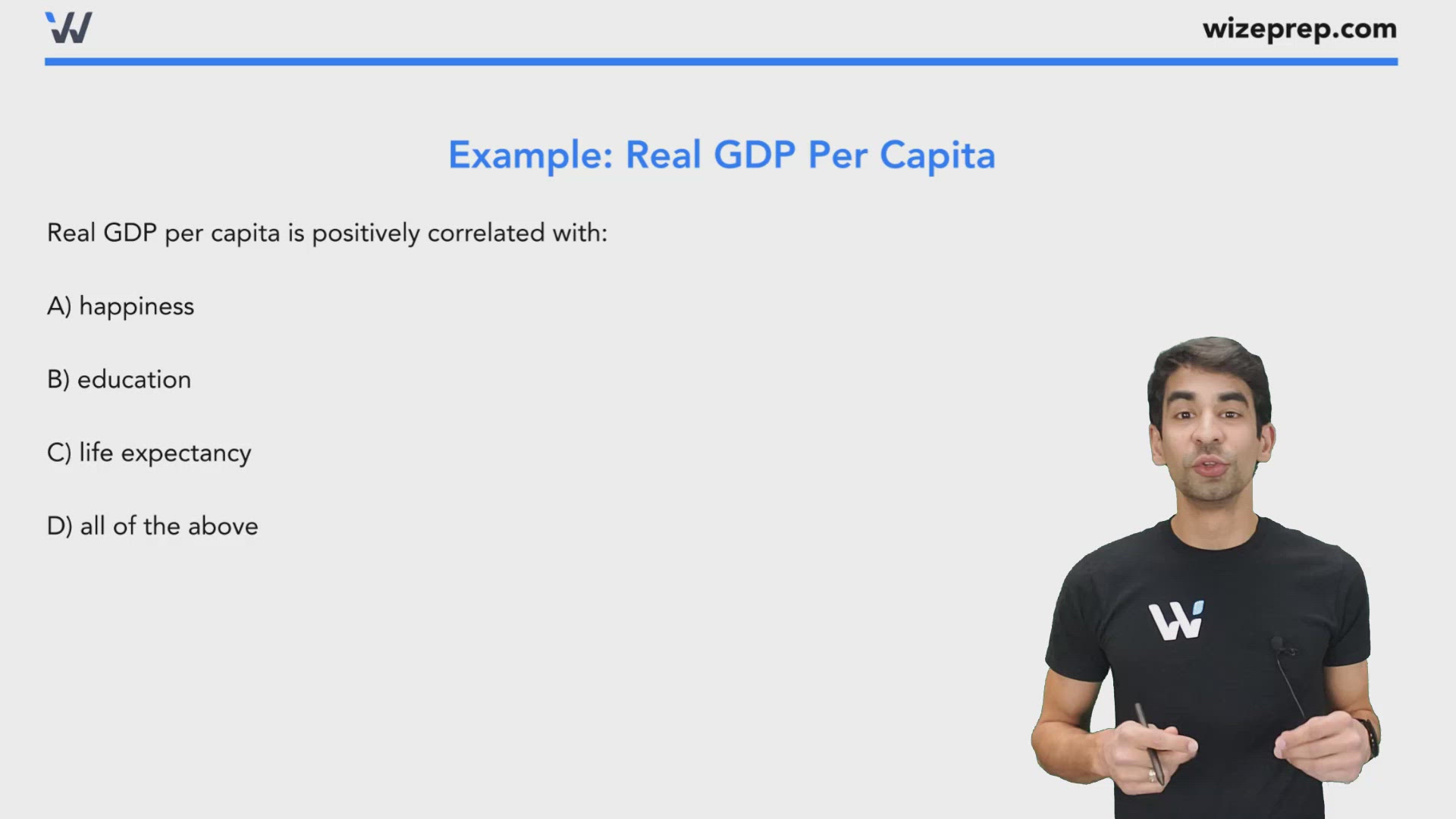
Example: Real GDP Per Capita
Real GDP per capita is positively correlated with:
A) happiness
B) education
C) life expectancy
D) all of the above
D
More developed countries like USA and Canada generally have a higher real GDP per capita than developing countries which also correlates with those developed countries having higher levels of education, life expectancy and happiness.
Practice: Real GDP Per Capita
Which of the following is/are the most commonly used measures of standard of living?