Popular Courses
ECON 203
Concordia University
ECON 203
Concordia University
Macroeconomics
University Study Guides
AP Macroeconomics Exam Prep Course
AP Exam Prep
ECONOMIC 1022A/B
Western University
Macroeconomics
General Course
ECON 102
University of British Columbia
ECON*1100
University of Guelph
Macroeconomics
University Study Guides
ECON 203
University of Calgary
ECON 102
University of Alberta
ECO102H1
University of Toronto
ECO 1102
University of Ottawa
ECON 209
McGill University
ECON 1BB3
McMaster University
COMM 171
Queen's University
ECON 112
Queen's University
AP/ECON 1010 3.00
York University
ECON 295
McGill University
ECON 110
Queen's University
0:00 / 0:00
CPI (Consumer Price Index)
- CPI (Consumer Price Index) - a measure of the cost of the overall basket of goods by a typical consumer.
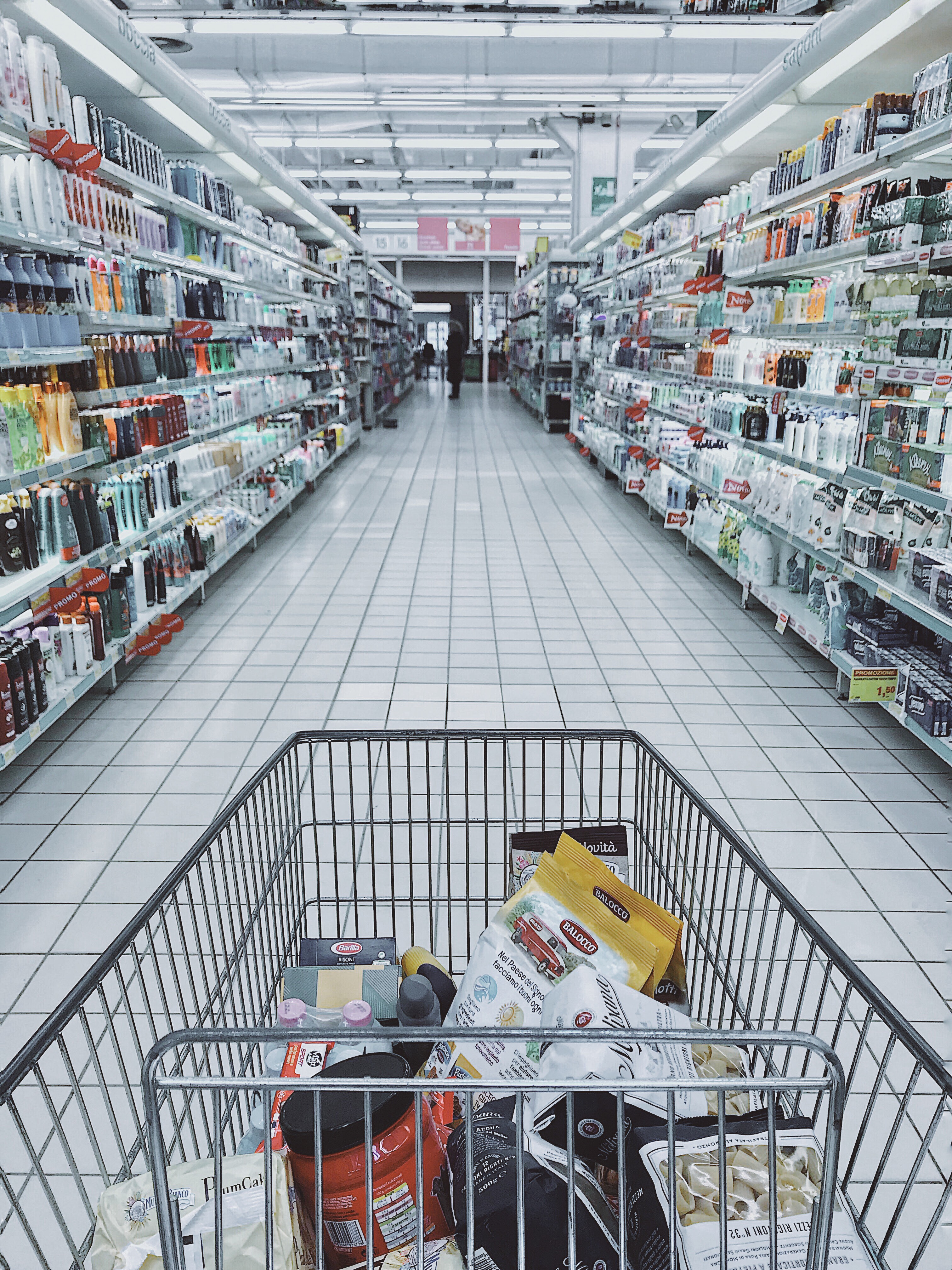
Where basket of goods (expenditure) = Current Price x Base Year Quantity
Example: Let’s assume 2005 is the base year and you are provided the table below. What would be the CPI in 2005 and 2006?
P(Books) P(Shoes) Q(Books) Q(Shoes)
2005 $50 $60 10 15
2006 $55 $65 9 14
Basket of Goods (expenditure) in 2005 =
50(10) + 60(15) = $1400
Basket of Goods (expenditure) in 2006 =
55(10) + 65(15) = $1525
CPI in 2005 =
1400/1400 * 100 = 100
CPI in 2006 =
1525/1400 * 100 = 108.93
- Core Inflation - a measure of the underlying inflation. It excludes volatile parts of the CPI like fruits, vegetables, and gas.
Problems with CPI
1. Substitution Bias - also called the commodity substitution bias. This is when the price of a good in the basket increases and consumers substitute to another good. It leads to CPI overstating inflation.
Example: if pears become more expensive than apples, people will just buy more apples and less pears so their cost of living won't really go higher.
2. New Product Bias - sometimes a new good, reduces the need for other goods which lowers the consumers' cost of living.
Example: when the iPod was first introduced, it lowered people's cost of living (didn't need as many CDs) but this was not reflected in the CPI.
3. Quality Bias - sometimes the price of certain products increases because they are higher quality. Additionally, sometimes a product may be the same price but could last for a longer time.
Example: smart phones have better technology which is why they are getting more expensive. This does not necessarily mean that there's inflation in the economy.
4. Outlet Bias - this is when the consumer switches to other outlets like wholesale clubs or online retailers.
Example: Consumers switching to Costco/Walmart or online shopping on Amazon can reduce their costs but it's not reflected in the CPI.
GDP Deflator vs CPI
The GDP Deflator looks at all goods produced domestically, whereas CPI looks at a basket of goods that are consumed domestically.
Example: changes in the price of coffee would be reflected in the
CPI
but not in the Deflator
of Canada.Example: The CPI in 1965 was 35 and CPI in 2019 was 135. Additionally, the price of a gallon of milk was $2 in 1965 and $3 in 2019. What was the price in 2019 in 1965 dollars?
Answer =
35/135 * 3 = $0.78
- Indexation - the automatic correction of a dollar amount for the effects of inflation by law or contract. Example: On average there's about 2% inflation per year so some pension plans also increase payments to retirees by 2% per year.
0:00 / 0:00
Example: CPI
Suppose our current nominal wage is $20 per hour, and the current CPI is 115. Our labour unions are currently negotiating with the firms for a new nominal wage for next year. Our unions want us to be able to afford the same goods and services that we typically buy. If we agree to a new nominal wage of $24 per hour, this implies we believe the CPI for next year to be ________
a) 138
b) 122
c) 85
d) 112
A.
Real Wage = CPI(base)/CPI(current) * Nominal Price Current
20 = (115/CPI) * 24
0.833 = 115/CPI
CPI = 115/0.83333
CPI = 138
Practice: CPI
The weekly expenditures for a family in 2015 was $1,200. In 2018, the weekly expenditure was $1,600. If 2015 is the base year, what was the CPI in 2018?
Practice: CPI Definition
What does the CPI measure?
Practice: CPI Calculation
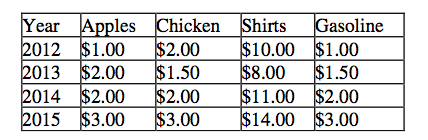
In the country of Fiji, the CPI is calculated using a market basket consisting of 5 apples, 4 kg of chicken, 3 shirts, and 2 litres of gasoline. The per-unit prices of these goods are provided above. What was the inflation rate, as measured by the CPI, between 2014 and 2015?