Wize University Macroeconomics Textbook > Production and Growth
Production and Growth
Popular Courses
ECON 203
Concordia University
ECON 203
Concordia University
Macroeconomics
University Study Guides
AP Macroeconomics Exam Prep Course
AP Exam Prep
ECONOMIC 1022A/B
Western University
Macroeconomics
General Course
ECON 102
University of British Columbia
ECON*1100
University of Guelph
Macroeconomics
University Study Guides
ECON 203
University of Calgary
ECON 102
University of Alberta
ECO102H1
University of Toronto
ECO 1102
University of Ottawa
ECON 209
McGill University
ECON 1BB3
McMaster University
COMM 171
Queen's University
ECON 112
Queen's University
AP/ECON 1010 3.00
York University
ECON 295
McGill University
ECON 110
Queen's University
0:00 / 0:00
Production and Growth
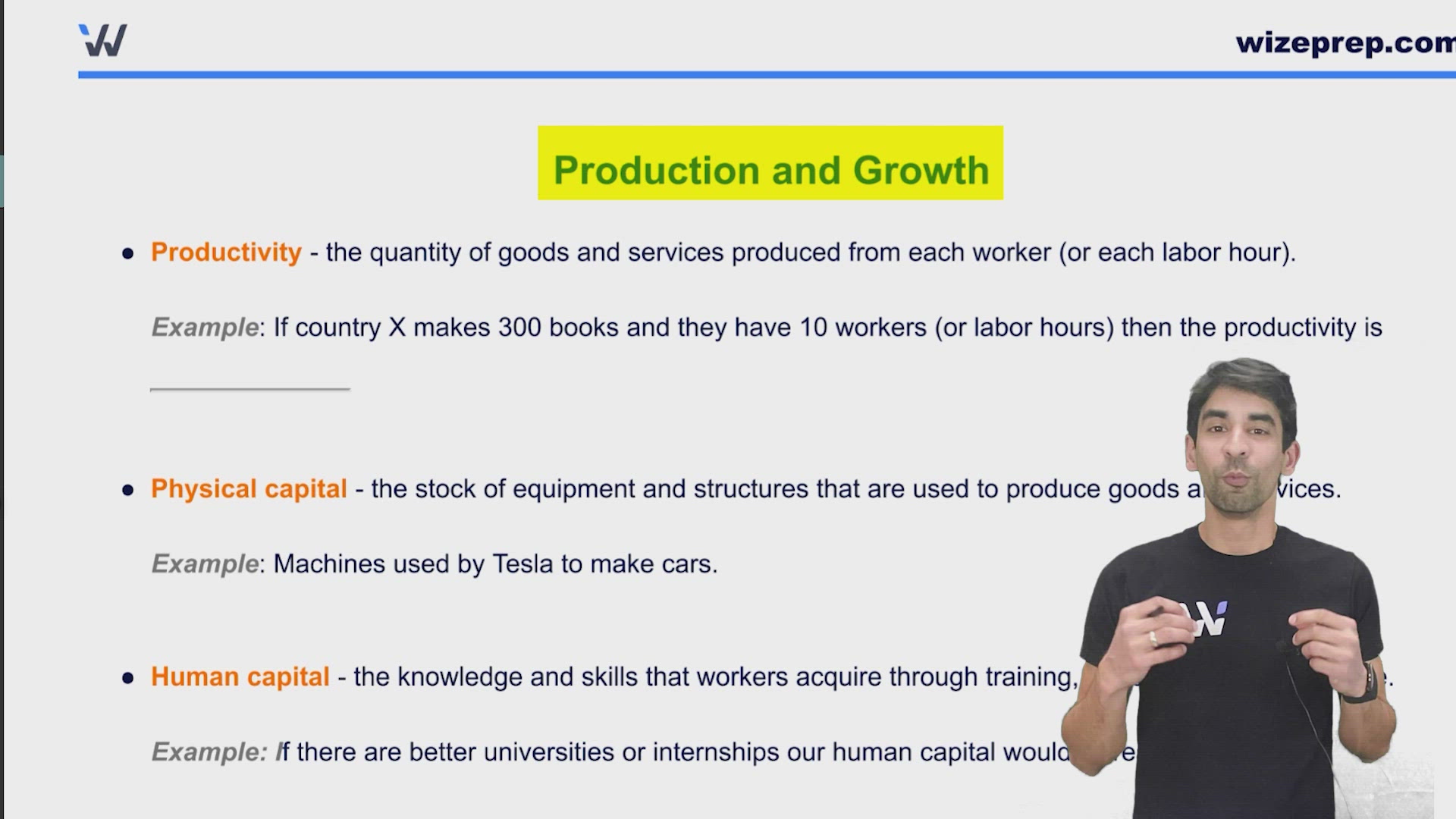
- Productivity - the quantity of goods and services produced from each worker (or each labor hour). Example: If country X makes 300 books and they have 10 workers (or labor hours) then the productivity is300/10 = 30
- Physical capital - the stock of equipment and structures that are used to produce goods and services. Example: Machines used by Tesla to make cars.
- Human capital - the knowledge and skills that workers acquire through training, education and experience. Example: If there are better universities or internships our human capital would increase.
- Natural resources - the inputs that are natural. Example: Land, rivers and minerals.
- Technological knowledge - society's understanding of the best way to produce goods and services. This is also called the Embodied Technological Change or the Solow Residual. Example: Ford with mass production methods for cars.
- Diminishing Returns - when more inputs (like labor) are hired, each additional input becomes less and less productive. Example: If a firm hires an additional 100 workers but has only 5 machines, eventually each additional worker will become less and less productive because they don't have enough machines to work with.
Economic Growth Model (New Classical Growth Theory)
The economic growth model, also called the production function, shows the relationship between the capital per worker and the GDP per worker.
- As we move along the curve to the right there is diminishing marginal product of capital.
- If there is embodied technological change, the production function shifts upward

- Catch Up Effect - the theory that countries that start off poor will grow at faster rates than countries that start off richer. This is also supported by the economic growth model above. Example: The GDP per capita growth rate in the USA in 2017 was around 4%, whereas for India it was around 14%.
- Foreign Direct Investment - a capital investment that is owned and run by a foreign country. Example: Nike building a factory in China
- Education - this can improve human capital and provide positive externalities, which is when other members of society benefit from a good or service. Example: Cities that have better education systems generally have more employment and less homeless people.
- Property Rights - allow the price system to work by protecting businesses from theft. Example: Pharmaceutical companies that develop a new drug can get a patent to protect them from generic firms copying their drug and selling it for cheaper.
- Free Trade - allowing countries to trade freely with each other encourages competition and allows nations to benefit from each others' technological advances.
- Research and Development - although a lot of this comes from private firms, knowledge is a public good. So once one person discovers something, other people can benefit from it for free.
- Population Growth - developing countries that have high growth rates in population often can't build enough schools at the same rate, so human capital in those countries suffers as a result. Example: Countries like India where the population growth rate is very high.
- Rule of 70 - to find out roughly how long it takes an economy to double we can take the number 70 and divide it by the growth rate of the economy. Example: If the growth rate of a country is 5% per year than it would take approximately 70/5 = 14 years for the economy to double.
0:00 / 0:00
Example: Production and Growth
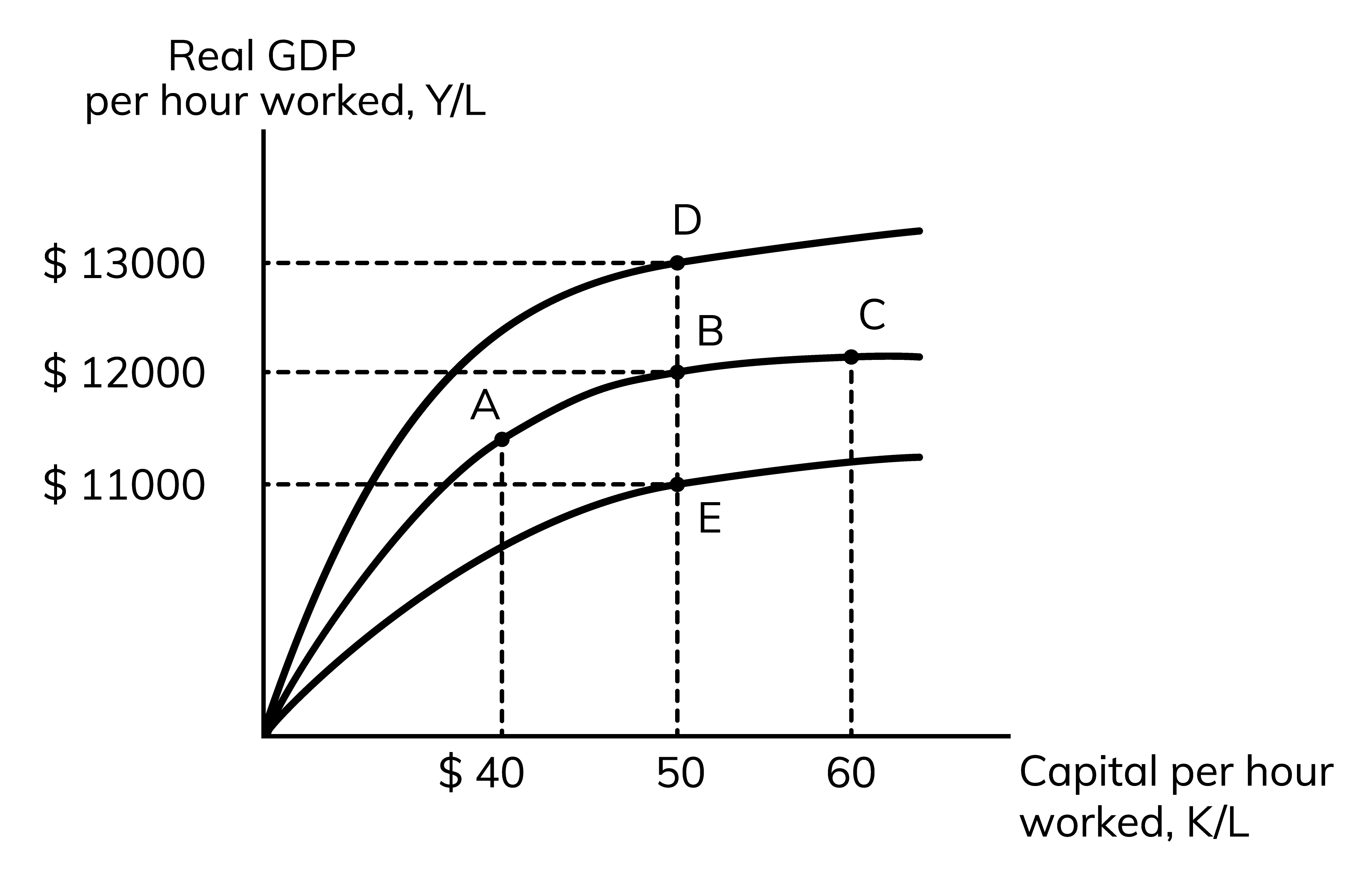
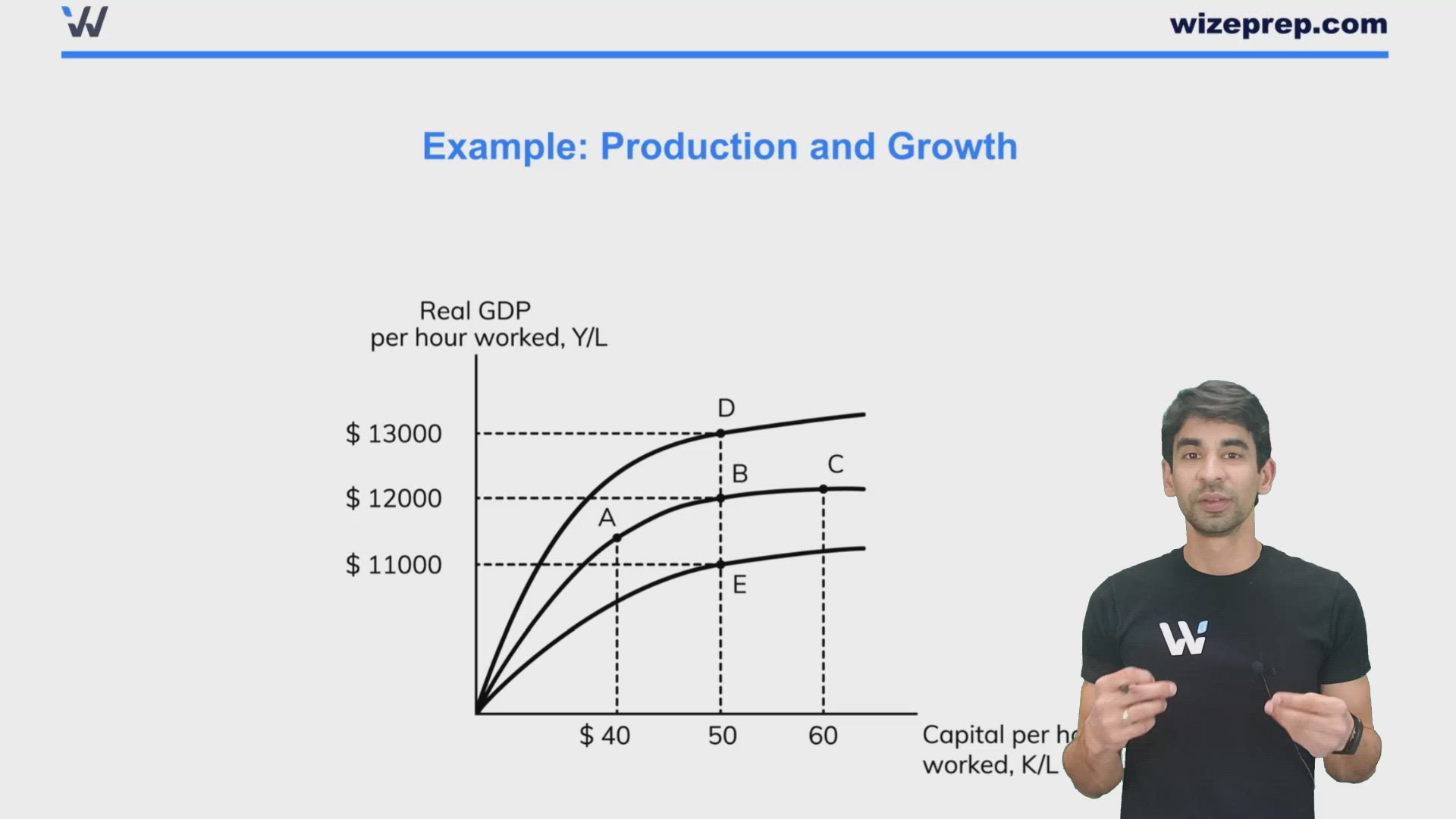
Refer to the diagram above. The movement from E to B to D in the figure above illustrates
A) a decline in capital per worker
B) diminishing returns to capital
C) diminishing returns to labor
D) an improvement in technology
E) an increase in the price level
D
As the production function shifts upward it means there is an improvement in technology/education/human capital because with the same amount of capital per worker (machines per worker) the real GDP per worker has increased.

0:00 / 0:00
Example: Catch Up Effect
Which of the following does not contribute to the explanation why some countries have not experienced relatively high growth rates in real GDP per capita despite relatively low initial levels of real GDP per capita?
A) Countries that are relatively poor are likely to have a lower quality of health care and education.
B) Countries that are relatively poor are more likely to experience wars and revolutions.
C) Many of these developing countries do not have a functioning court system that can enforce laws.
D) Countries that are relatively poor are more likely to have higher savings.
D
Countries that are relatively poor have lower incomes so lower savings.
Practice: Economic Growth Model
The economic growth model predicts that______ across countries will converge over time.
Practice: Catch Up Effect
The catch up effect refers to the idea that:
Practice: Rule of 70
If an economy is growing at a rate of 3% per year, approximately how long will it take the economy to double in size?
Practice: Human Capital
Human capital refers to which of the following?