Wize University Macroeconomics Textbook > Money and Prices in the Long Run
Money Supply and Demand
Popular Courses
ECON 203
Concordia University
Macroeconomics
University Study Guides
AP Macroeconomics Exam Prep Course
AP Exam Prep
ECONOMIC 1022A/B
Western University
Macroeconomics
General Course
ECON*1100
University of Guelph
Macroeconomics
University Study Guides
ECON 203
University of Calgary
ECON 102
University of Alberta
ECO102H1
University of Toronto
ECO 1102
University of Ottawa
ECON 110
Queen's University
ECON 1102
Dalhousie University
ECON 1002
Carleton University
ECON 1BA3
McMaster University
ECON 330
McGill University
EC 202
Michigan State University
ECON 104
Pennsylvania State University
ECN 211
Arizona State University - Tempe
ECN 001B
University of California - Davis
0:00 / 0:00
Money Supply and Demand
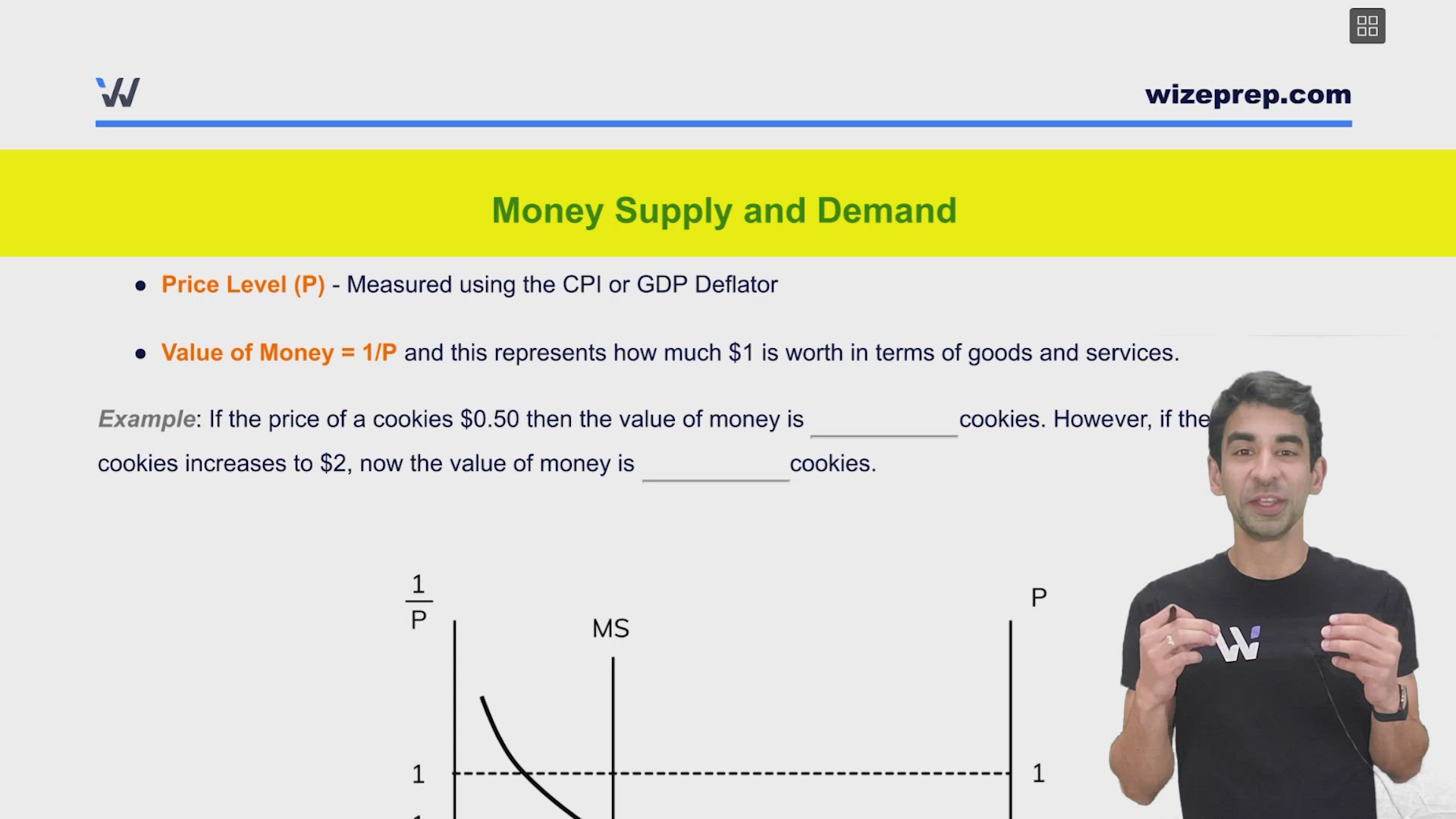
- Price Level (P) - Measured using the CPI or GDP Deflator
- Value of Money = 1/P and this represents how much $1 is worth in terms of goods and services.
Example: If the price of a cookies $0.50 then the value of money is
1/0.5 = 2
cookies. However, if the price of cookies increases to $2, now the value of money is 1/2 = 0.5
cookies.
- If there is a monetary injection (increase in money supply) the price level willincreaseand the value of a dollar willdecrease.
- Quantity Theory of Money - a theory asserting that the quantity of money available determines the price level and that the growth rate in the quantity of money available determines the inflation rate
- Nominal Variables - variables measured in monetary units
- Real Variables - variables measured in physical units. Example: If the price of books are $20 and price of shirts are $40 those arenominalprices. The real (or relative) price of one shirt is2books.
- Classical Dichotomy - the theoretical separation of nominal and real variables
- Monetary Neutrality - the proposition that changes in the money supply do not affect real variables. From the example above, if money supply increases and the prices of both products double to $40 for books and $80 for shirts, the real price of one shirt is still2books.