Create a free account to get started

Unlock full course notes by signing up

  • Video lessons taught by top educators
  • Practice questions with guided solutions
  • Written review notes for reference
  • Expert answers anytime from course tutors

Interval Notation

Interval notation is a way of writing subsets of the real number line.


Closed Interval

  • A closed interval is one that includes its endpoints
  • We use square brackets [ ].


Example 1

[-5, 1] denotes the set of real numbers between -5 and 1 inclusively and can be shown on a number line as follows:
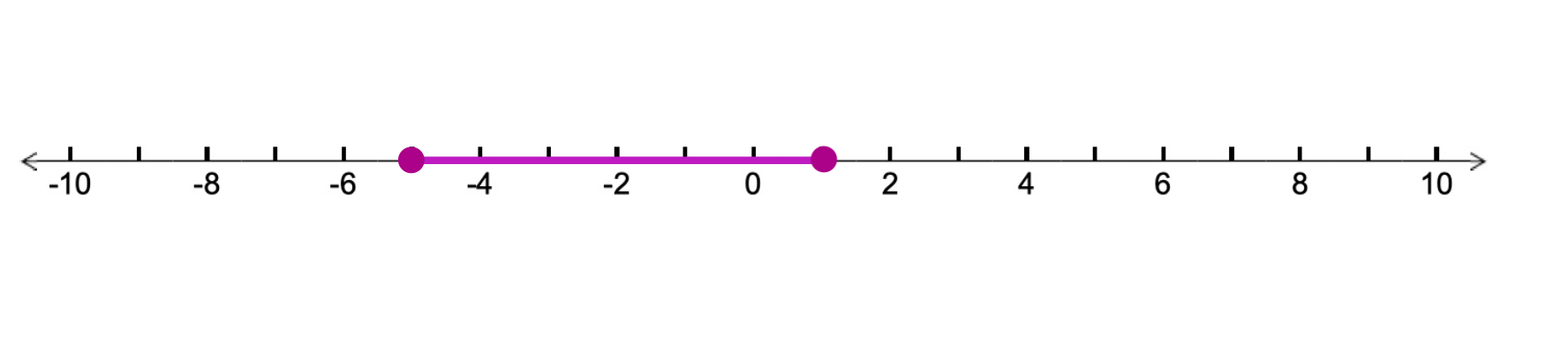
Image illustrating Interval Notation

Open Interval

  • An open interval is one that excludes its endpoints
  • We use parentheses ( ).


Example 2

(-5, 1) denotes the set of real numbers between -5 and 1 exclusively and can be shown on a number line as follows:


Image illustrating Interval Notation


Mixed Intervals

Mixed intervals contain both open and closed intervals.


Example 1

[3, 8) denotes the set of real numbers between 3 and 8 that are greater than or equal to 3 but strictly less than 8. On a number line, it is shown as follows:

Image illustrating Interval Notation

Infinite Intervals

Infinite intervals are intervals that tend towards infinity in one or both directions.


Example 2

[4,∞)[4,\infin) denotes the set of real numbers greater than or equal to 4 and can be shown on a number line as follows:

Image illustrating Interval Notation


Note: When working with positive & negative infinity, ±∞\pm\infin, parenthesis are always used next to infinity.


Union of Sets

The union of two sets A and B is the set of elements in A, in B, or in both.

  • The symbol used to indicate the union of two sets is ∪\cup
  • We use the union symbol to combine two or more intervals together


Example

The interval x<−5  or  x≥3x<-5~~\text{or}~~x\ge3 denotes the set of real numbers less than -5 and greater than or equals to 3. On a number line, this it looks like:

Image illustrating Interval Notation

In interval notation, we can express the above interval & number line as:
(−∞,−5) ∪ [3,∞)(-\infin,-5)~\cup~[3,\infin)


Create a free account to get started

Unlock full course notes by signing up

  • Video lessons taught by top educators
  • Practice questions with guided solutions
  • Written review notes for reference
  • Expert answers anytime from course tutors

Set Notation


Set notation is a flexible (but slightly more complicated) way of writing down sets and it is an alternative method to interval notation.


What is a set?

A set is a collection of well-defined objects and we encounter sets in math frequently.


Example

Let us look at the list of numbers 0, 1, 2, 3, 4, 5. We can call our list of numbers a set and label it whatever we like so let us call this set X. Therefore, the list of numbers in set X is:

X = {0,1,2,3,4,5}X~=~\big\{0, 1, 2, 3, 4, 5\big\}


Note: Sets and set notation are delimited by curly braces { }.


Common Sets

N={1,2,3,4,5,...}→Natural NumbersW={0,1,2,3,4,...}→Whole NumbersZ={0,±1,±2, ...}  →IntegersQ={x∣ x=ab, b≠0}→Rational NumbersI={x∣ x≠ab, b≠0}→Irrational NumbersR=Q ∪ I                  →Real Numbers\begin{array} {l r} \mathbb{N}=\{1, 2, 3, 4, 5,...\}\rightarrow&\text{Natural Numbers}\\\\ \mathbb{W}=\{0, 1, 2, 3, 4,...\}\rightarrow&\text{Whole Numbers}\\\\ \mathbb{Z}=\{0,\pm1,\pm2,\,...\}~~\rightarrow&\text{Integers}\\\\ \mathbb{Q}=\{x|~x=\frac{a}{b},~b\neq0\}\rightarrow&\text{Rational Numbers}\\\\ \mathbb{I}=\{x|~x\neq\frac{a}{b},~b\neq0\}\rightarrow&\text{Irrational Numbers}\\\\ \mathbb{R}=\mathbb{Q}~\cup~\mathbb{I}~~~~~~~~~~~~~~~~~~\rightarrow&\text{Real Numbers} \end{array}


Set Notation

We can also use set notation instead of interval notation.


Example 1

[-5, 1] denotes the set of real numbers between -5 and 1 inclusively and can be shown on a number line as follows:

Image illustrating Set Notation

In set notation, our answer would be:

{x∈R∣ −5≤x≤1}\{x\in\mathbb{R}|~-5\leq{x}\leq{1}\}


Example 2

(-5, 1) denotes the set of real numbers between -5 and 1 exclusively and can be shown on a number line as follows:

Image illustrating Set Notation

In set notation, our answer would be:

{x∈R∣ −5<x<1}\{x\in\mathbb{R}|~-5<{x}<1\}


Create a free account to get started

Unlock full course notes by signing up

  • Video lessons taught by top educators
  • Practice questions with guided solutions
  • Written review notes for reference
  • Expert answers anytime from course tutors

Example: Interval Notation vs. Set Notation

Express the following inequalities in both interval notation and set notation:

  1. −2≤x≤4-2\leq{x}\leq{4}

Interval NotationSet Notation[−2, 4]  →  Inclusive{x∈R∣ −2≤x≤4}\begin{array} {l|l} \text{Interval Notation}&\text{Set Notation}\\ \hline \\ [-2,~4]~~{\color{red}\rightarrow}~~\color{magenta}\scriptsize{\text{Inclusive}}&\{x\in\mathbb{R}|~-2\leq{x}\leq{4}\} \end{array}


  1. x<4  or  x≥9x<4~~\text{or}~~x\ge9

Interval Notation Set Notation(−∞, 4) ∪ [9, ∞)        {x∈R∣ x<4  &  x≥9}\begin{array} {l|l} \text{Interval Notation}&\text{~Set Notation}\\ \hline \\ (-\infin,~4)~\cup~[9,~\infin)~~~~~~~&~\{x\in\mathbb{R}|~x<4~~\&~~x\geq{9}\} \end{array}


  1. x>3  and  x≤14x>3~~\text{and}~~x\leq{14}

Interval NotationSet NotationExclusive  ←  (3, 14]  →  Inclusive{x∈R∣ 3<x≤14}\begin{array} {l|l} \text{Interval Notation}&\text{Set Notation}\\ \hline \\ {\scriptsize{\color{magenta}\text{Exclusive}}}~~{\color{red}\leftarrow}~~(3,~14]~~{\color{red}\rightarrow}~~{\scriptsize{\color{magenta}\text{Inclusive}}}&\{x\in\mathbb{R}|~3<{x}\leq{14}\} \end{array}

Match the interval with its appropriate notation.

Match each term
A.

{x∈R∣ −6<x<3}\{x\in\mathbb{R}|~-6<x<3\}

B.

[10, ∞)[10,~\infty)

C.

{x∈R∣ x<8}\{x\in\mathbb{R}|~x<8\}

D.

[−6, 3][-6,~3]

E.

(−∞, 7](-\infin,~7]

x≤7x\leq7

x≥10x\geq{10}

x<8x<8

−6≤x≤3-6\leq{x}\leq3

−6<x<3-6<x<3

Create a free account to get started

Unlock full course notes by signing up

  • Video lessons taught by top educators
  • Practice questions with guided solutions
  • Written review notes for reference
  • Expert answers anytime from course tutors

Convert the following set into set notation:

A={−4,−3,−2,−1,0}\text{A}=\{-4, -3, -2, -1, 0 \}


Choose an answer

Create a free account to get started

Unlock full course notes by signing up

  • Video lessons taught by top educators
  • Practice questions with guided solutions
  • Written review notes for reference
  • Expert answers anytime from course tutors

Cheatsheet: Interval VS Set Notation


Type of IntervalDescriptionInterval NotationSet NotationOpen IntervalSet of real numbers between a & b(a, b){x∈R∣ a<x<b}but not including a & b themselvesClosed IntervalSet of real numbers between a & b[a, b]{x∈R∣ a≤x≤b}including a & b12-Open,12-ClosedSet of real numbers between a & b(a, b]{x∈R∣ a<x≤b}not including ’a’ but including ’b’12-Closed,12-OpenSet of real numbers between a & b[a,b){x∈R∣ a≤x<b}including ’a’ but not including ’b’Infinite IntervalSet of real numbers greater than ’a’(a,∞){x∈R∣ x>a}Infinite IntervalSet of real numbers greater than or[a,∞){x∈R∣ x≥a}equal to ’a’Infinite IntervalSet of real numbers less than ’a’(−∞,a){x∈R∣ x<a}Infinite IntervalSet of real numbers less than or(−∞,a]{x∈R∣ x≤a}equal to ’a’Infinite IntervalSet of all real numbers(−∞,∞){x∈R∣ x is a real number}\begin{array} {|l|l|c|c|} \hline\textbf{Type of Interval}&\textbf{Description}&\textbf{Interval Notation}&\textbf{Set Notation}\\ \hline\\ \text{Open Interval}&\footnotesize{\text{Set of real numbers between a \& b}}&(a,~b)&\{x\in\mathbb{R}|~a<x<b\}\\&\footnotesize{\text{but not including a \& b themselves}} \\\\\hline\\\text{Closed Interval}&\footnotesize{\text{Set of real numbers between a \& b}}&[a,~b]&\{x\in\mathbb{R}|~a\leq{x}\leq{b}\}\\&\footnotesize{\text{including a \& b}}\\ \hline \\\frac{1}{2}\text{-Open}, \frac{1}{2}\text{-Closed}&\footnotesize{\text{Set of real numbers between a \& b}}&(a,~b]&\{x\in\mathbb{R}|~a<x\leq{b}\}\\&\footnotesize{\text{not including 'a' but including 'b'}}\\ \hline\\ \frac{1}{2}\text{-Closed}, \frac{1}{2}\text{-Open}&\footnotesize{\text{Set of real numbers between a \& b}}&[a,b)&\{x\in\mathbb{R}|~a\leq{x}<b\}\\&\footnotesize{\text{including 'a' but not including 'b'}}\\ \hline\\ \text{Infinite Interval}&\footnotesize{\text{Set of real numbers greater than 'a'}}&(a,\infin)&\{x\in\mathbb{R}|~x>a\}\\\\ \hline\\ \text{Infinite Interval}&\footnotesize{\text{Set of real numbers greater than or}}&[a,\infin)&\{x\in\mathbb{R}|~x\geq{a}\}\\&\footnotesize{\text{equal to 'a'}} \\ \hline\\ \text{Infinite Interval}&\footnotesize{\text{Set of real numbers less than 'a'}}&(-\infin,a)&\{x\in\mathbb{R}|~x<a\}\\\\ \hline\\ \text{Infinite Interval}&\footnotesize{\text{Set of real numbers less than or}}&(-\infin,a]&\{x\in\mathbb{R}|~x\leq{a}\}\\ &\footnotesize{\text{equal to 'a'}}\\ \hline\\ \text{Infinite Interval}&\footnotesize{\text{Set of all real numbers}}&(-\infin, \infin)&\{x\in\mathbb{R}|~x~\footnotesize{\text{is a real number}}\}\\\\ \hline \end{array}