Wize University Calculus 1 Textbook > Integrals
Integration by Substitution (U-Substitution)
Popular Courses
CALCULUS 1000A/B
Western University
Calculus 1
University Study Guides
AP Calculus (AB) Exam Prep Course
AP Exam Prep
MATH 209
Concordia University
MATH 1LS3
McMaster University
MATH 249
University of Calgary
MATH 265
University of Calgary
Calculus 1
General Course
MATH 275
University of Calgary
MATH 140
McGill University
MATH 121
Queen's University
MATH*1080
University of Guelph
MATH 134
University of Alberta
MATH 154
University of Alberta
Calculus 1
University Study Guides
MAT 1320
University of Ottawa
MATH 100
University of Alberta
MAT 1330
University of Ottawa
MTH 140
Toronto Metropolitan University
SC/MATH 1013 3.00
York University

0:00 / 0:00
Integration by Substitution (U-Substitution)
There is no "Chain Rule for Integrals" like there is for derivatives. When we are trying to integrate compositions of functions, often we use the technique of U Substitution.
U Substitution
If is a differentiable function with a continuous derivative , by letting we have
Wize Tip
We typically use U-Substitution when the derivative of one part shows up elsewhere in the integral.
Procedure for U-Substitution
- Let equal part of the integrand (usually what's inside parenthesis or the "messy" part of the function)
- Differentiate to get
- Solve for
- Substitute and into your integral (for definite integrals replace the bounds)
- Integrate with respect to
- Substitute the original expression back in (only for indefinite integrals)

0:00 / 0:00
Example: U-Sub
Evaluate the following definite integral
.
1. Pick "u" expression
We have 2 candidates for : and
Both of these are wrapped inside brackets, let's pick the higher degree part:
2. Differentiate u to get du=...dx
3. Solve for dx
4. Substitute u and replace dx
(Since this is a definite integral, we need to replace the bounds)
When the lower bound is
When the upper bound is
Let's substitute in the expression, the bounds, and replace the expression:
5. Integrate this new u expression
Wize Tip
Since this is a definite integral, we don't have to substitute the original x expression back in.

0:00 / 0:00
Example: U Sub
Evaluate the following definite integral
Notice that , which is similar to the that appears outside the square root.
1. Pick "u" expression
2. Differentiate u to get du
3. Solve for dx
4. Substitute u and replace dx
(Since this is a definite integral, we need to replace the bounds)
So then
5. Integrate this new u expression
0:00 / 0:00
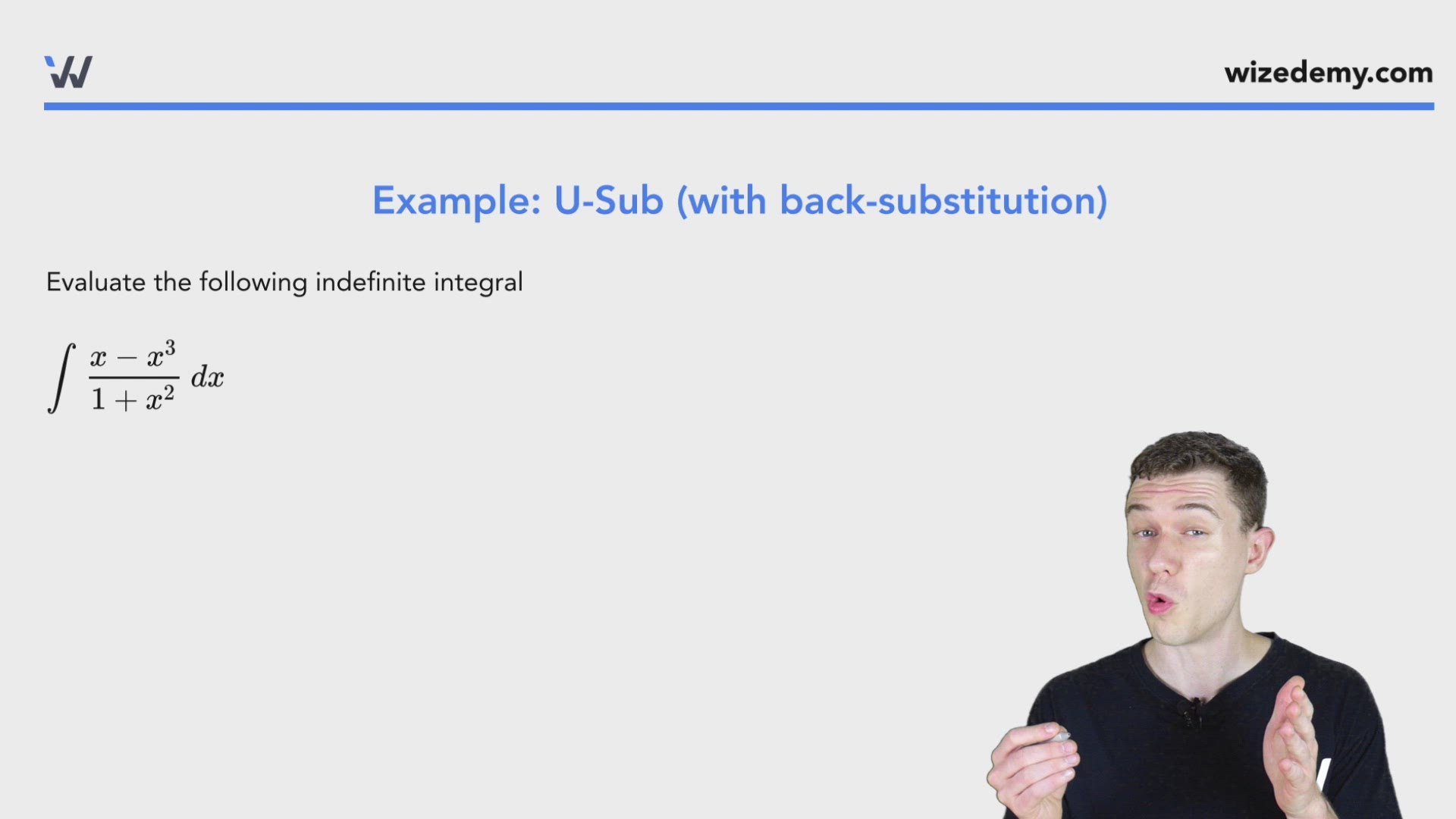
Example: U-Sub (with back-substitution)
Evaluate the following indefinite integral
Simplifying will not make this integration any easier, let's try u-substitution.
Normally, we will pick u to be the numerator because the numerator is of degree 3 and denominator is of degree 2. However, if you try that, you'll realize that we have nothing to cancel out with in our 4th step. So instead, let's pick u to be the denominator.
1. Pick "u" expression
2. Differentiate u to get du
3. Solve for dx
4. Substitute u and replace dx
Since the expression still involves an x term, we need to back-substitute:
From , we have .
We can now use this to replace the in our expression:
5. Integrate this new u expression
6. Sub the x expression back in for u:
*Since for all values of x, we don't need the absolute value signs.
Practice: U-Sub
Evaluate the following indefinite integral
Practice: U-Sub
Evaluate the following indefinite integral
Practice: U-Sub
Evaluate the following indefinite integral
Practice: U-Sub
Evaluate the following indefinite integral
Extra Practice
Practice: Substitution with Definite Integral
Practice: Substitution with Definite Integral
Evaluate .
Practice: Substitution with Definite Integral
Practice: Substitution with Definite Integral
Evaluate .
Practice: Substitution with Definite Integral
Practice: Substitution with Definite Integral
Evaluate .