Wize University Calculus 1 Textbook > Applications of Integration
Distance and Displacement
Popular Courses
CALCULUS 1000A/B
Western University
Calculus 1
University Study Guides
AP Calculus (AB) Exam Prep Course
AP Exam Prep
MATH 1LS3
McMaster University
Calculus 1
General Course
MATH 121
Queen's University
MATH 134
University of Alberta
Calculus 1
University Study Guides
MATH 141
McGill University
MAT 1320
University of Ottawa
MTH 140
Toronto Metropolitan University
MAT136H1
University of Toronto
MATH 100
University of Victoria
MAT133Y1
University of Toronto
ADM 1305
University of Ottawa
MATH 144
University of Alberta
MATH*1200
University of Guelph
MATH 1000
Dalhousie University
MTH 131
Toronto Metropolitan University
MATH 116
University of Waterloo
0:00 / 0:00
Distance and Displacement
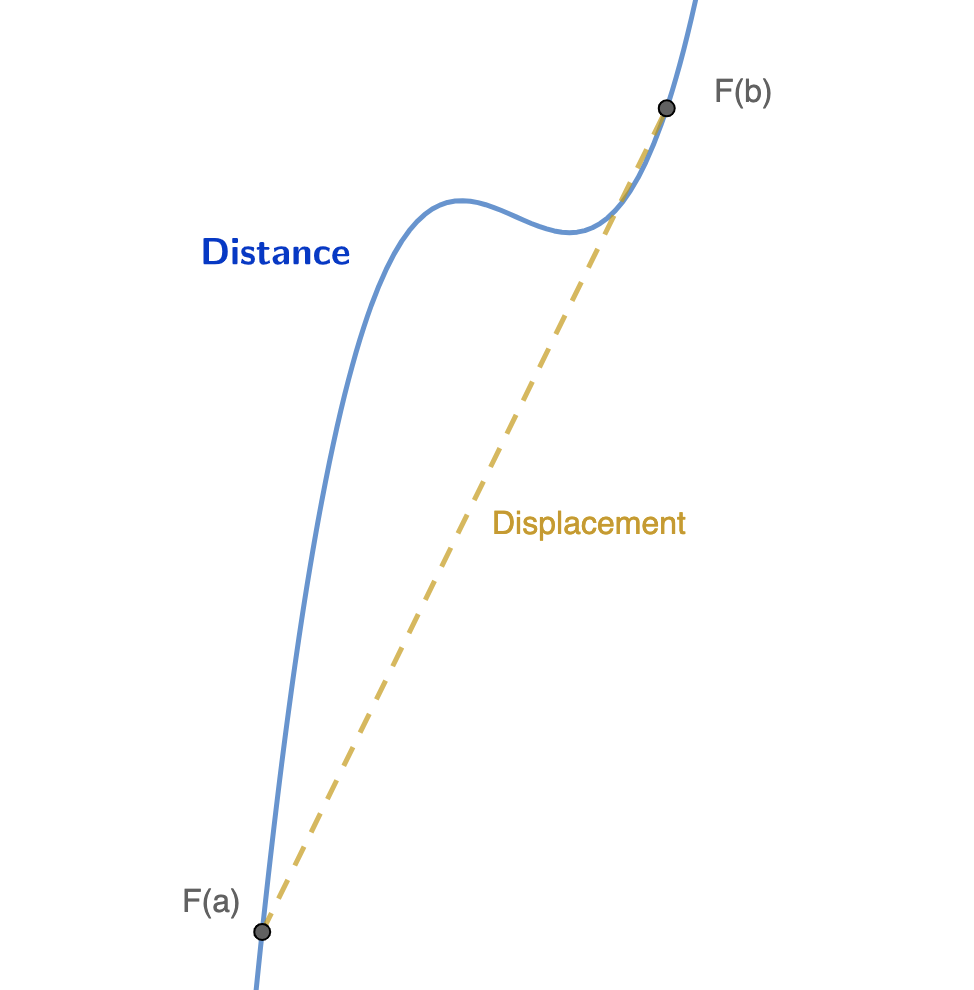
The area underneath the velocity curve of an object represents its distance traveled. If at some point the object moves backwards, then its velocity will be negative (subtracting some distance). In such cases we are measuring displacement - the distance between the initial and final position.
Displacement
If is the velocity of a particle on the interval then the displacement of the particle is given by
Total Distance
If is the velocity of a particle on the interval then the total distance of the particle is given by
Watch Out!
Displacement is also called net distance; don't mix up net distance and total distance.
0:00 / 0:00
Example: Distance and Displacement
A particle moves along a line so that its velocity at time t is , in meters per second.
Find the displacement of the particle during the time period , and then find the total distance traveled during this time period.
Displacement is net distance, which is just the integral of the velocity function over the time interval:
The negative sign means that the particle's position at time was 9/2 or 4.5 meters to the left of its position at time .
To find total distance, we need the absolute value of the velocity function. We need to find where the velocity function equals zero, and where it's negative (below the x-axis), we will make it positive:
.
At time , this is negative; and it becomes positive at time , and then stays positive for the rest of the time interval. So we need to split the integral at , and flip the sign for the interval :
Practice: Distance and Displacement
The velocity function, in meters per second, of a particle moving alone a line is given by
For the time interval , find
(a) the displacement of the particle
(b) the distance traveled by the particle
Practice: Displacement
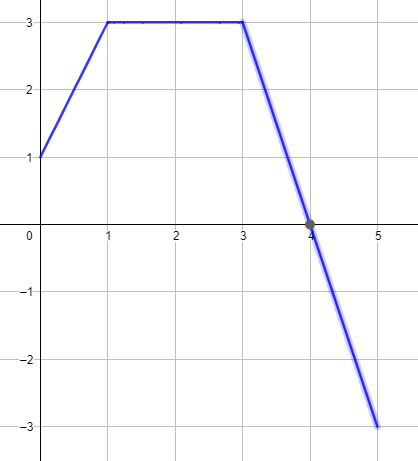
The following graph represents the velocity of a particle in m/s, find the displacement in meters of the particle from t=0 to t=5.