Wize University Calculus 1 Textbook > Applications of Integration
Volumes of Revolution by Cross Sections (Washers)
Popular Courses
CALCULUS 1000A/B
Western University
Calculus 1
University Study Guides
AP Calculus (AB) Exam Prep Course
AP Exam Prep
MATH 1LS3
McMaster University
Calculus 1
General Course
MATH 134
University of Alberta
Calculus 1
University Study Guides
MTH 140
Toronto Metropolitan University
MAT137Y1
University of Toronto
APSC 171
Queen's University
MTH 131
Toronto Metropolitan University
MATH 116
University of Waterloo
MATH 1225A/B
Western University
MATH 1500
University of Manitoba
MATH 122
McGill University
MA103
Wilfrid Laurier University
MATH 110
University of British Columbia
MATH 140
Pennsylvania State University
MATH 126
Queen's University
MATH 1510
University of Manitoba
0:00 / 0:00
Volumes of Revolution by Cross Sections (Washers)
While we commonly use integrals to find area under curves. If we imagine the graph "coming out of the page" and revolving in 3-D, we can extend our concepts of calculating area to calculating Volumes of Revolution.
Volumes of Solids by Cross Sections
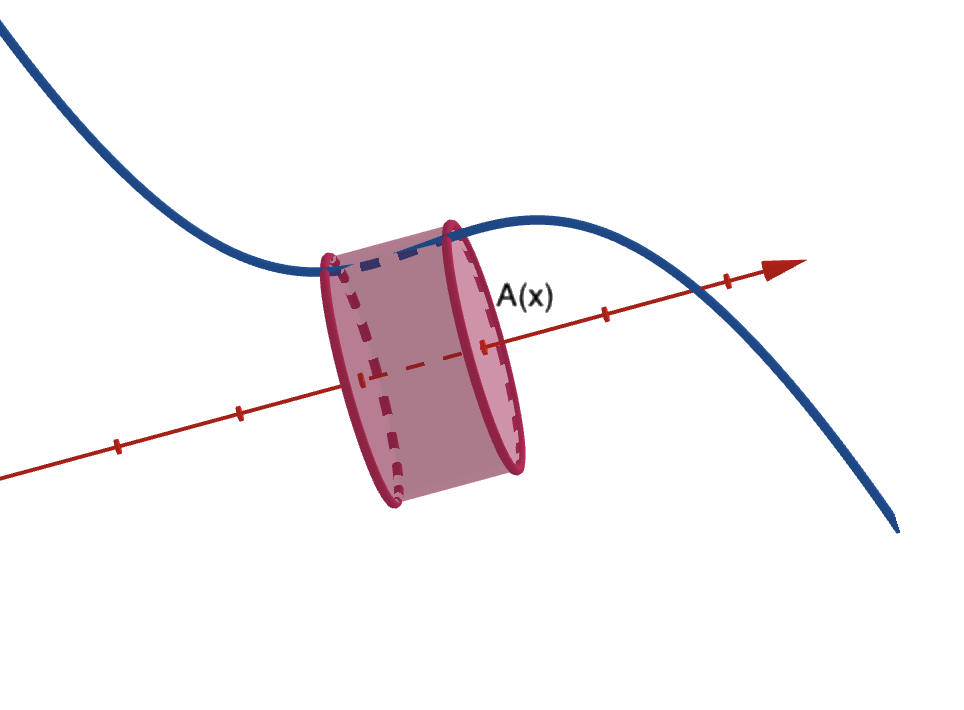
The volume of a solid between and having cross-sectional area is rotated about the x-axis is
The cross-section of the solid generated in the plane perpendicular to the x-axis.
Volumes of Solids by Washers
If your cross-sectional area is a disk, then the area of that disk will be . For a functionthe cross-sectional area is.
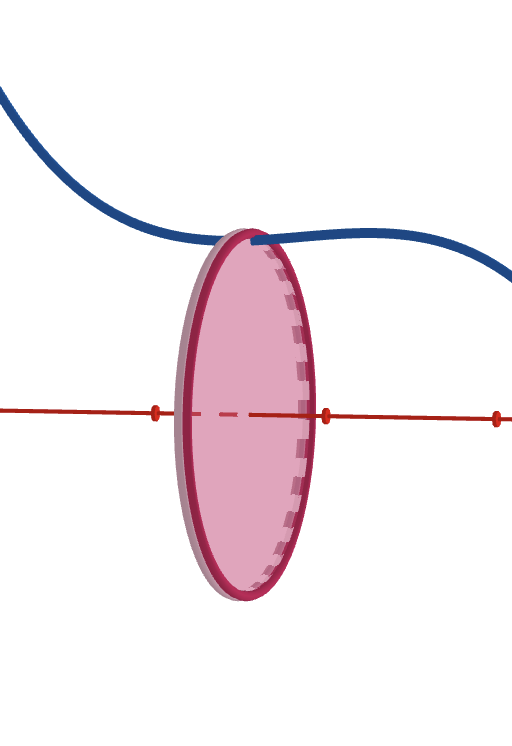
For a function , the volume of the solid of revolution obtained by revolving the region betweenand the x-axis between and about the x-axis is given by
This formula is useful for revolving about lines parallel to the x-axis.
Volumes Between Curves by Washers
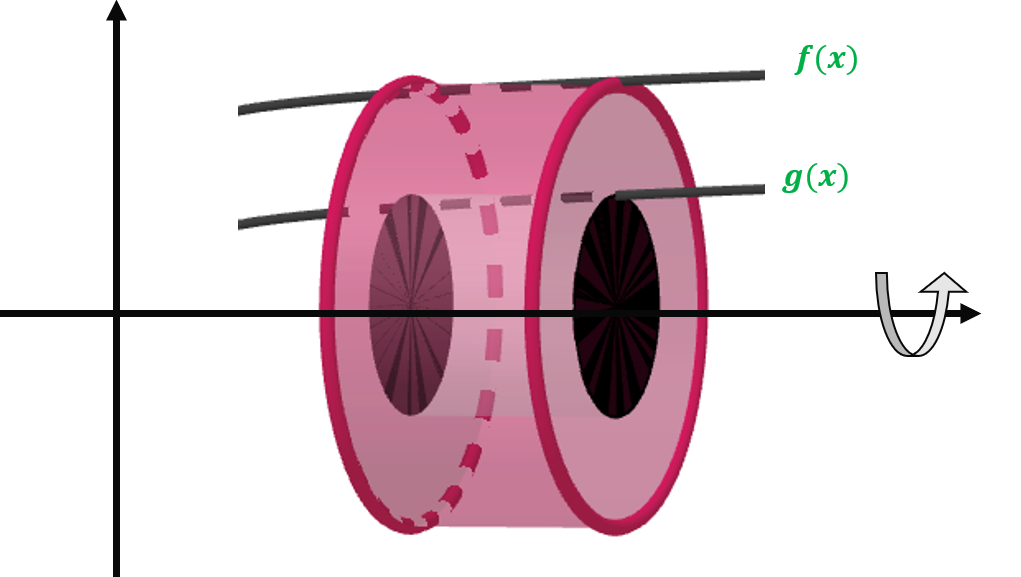
If then the volume of the solid of revolution obtained by revolving the region between and between and about the x-axis is given by
More generally, think of the formula as
Watch Out!
It may be necessary to compute the points of intersection in order to obtain and .
Volumes about the Y-Axis using by Washers
If we'd like to use the Washer method about the y-axis, we need to write our equation as a function of .
These formulas is useful for revolving about lines parallel to the y-axis.
Wize Concept
For the method of Washer the variables in the integral should be same of the axis of rotation. (revolving about the x-axis , revolving about the y-axis )
Watch Out!
Be careful to consider the inner and outer radii; this depends on the axis of rotation.
0:00 / 0:00
Example: Volumes of Revolution
Find the volume of the solid obtained by revolving the region between and around the -axis.
We begin by finding the intersection points of the curves. Setting , we get , and so the intersection points are and .
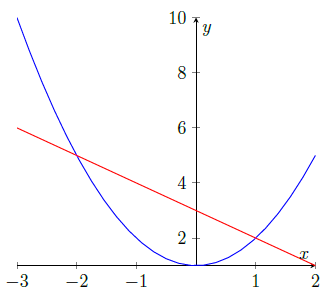
We have that on , , so the volume of the solid is given by
0:00 / 0:00
Example: Volumes of Revolution
Find the volume of a solid ball with radius .
The ball can be generated by rotating a half-disk. Since the radius is , we can use the half-disk whose area is generated by where , and revolve it around the x-axis.
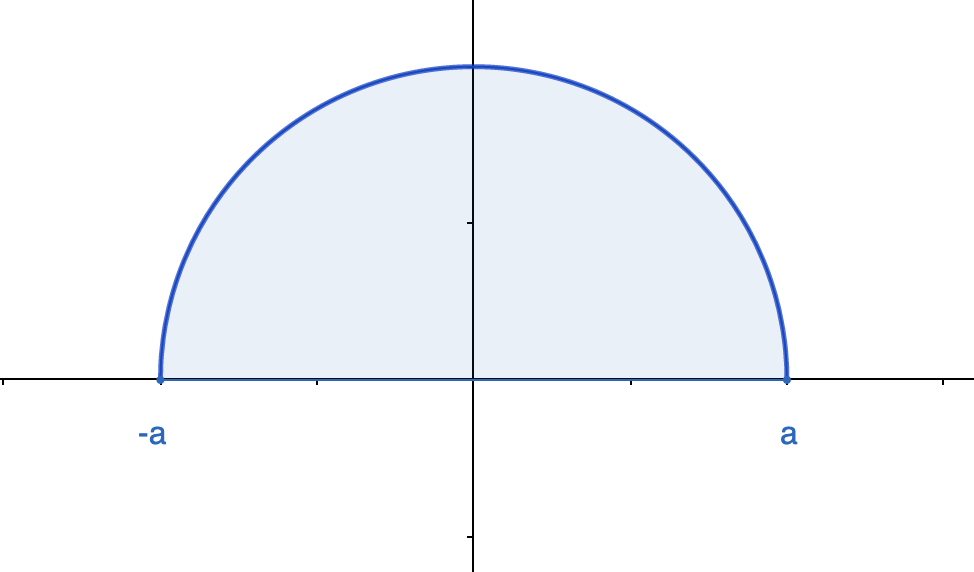
Note that visually, you could use a vertical half-disk instead, but that would no longer be a function of . A computation in this case can still be done, but it's easier, and more natural to do it in the way suggested initially. The volume then becomes
Practice: Volumes of Revolution
The volume of the solid that is produced by revolving the region bounded between and about the x-axis.
Practice: Volumes of Revolution
Write an integral representing the volume of the solid that is produced by revolving the region bounded between and about the line . Do not compute the integral.