Popular Courses
CALCULUS 1000A/B
Western University
Calculus 1
University Study Guides
AP Calculus (AB) Exam Prep Course
AP Exam Prep
MATH 209
Concordia University
MATH 100A
University of British Columbia
MATH 100C
University of British Columbia
MATH 1LS3
McMaster University
MATH 249
University of Calgary
MATH 265
University of Calgary
Calculus 1
General Course
MATH 275
University of Calgary
MATH 140
McGill University
MATH 121
Queen's University
MAT135H1
University of Toronto
MATH*1080
University of Guelph
MATH 134
University of Alberta
MATH 154
University of Alberta
Calculus 1
University Study Guides
MAT 1320
University of Ottawa
MATH 100
University of Alberta

0:00 / 0:00
Curve Sketching
Combining our knowledge of the first and second derivatives lets us sketch the graph of functions by hand. We will put together the techniques of finding asymptotes, intervals of increase/decrease, extrema, intervals of concavity, and inflection points.
Procedure for completely Sketching a Curve
- Find the domain of .
- Find the -intercepts and (if possible) the-intercepts.
- Find all the vertical, horizontal and slant asymptotes. The line is a slant asymptote of the graph of if either (You might have to do long division)
- Compute . Use it to find all the critical points and singular points of . Use this information to find the intervals of increase and decrease and extrema.
- Compute. Find the points for which or does not exist. Use this information to find the intervals of concavity and inflection points.
- Plot all relevant points, asymptotes, and use the information gathered to plot the graph of .
Wize Tip
It is not always necessary, but it may be helpful to check if has even or odd symmetry.
0:00 / 0:00
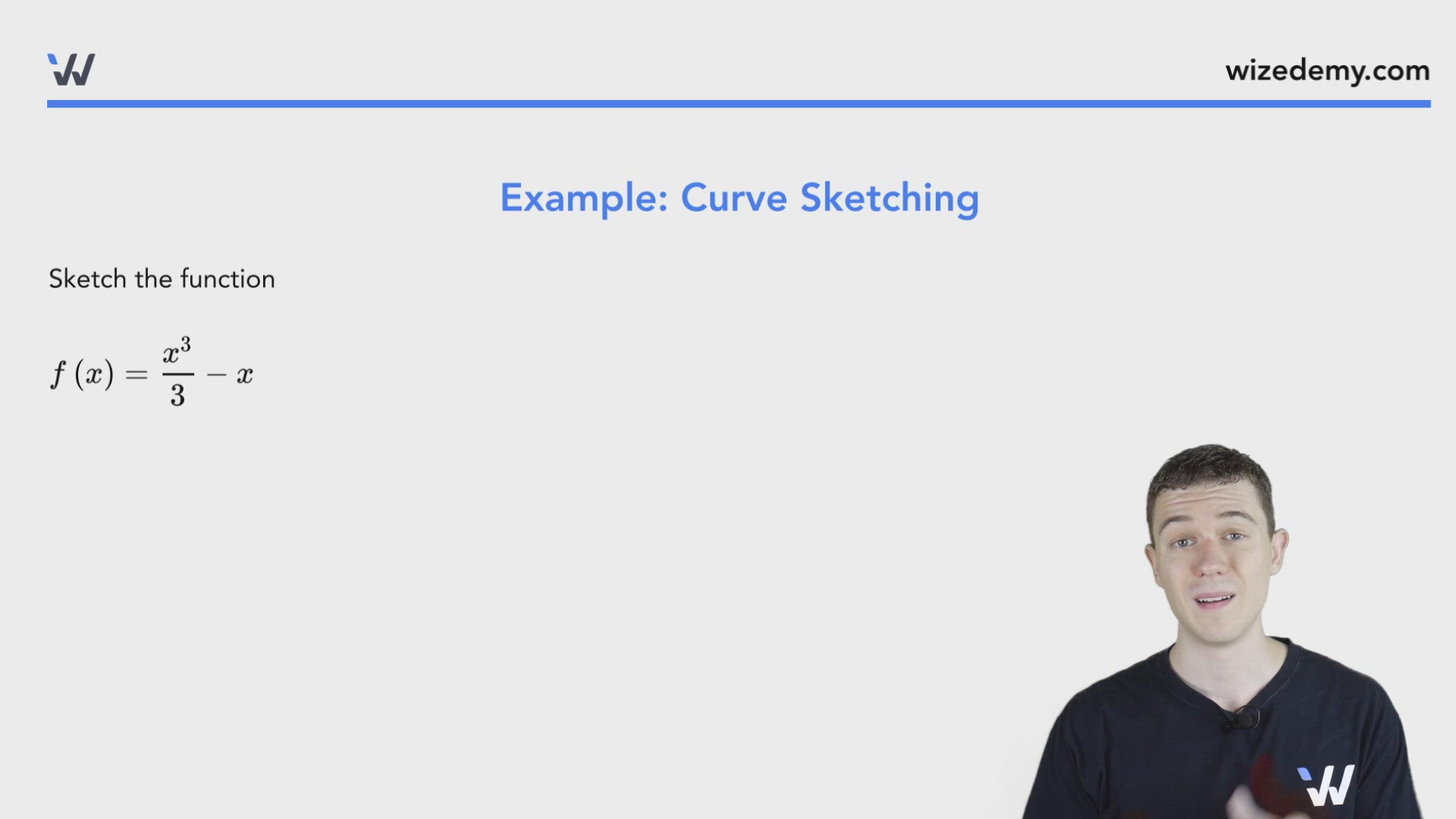
Example: Curve Sketching
Sketch the function
1) Find the Domain
is a polynomial so the domain is
2) Find the intercepts
x intercept:
y intercept:
3) Find the Asymptotes
is a polynomial and has no asymptotes.
4) Critical points and intervals of Increasing/decreasing
5) Inflection points and intervals of Concavity
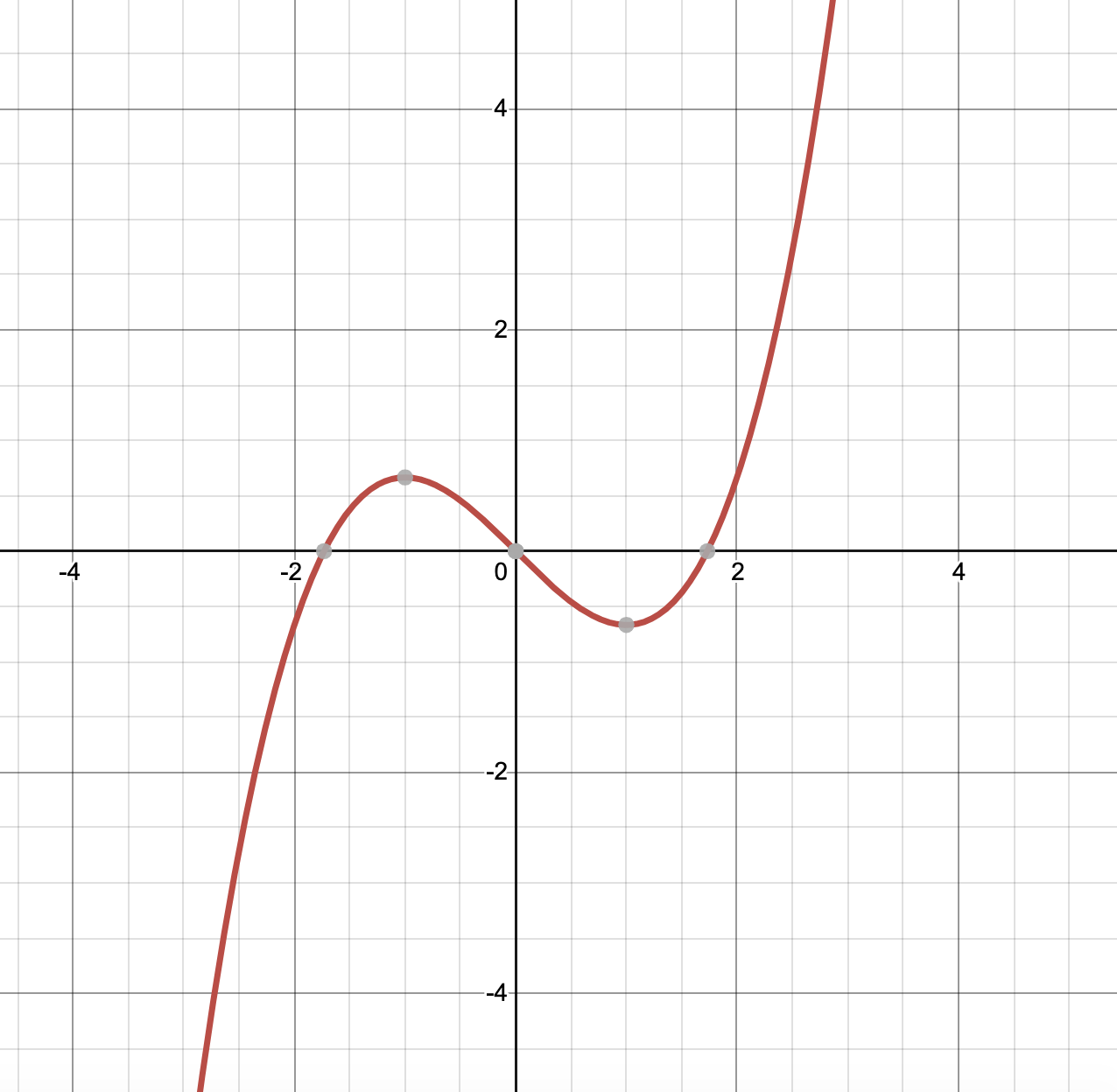
6) Plot points, asymptotes, and Graph

Mark Yourself Question
- Grab a piece of paper and try this problem yourself.
- When you're done, check the "I have answered this question" box below.
- View the solution and report whether you got it right or wrong.
Sketch of the graph of . The first and the second derivatives are
Practice: Curve Sketching From Derivatives
The first derivative is depicted below

Mark Yourself Question
- Grab a piece of paper and try this problem yourself.
- When you're done, check the "I have answered this question" box below.
- View the solution and report whether you got it right or wrong.
List the critical points of and classify them as a max, min, or neither.