Wize University Calculus 1 Textbook > Pre-Calculus (Review)
Exponential Functions
Popular Courses
CALCULUS 1000A/B
Western University
Calculus 1
University Study Guides
AP Calculus (AB) Exam Prep Course
AP Exam Prep
MATH 100A
University of British Columbia
MATH 100C
University of British Columbia
MATH 1LS3
McMaster University
MATH 249
University of Calgary
MATH 265
University of Calgary
Calculus 1
General Course
MATH 275
University of Calgary
MATH 140
McGill University
MATH 121
Queen's University
MAT135H1
University of Toronto
MATH*1080
University of Guelph
MATH 134
University of Alberta
MATH 154
University of Alberta
Calculus 1
University Study Guides
MAT 1320
University of Ottawa
MATH 100
University of Alberta
MATH 100B
University of British Columbia
0:00 / 0:00
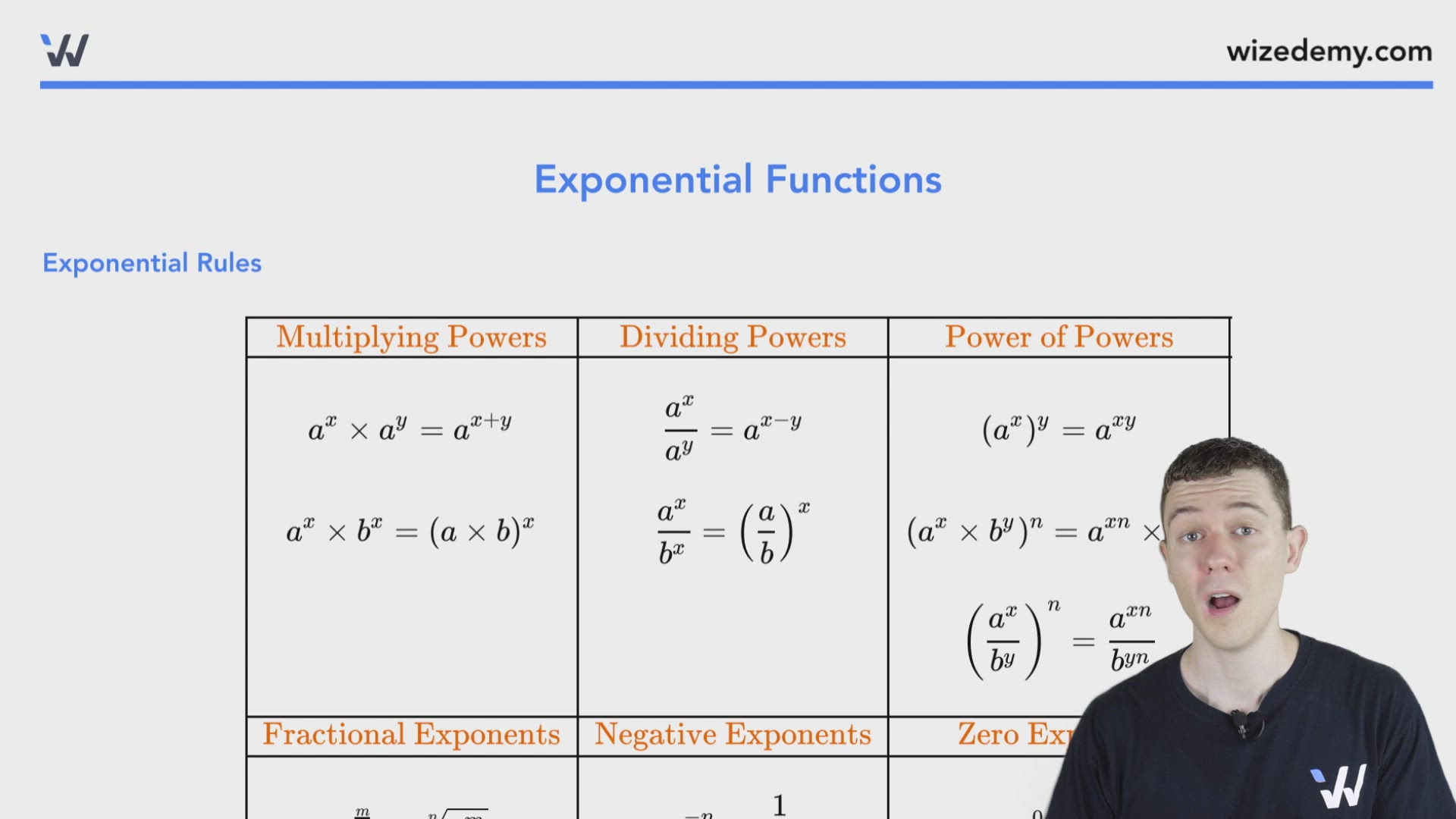
Exponential Functions
Exponential Rules
Exponential Functions and Graphs
Exponential Functions have the form: .

has a horizontal asymptote at
y=0
.The most common exponential function is , where is Euler's number.
Euler's Number
The exponential number (Euler's number) is
Example: Which is larger: , ,or ?

0:00 / 0:00
Example: Solving Exponential Equations
Solve for in
0:00 / 0:00
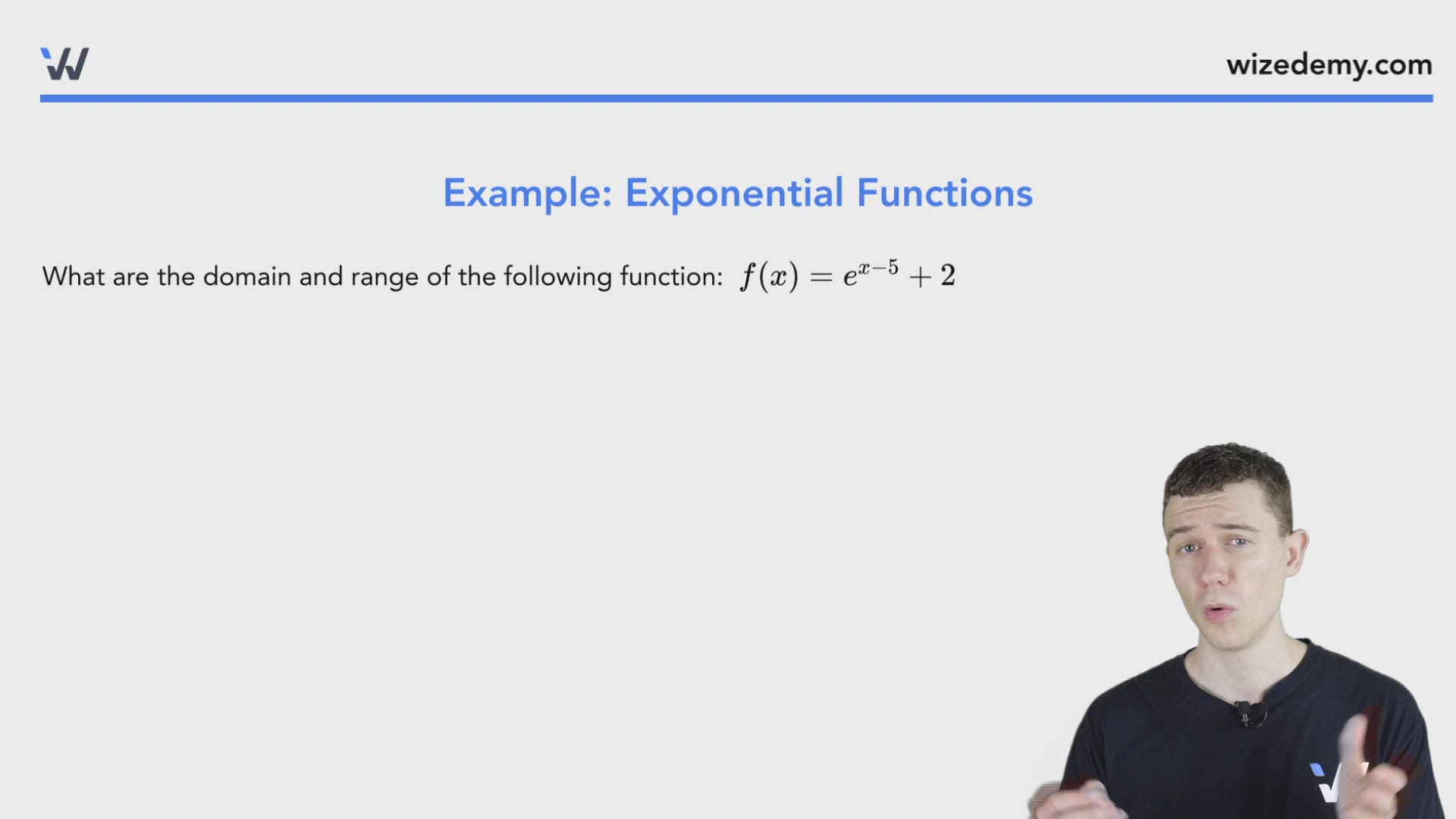
Example: Exponential Functions
What are the domain and range of the following function:
has a domain of all real numbers, so has a domain of all real numbers,
The standard graph of has a range of, and is shifted two units up, so the range is .