Wize University Calculus 1 Textbook > Limits
Limits at Infinity
Popular Courses
CALCULUS 1000A/B
Western University
Calculus 1
University Study Guides
AP Calculus (AB) Exam Prep Course
AP Exam Prep
MATH 209
Concordia University
MATH 100A
University of British Columbia
MATH 100C
University of British Columbia
MATH 1LS3
McMaster University
MATH 249
University of Calgary
MATH 265
University of Calgary
MATH 275
University of Calgary
Calculus 1
General Course
MATH 140
McGill University
MATH 121
Queen's University
MAT135H1
University of Toronto
MATH*1080
University of Guelph
MATH 134
University of Alberta
Calculus 1
University Study Guides
MATH 154
University of Alberta
MAT 1320
University of Ottawa
MATH 100
University of Alberta
0:00 / 0:00
Limits at Infinity
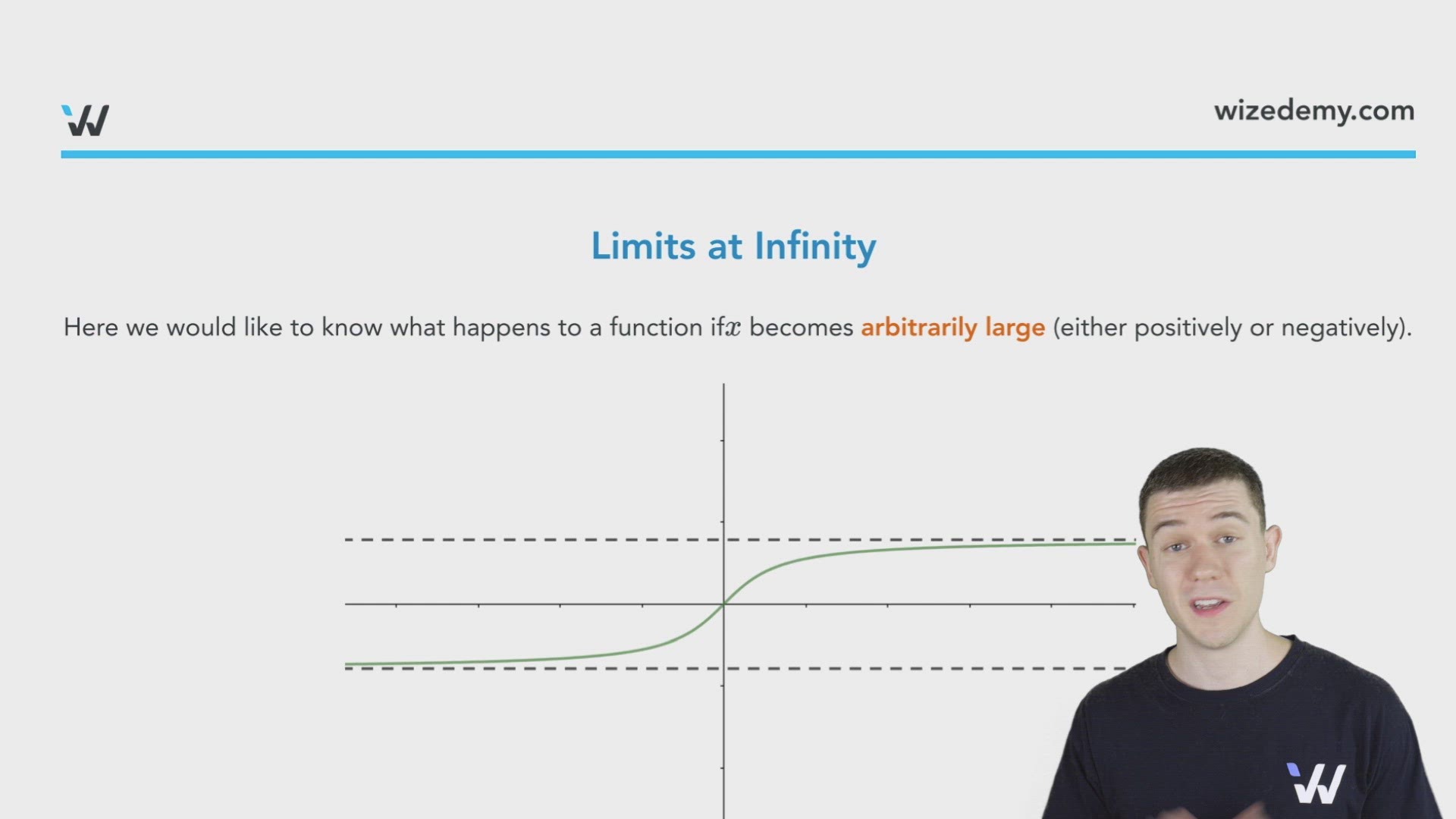
Here we would like to know what happens to a function if becomes arbitrarily large (either positively or negatively).
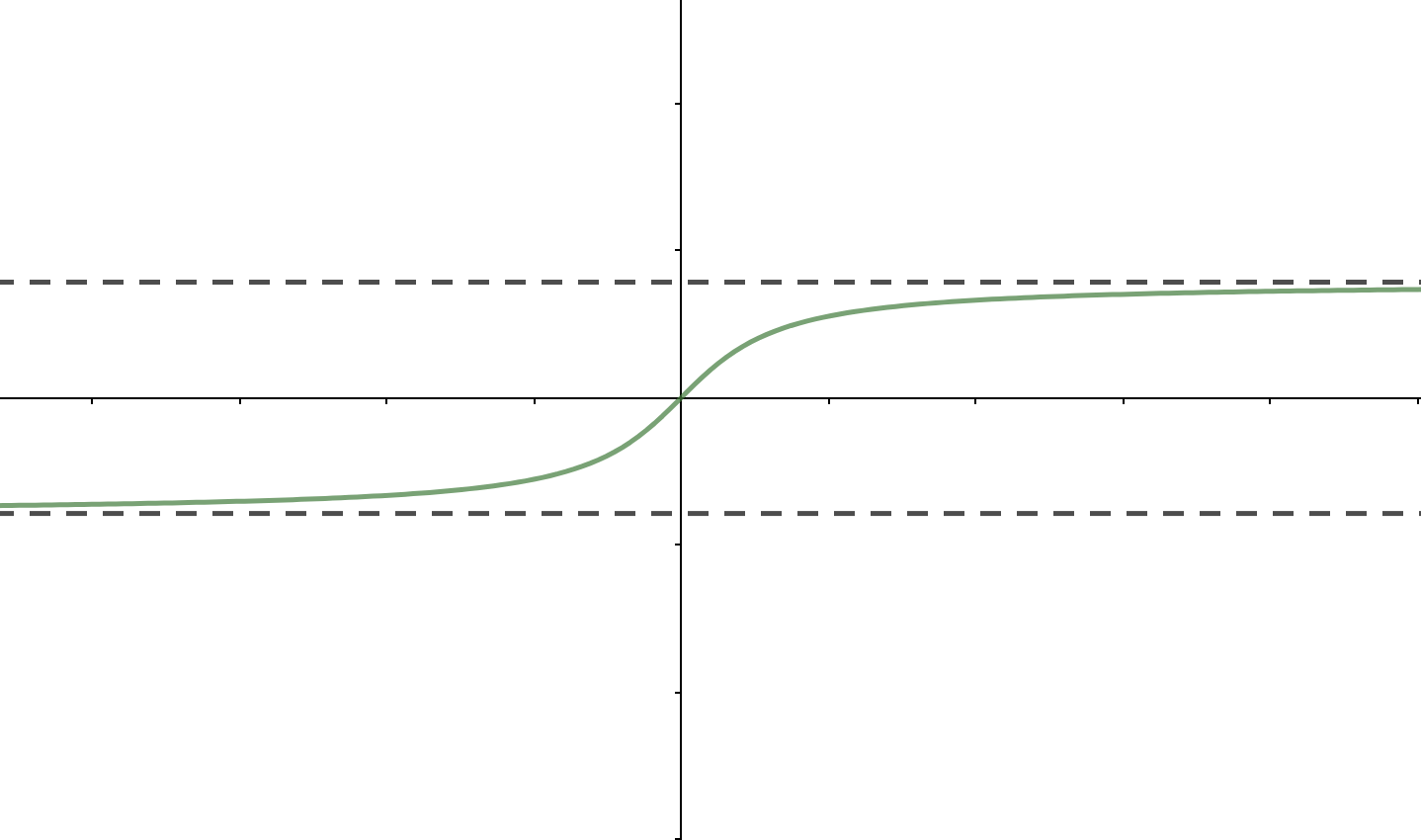
Limits at (Positive) Infinity
If a function approaches as grows arbitrarily large, then
Limits at (Negative) Infinity
If a function approaches as grows arbitrarily small, then
Wize Tip
, for any
Since 1 divided by something "very large" is very close to 0.
Wize Tip
If you are dealing with powers of in a limit, it might help to factor out the largest power of in the numerator and denominator (if it’s a fraction)
Horizontal Asymptotes
A function has a horizontal asymptote with equation if at least one of these statements is true:
0:00 / 0:00
Example: Limits at Infinity
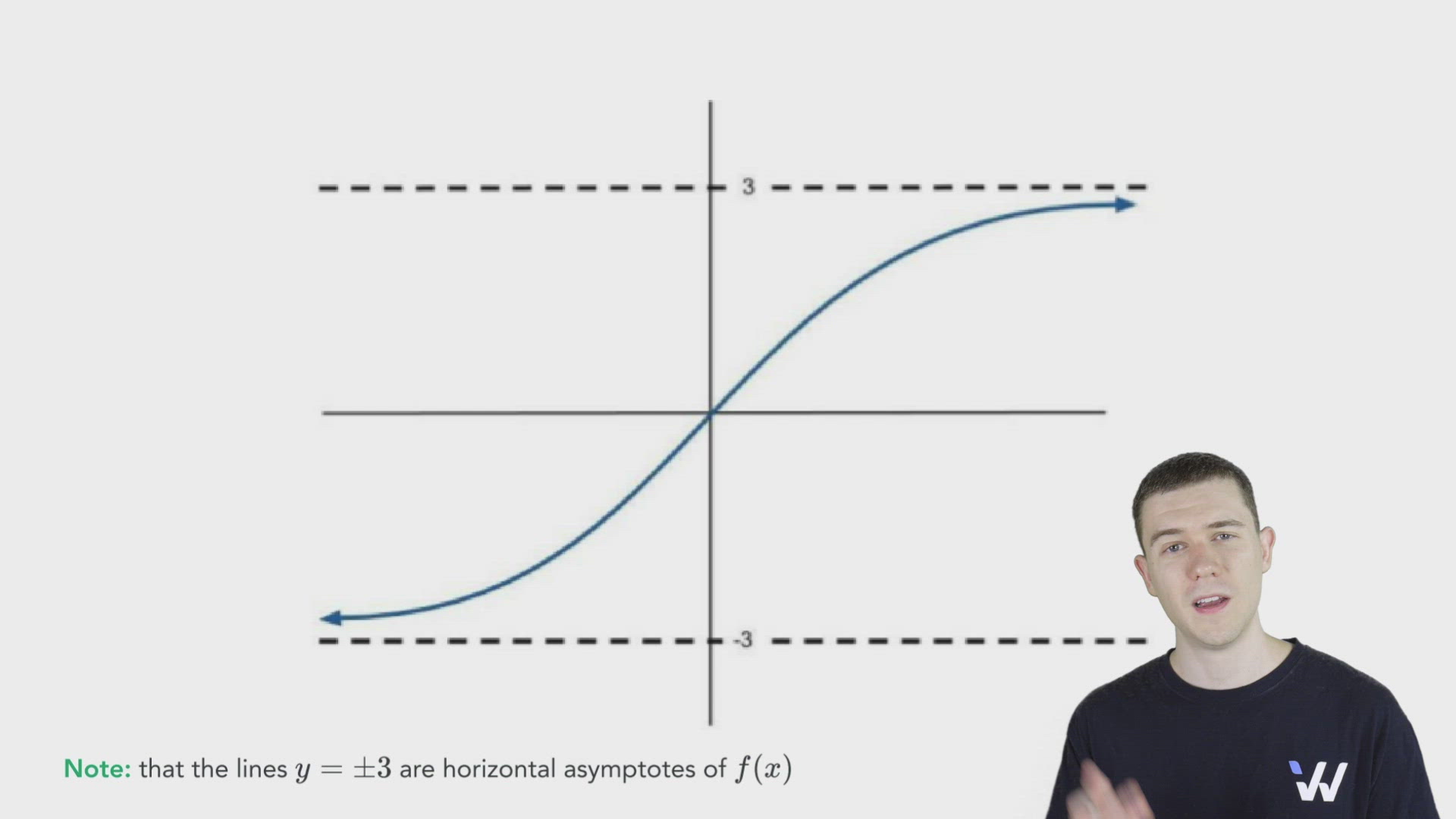
For the following graph, find:
i)
ii)
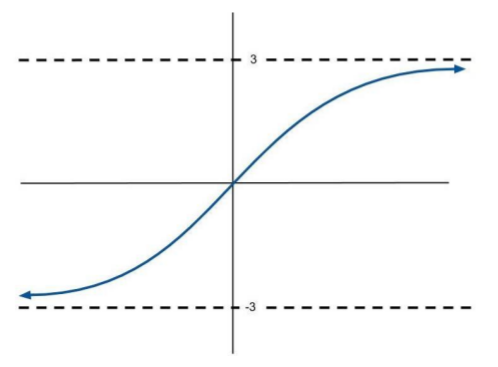
Note: that the lines are horizontal asymptotes of
i)
ii)
0:00 / 0:00
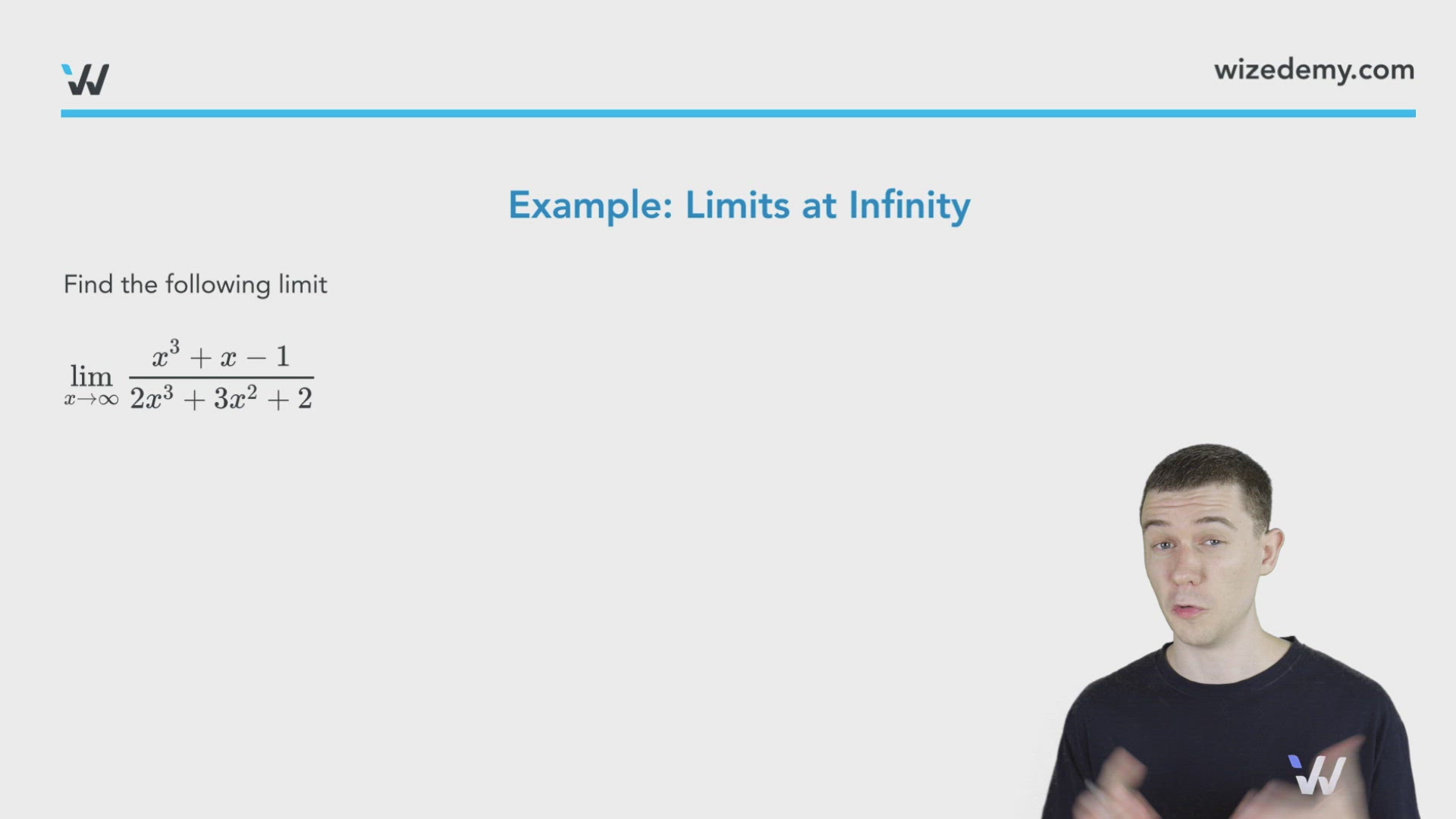
Example: Limits at Infinity
Find the following limit
0:00 / 0:00
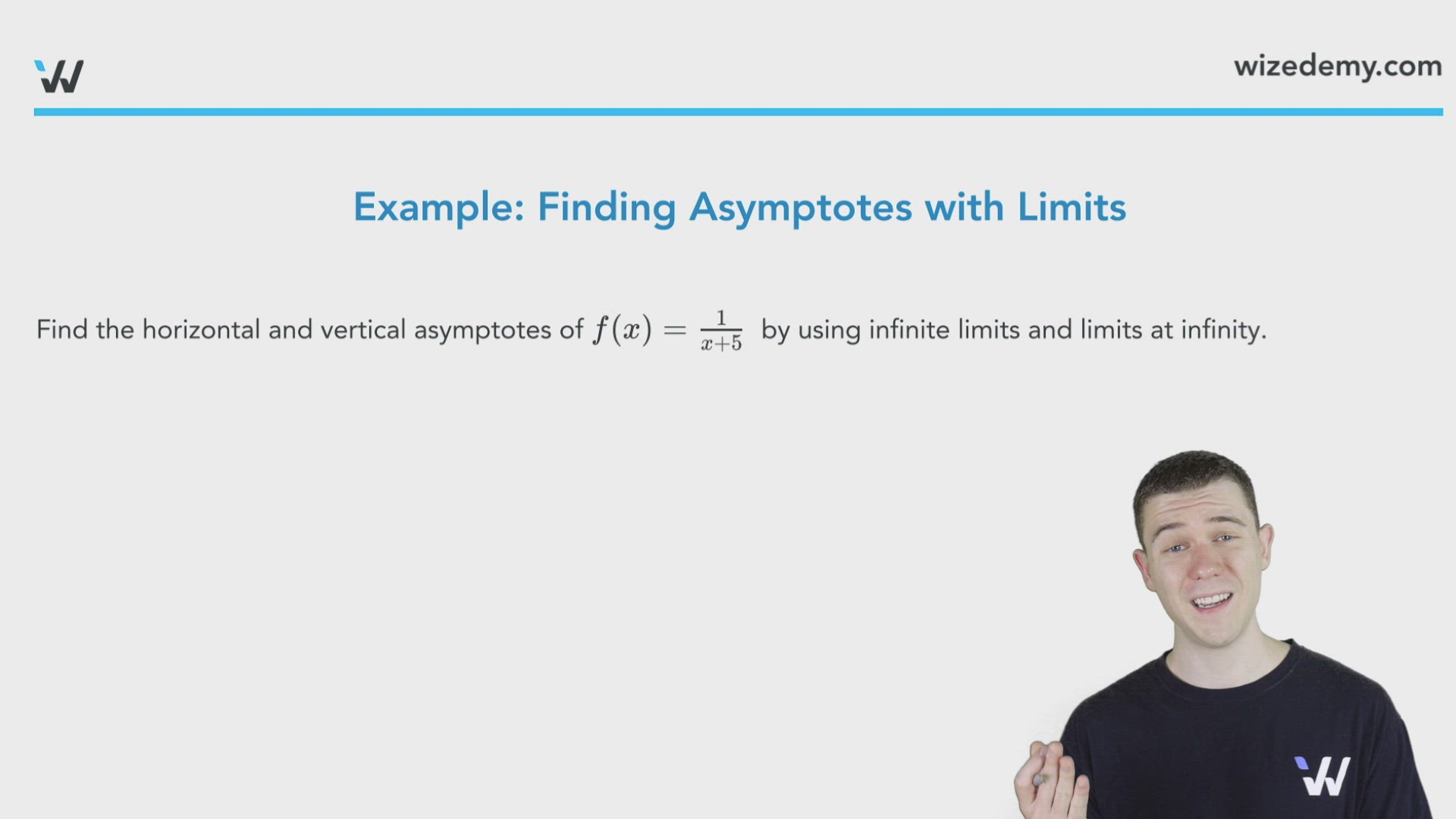
Example: Finding Asymptotes with Limits
Find the horizontal and vertical asymptotes of by using infinite limits and limits at infinity.
Vertical Asymptote(s)
- (here denotes approaching 0 from positive values of x)
- (here denotes approaching 0 from negative values of x)
Therefore, there is a vertical asymptote at .
Note: this is the value for which makes the denominator 0.
Horizontal Asymptote(s)
Therefore, there is a horizontal asymptote at .
Note: we also know this since the degree of the polynomial in the denominator is larger than the degree of the polynomial in the numerator.
Evaluate
*Be careful with the negative sign in ! Check out the hint for more info.
Extra Practice
Limits at infinity: Indeterminate forms
Which of the following statements is true about the function?
Limits at infinity: Indeterminate forms
Which of the following statements is true about the function?
Limits at infinity: Indeterminate forms
Which of the following statements is true about the function?
Limits at infinity: Indeterminate forms
Which of the following statements is true about the function?