Wize University Calculus 1 Textbook > Applications of Differentiation
Maximum and Minimum on Closed Intervals
Popular Courses
CALCULUS 1000A/B
Western University
Calculus 1
University Study Guides
AP Calculus (AB) Exam Prep Course
AP Exam Prep
MATH 209
Concordia University
MATH 100A
University of British Columbia
MATH 100C
University of British Columbia
MATH 1LS3
McMaster University
MATH 249
University of Calgary
MATH 265
University of Calgary
Calculus 1
General Course
MATH 275
University of Calgary
MATH 140
McGill University
MAT135H1
University of Toronto
MATH*1080
University of Guelph
MATH 134
University of Alberta
MATH 154
University of Alberta
Calculus 1
University Study Guides
MAT 1320
University of Ottawa
MATH 100
University of Alberta
MATH 100B
University of British Columbia

0:00 / 0:00
Maximum and Minimum on Closed Intervals
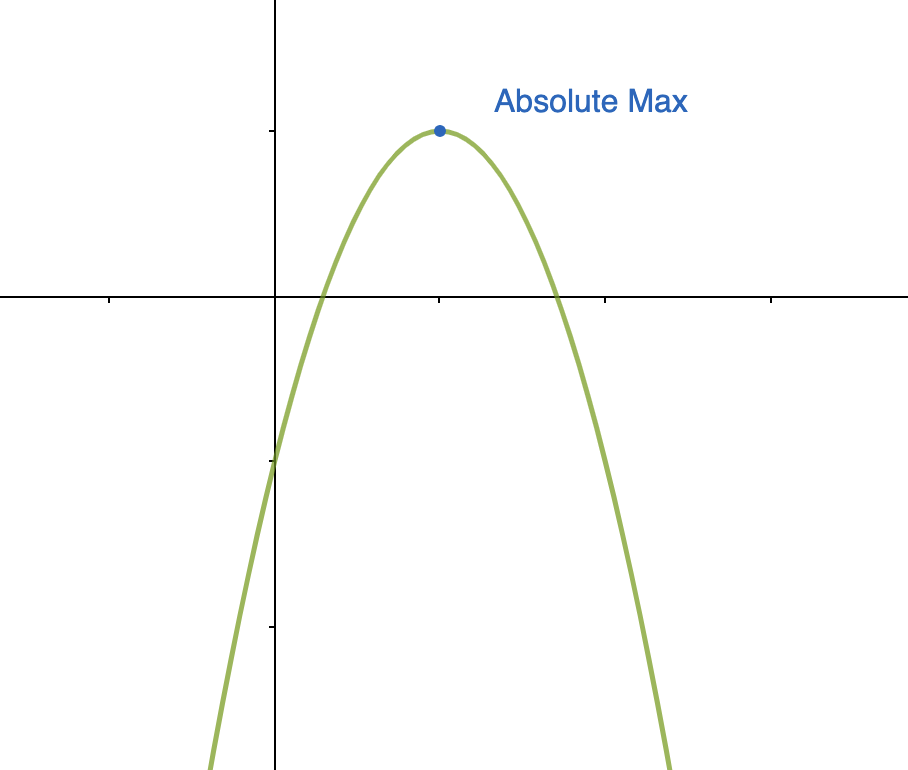
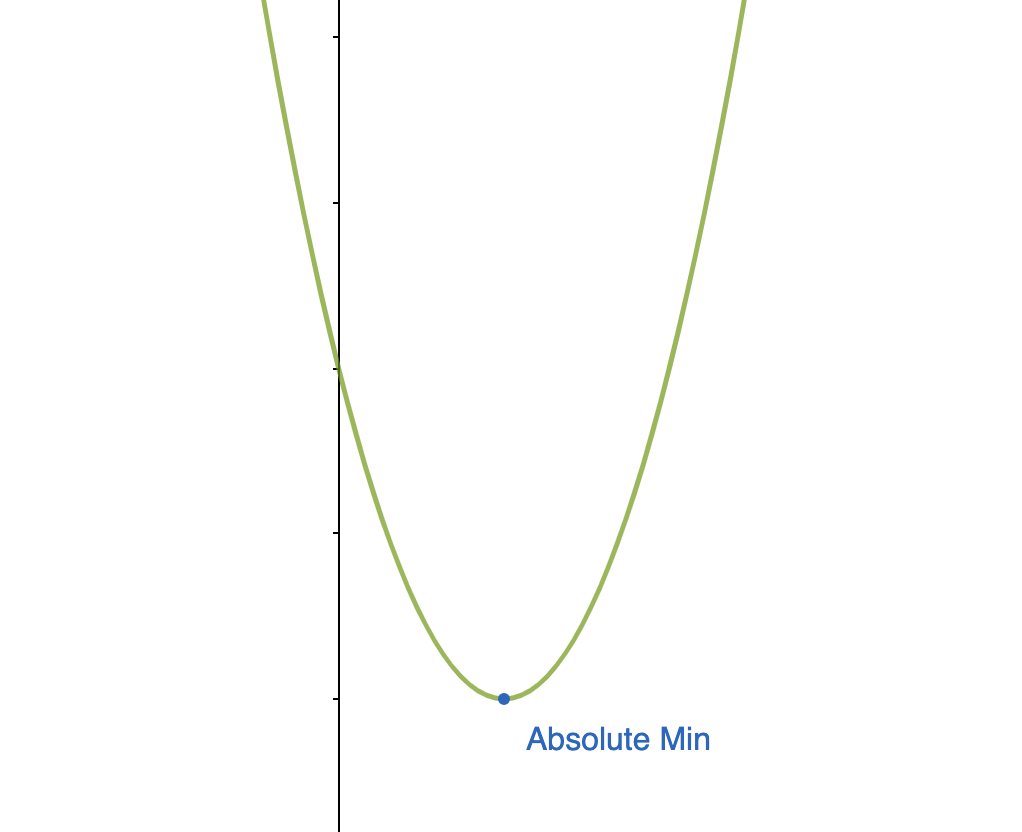
A continuous function on a closed interval will always have a largest and smallest value. The values are called Absolute Extrema or Global Extrema.
Absolute Extrema
A function has an absolute maximum at a point in its domain if for every in the domain.
A function has an absolute minimum at a point in its domain if for every in the domain.
Note: This definition can also be applied to a function on an interval. The absolute extrema are the biggest and smallest value achieved by the function on that interval.
Maximum and Minimum on Closed Intervals
For a continuous function on a closed interval there exists an absolute minimum and an absolute maximum.
Watch Out!
This is not necessarily true on an open interval!
Procedure to find the Absolute Extrema of a function on a Closed Interval [a,b]
- Find all critical points and singular points of in the open interval
- Compute at the critical points and singular points and at the endpoints and
- The largest and smallest values found are the absolute maximum and minimum respectively

0:00 / 0:00
Example: Finding Absolute Extrema
Find the absolute extrema (max/min) of on the interval .
1. Find all critical points of the function
The first derivative is .
2. Compute the value of the critical points
*If an interval is given, compute the values at these end points
"Sub" in the right end-point:
3. The largest and smallest values that we find are the absolute max and min, respectively
Observe that .
Therefore, the absolute max point is and there is no absolute min point, but instead, as , there is a horizontal asymptote at (all values are above this line)
Find the absolute minimum of on the interval .
Find the absolute maximum and minimum of value of on the interval