Wize University Calculus 1 Textbook > Integrals
Approximating Areas & Riemann Sums
Popular Courses
CALCULUS 1000A/B
Western University
Calculus 1
University Study Guides
AP Calculus (AB) Exam Prep Course
AP Exam Prep
MATH 209
Concordia University
MATH 1LS3
McMaster University
MATH 249
University of Calgary
MATH 265
University of Calgary
Calculus 1
General Course
MATH 275
University of Calgary
MATH 140
McGill University
MATH 121
Queen's University
MATH*1080
University of Guelph
MATH 134
University of Alberta
Calculus 1
University Study Guides
MAT 1320
University of Ottawa
MATH 100
University of Alberta
MAT 1330
University of Ottawa
MTH 140
Toronto Metropolitan University
SC/MATH 1013 3.00
York University
MAT186H1
University of Toronto
0:00 / 0:00
Approximating Areas & Riemann Sums
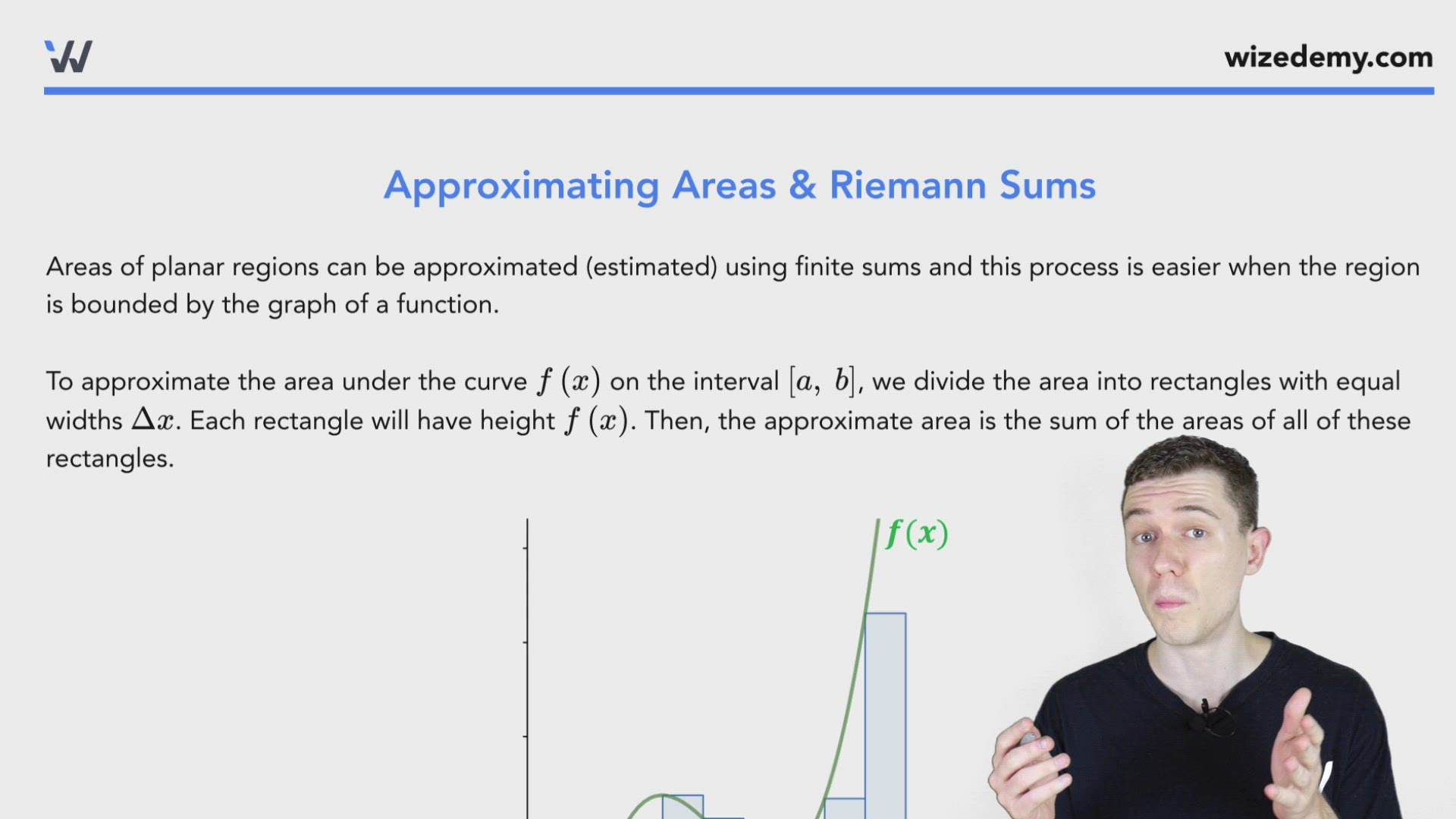
Areas of planar regions can be approximated (estimated) using finite sums and this process is easier when the region is bounded by the graph of a function.
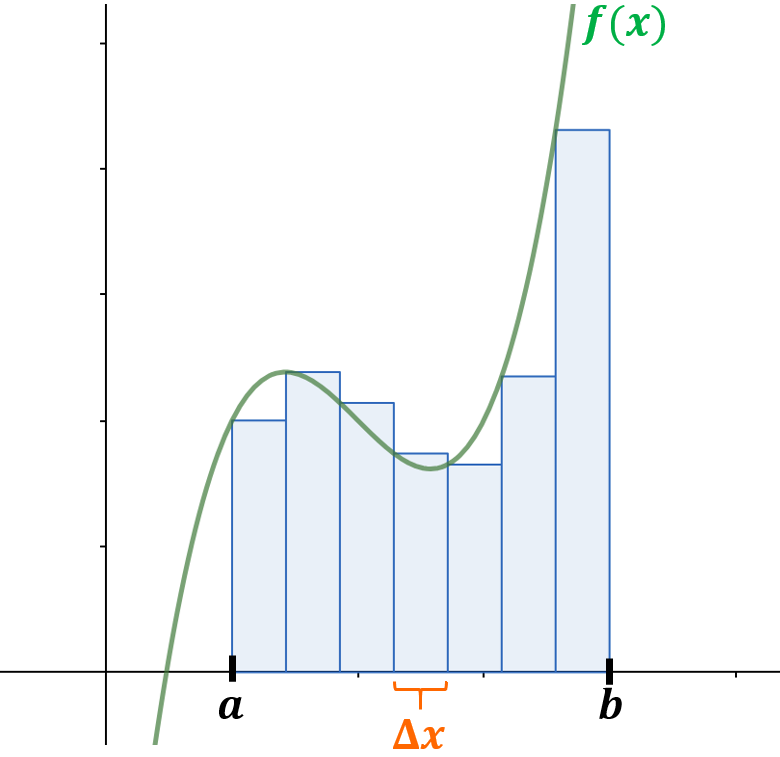
To approximate the area under the curve on the interval , we divide the area into rectangles with equal widths . Each rectangle will have height . Then, the approximate area is the sum of the areas of all of these rectangles.
Wize Tip
Depending on how we draw these rectangles, we will get slightly different area approximations.
Common Approximation Rules/Methods
- Right Endpoint Rule: The area is estimated using rectangles whose right endpoint touches the graph of the function.
- Left Endpoint Rule: The area is estimated using rectangles whose left endpoint touches the graph of the function.
- Midpoint Rule: The area is estimated using rectangles whose midpoint touches the graph of the function.
- Lower Sum: The area is estimated using rectangles lying inside the region, with one point touching the graph.
The sum of the areas of these rectangles is called a Riemann Sum.
Riemann Sum
Let be a function and a set of points in its domain. We can estimate the area under the graph of on the interval using the Riemann Sum
Where is a constant of the form
- is a right hand rule
- is a left hand rule
- is a midpoint rule
0:00 / 0:00
Example: Riemann Sums
Estimate the area under the curve and over of the function using 4 rectangles.
First divide into 4 equal sub-intervals:
So, the sub-intervals are
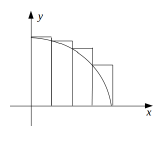
If we like to use the left endpoint method, we should take , , ,
Consider the table

Now the approximate area is
*If you use another rule/method such as the midpoint rule or right endpoint rule to approximate the area, you'll get a slightly different approximation
Use the left-endpoint Riemann sum, with , to estimate the area under the curve on the interval .
Extra Practice
Approximating Rectangles: Riemann Sums
Approximate the area under the curve of the function from to .
Approximating Rectangles: Riemann Sums
Approximate the area under the curve of the function from to .
Approximating Rectangles: Riemann Sums
Approximate the area under the curve of the function from to .