Popular Courses
Calculus 2
University Study Guides
AP Calculus (BC) Exam Prep Course
AP Exam Prep
MATH 101
University of British Columbia
Calculus 2
General Course
CALCULUS 1301A/B
Western University
Calculus 2
University Study Guides
MATH 205
Concordia University
MAT 1322
University of Ottawa
MATH 267
University of Calgary
MATH 101
University of Alberta
MATH 101A
University of British Columbia
SC/MATH 1014 3.00
York University
MATH 105
University of British Columbia
MATH 101
University of Victoria
MATH 103
University of British Columbia
MATH 101B
University of British Columbia
MTH 240
Toronto Metropolitan University
MTH 240
Toronto Metropolitan University
MATH 101C
University of British Columbia
MATH-1730
University of Windsor
0:00 / 0:00
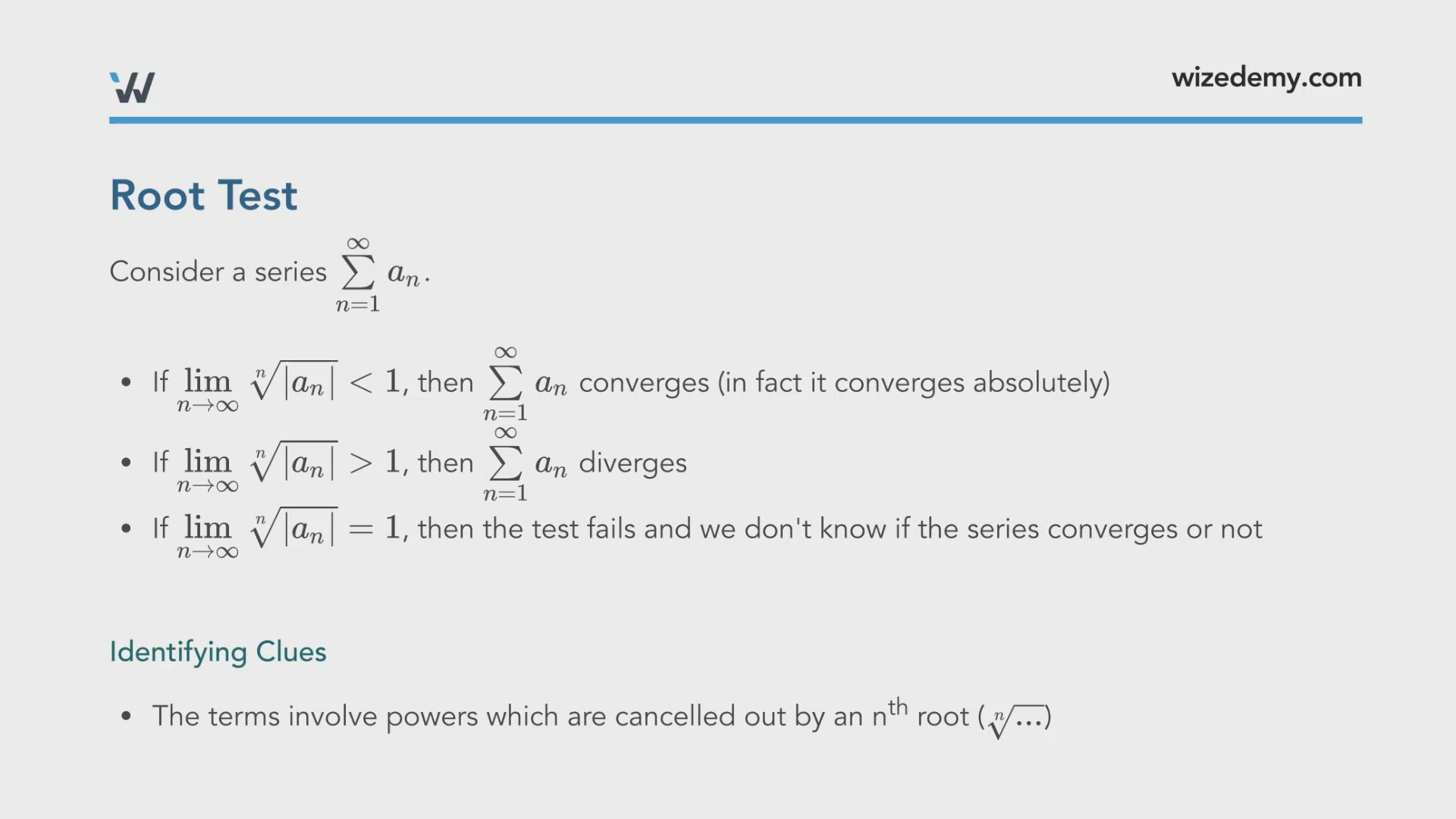
Root Test
Consider a series .
- If , then converges (in fact it converges absolutely)
- If , then diverges
- If , then the test fails and we don't know if the series converges or not
Identifying Clues
- The terms involve powers which are cancelled out by an nth root ()
Practice Question
Determine whether converges or diverges.
Practice Question
Detemine whether the series converges absolutely, converges conditionally, or diverges.