Wize High School Grade 12 Pre-Calculus Textbook > Rates of Change
Average Rate of Change & the Secant Line
Popular Courses
Grade 12 Advanced Functions
Ontario High School
Grade 12 Pre-Calculus/Functions
Canada High School
AP Calculus (AB) Exam Prep Course
AP Exam Prep
AP Calculus (BC) Exam Prep Course
AP Exam Prep
MAT133Y1
University of Toronto
ADM 1305
University of Ottawa
MATH 144
University of Alberta
MATH 1215
Dalhousie University
MATH 1025
Virginia Tech
MATH 22
Pennsylvania State University
MAC 1140
University of Florida
MATH 41
Pennsylvania State University
MAC 1105
Florida State University
MAT 012
University of California - Davis
MTH 103A
Michigan State University
MTH 116
Michigan State University
MAC 1147
University of Florida
MATH 140
San Diego State University
MAC 1140C
University of Central Florida
MA 15800
Purdue University
0:00 / 0:00
Average Rate of Change & the Secant Line
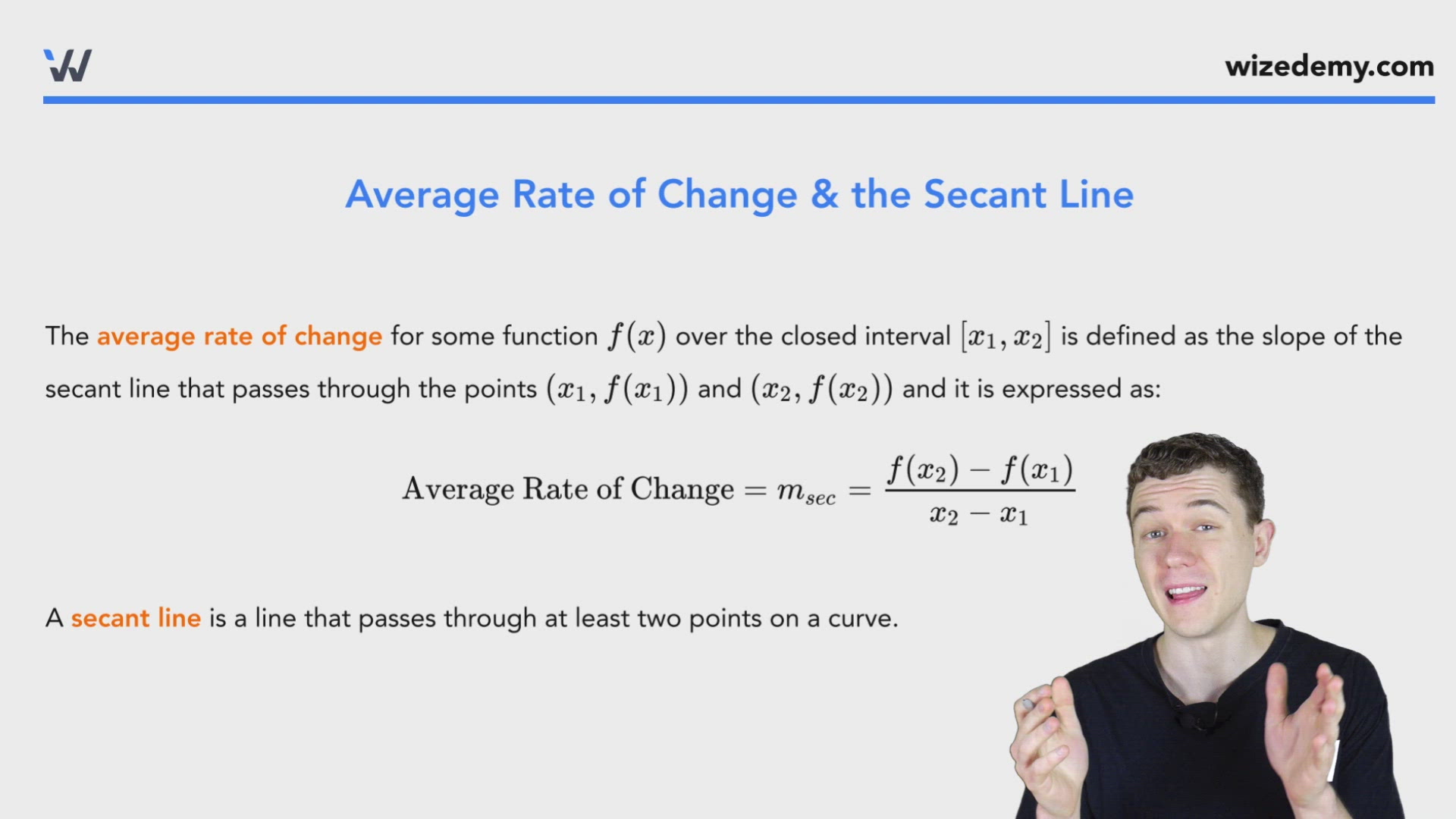
The average rate of change for some function over the closed interval is defined as the slope of the secant line that passes through the points and and it is expressed as:
A secant line is a line that passes through at least two points on a curve.
Example
Let represent the height, in meters, of a cannon when ( is in seconds).
The average rate of change over each of the following intervals is:
Example: Average Rate of Change & the Secant Line
The volume of an air balloon is given by . Compute the average rate of change of the air balloon between and the following values of .
Practice: Average Rate of Change & the Secant Line
Determine the average rate of the change of the function over the interval .
Practice: Average Rate of Change & the Secant Line
The population, , of a certain species over time (in years) is given by the table of values below.
Determine the following average rates of change over the following intervals:
Practice: Average Rate of Change & the Secant Line
Germaine and his family purchased a home in 2000 for . years later, they sold the house for . What is the average annual rate of change of the value of the home?