Wize University Calculus 1 Textbook > Derivatives
Higher Order Derivatives
Popular Courses
CALCULUS 1000A/B
Western University
Calculus 1
University Study Guides
AP Calculus (AB) Exam Prep Course
AP Exam Prep
MATH 100A
University of British Columbia
MATH 100C
University of British Columbia
MATH 1LS3
McMaster University
MATH 249
University of Calgary
MATH 265
University of Calgary
Calculus 1
General Course
MATH 275
University of Calgary
MATH 140
McGill University
MAT135H1
University of Toronto
MATH*1080
University of Guelph
MATH 134
University of Alberta
MATH 154
University of Alberta
Calculus 1
University Study Guides
MAT 1320
University of Ottawa
MATH 100
University of Alberta
MATH 100B
University of British Columbia
MATH 203
Concordia University

0:00 / 0:00
Higher Order Derivatives
To get the second derivative, differentiate the first derivative. Then the third is the derivative of the second and so on.
The second derivative is denoted:
The nth derivative is denoted:

0:00 / 0:00
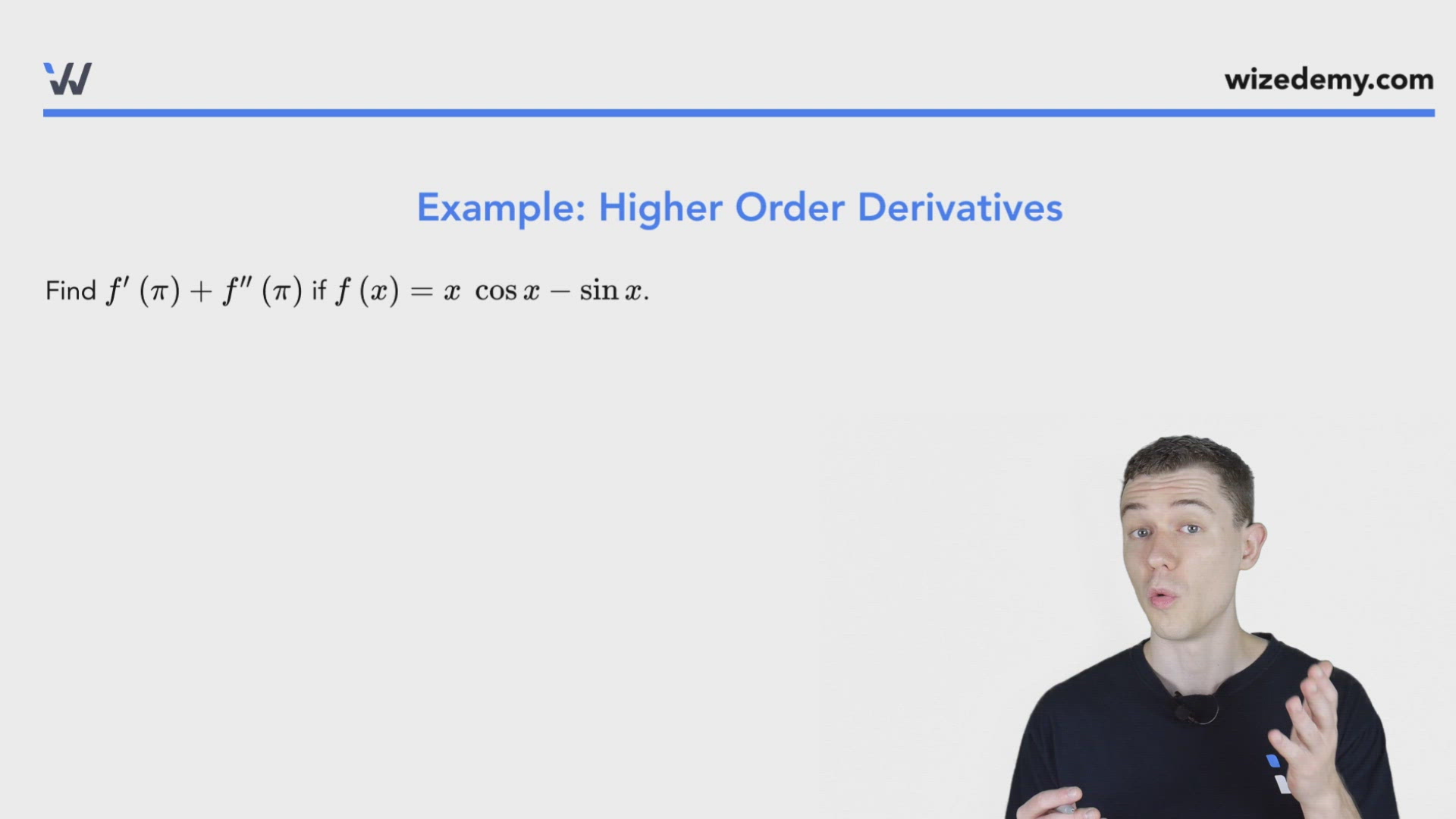
Example: Higher Order Derivatives
Find if .
First Derivative
There's not much we can simplify with this expression, and since we have a product of functions, we need to use product rule.
Second Derivative
Since we have a product of functions, we need the product rule again.
Substituting :
Find the third derivative of .
If find .
(i.e. the 9th derivative)