Popular Courses
MCAT
General Course
Intro to Physics
University Study Guides
PHYSICS 1D03
McMaster University
AP Physics C: Mechanics Exam Prep Course
AP Exam Prep
Physics
General Course
PHYS 115
Queen's University
PCS 211
Toronto Metropolitan University
PHYS 204
Concordia University
Intro to Physics
University Study Guides
PHYS*1300
University of Guelph
PHYS*1080
University of Guelph
PHY 1321
University of Ottawa
PHYS 131
McGill University
APSC 111
Queen's University
PHYS 111
University of Waterloo
PCS 120
Toronto Metropolitan University
PHYS 110
University of Victoria
LE/PHYS 1800 3.00
York University
PHY131H1
University of Toronto
PHY 1331
University of Ottawa
0:00 / 0:00
Tension
When we exert a force by a rope, a chain or a string, there is a tension force. Usually this rope is massless, so we don't have to consider it as another "body" in our free-body diagram.
- Tension force is always parallel to the rope, chain or string and is pointing away from the object ( in other words, you can only pull with a rope/string).
Wize Tip
Tension is the same at any point of a string, chain or rope. However, two ropes, chains or strings attached to an objet might have different tensions.
- The rope/string can be used in conjunction with pulleys which are usually weightless and frictionless in the problems. These pulleys will change the direction of the forces that are applied.

0:00 / 0:00
Example: A Rope Connecting Two Blocks
Two blocks are attached by a rope and are pulled upward by force F. The mass of the lower block is double the mass of the upper block. If the tension along the rope is 5N and the system is moving with an upward acceleration of , find magnitude of force F and the mass of each block.
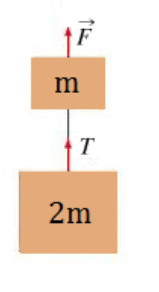
Solution:
Since we have two objects in motion, we can write down the second law of Newton for each of them separately.
From these two equations, we have:
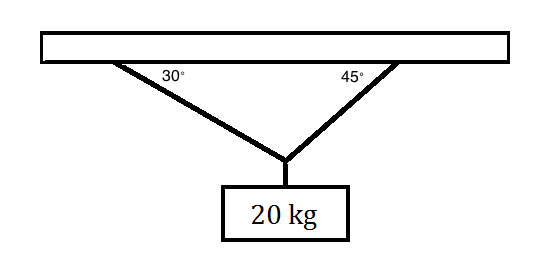
A 20-kg box is hanging from two ropes as shown below. What is the tension in each rope?