Popular Courses
Find My CourseSatellites and Objects in Orbit
- Objects in orbit, including satellites, move around the planet in a circular motion.
- The gravitational force provides the centripetal force in this case.
- This gives an expression for the orbital speed of the object:
- And thus we have expressions for the energy:
Kinetic energy:
Potential energy:
Total energy:
Wize Tip
In all cases of orbiting satellites, the total angular momentum of the satellite is constant!
Wize Concept
Conservation of Mechanical Energy and Conservation of Angular Momentum can be used to determine speeds at different positions in the elliptical orbit
0:00 / 0:00
Orbital Energies
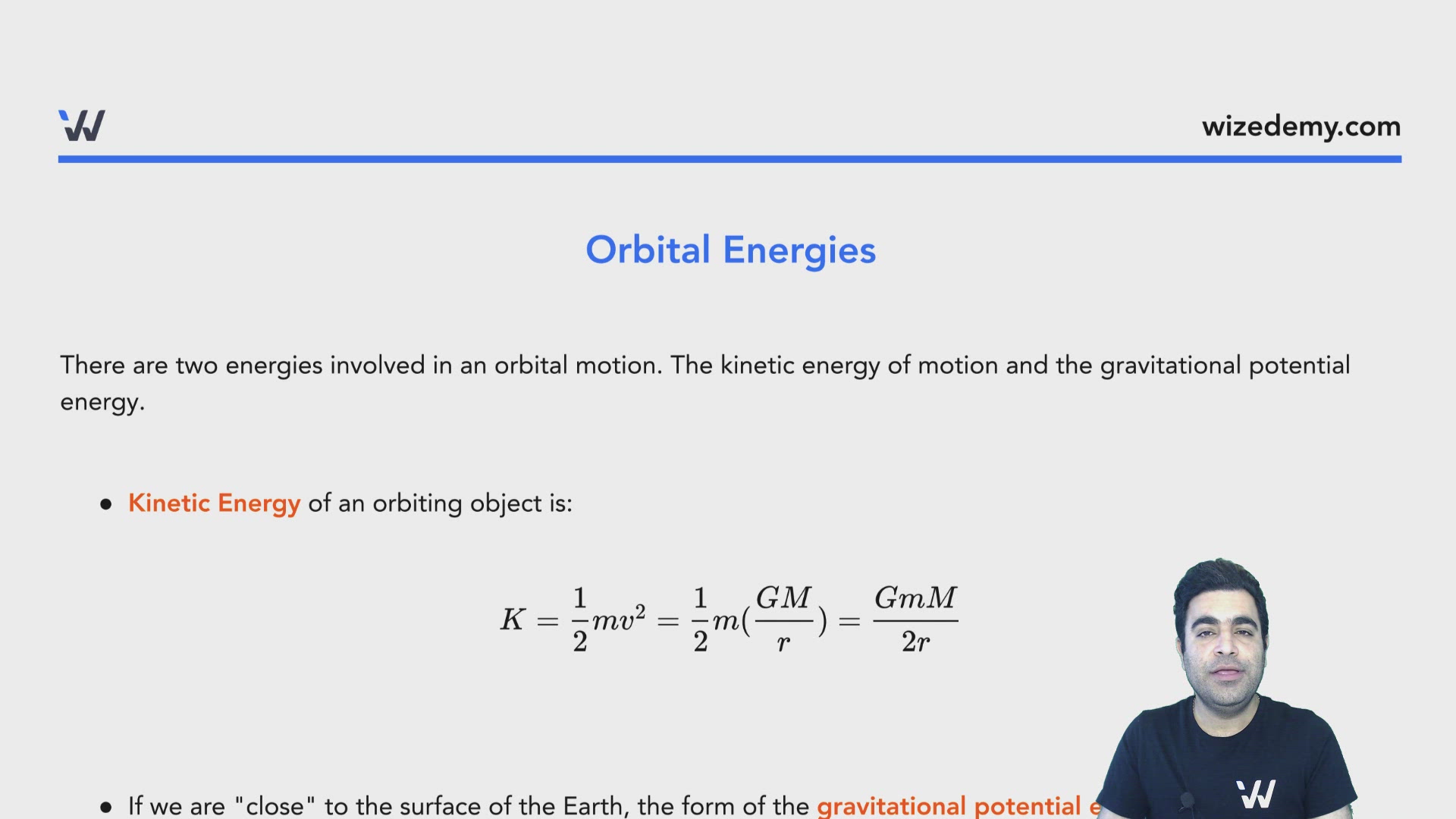
There are two energies involved in an orbital motion. The kinetic energy of motion and the gravitational potential energy.
- Kinetic Energy of an orbiting object is:
- If we are "close" to the surface of the Earth, the form of the gravitational potential energy is
where h is the height above the surface. For the general form, we would have to use the general form of .
- But if we are far away from Earth's surface, we have to use the general form of gravitational potential energy:
where "height" is now denoted as a radius (which is measured from the centre of the masses).
Some notes:
- Why is it negative!? In the mgh form, we used the Earth's surface as a "zero" reference point. But for the more general form, the reference point (zero point) is set where the force is totally gone, which is when . As the objects get closer and closer , we should have less and less energy (more negative), so our expression has a negative sign.
- As per Newton's law of universal gravity, this exists for every pair of massive object, and not just planets and stars!
- As a result, the total mechanical energy is:
The total mechanical energy determines the shape of the orbit:
- E < 0, then the orbit is closed, the object will be bound to the planet.
- E = 0, then the orbit is parabolic. The object will fly away.
- E > 0, then the orbit is hyperbolic. The object will fly away.
Wize Tip
The shape of the orbits comes from much more complicated maths, but you can interpret it like the balancing of kinetic/potential energy (the negative part comes from the potential energy).
At E < 0, the speed and the gravitational pull balances out, and the object will not fling off. At E = 0, this is just when the object is just fast enough to fling away, etc.
0:00 / 0:00
Kepler's Laws
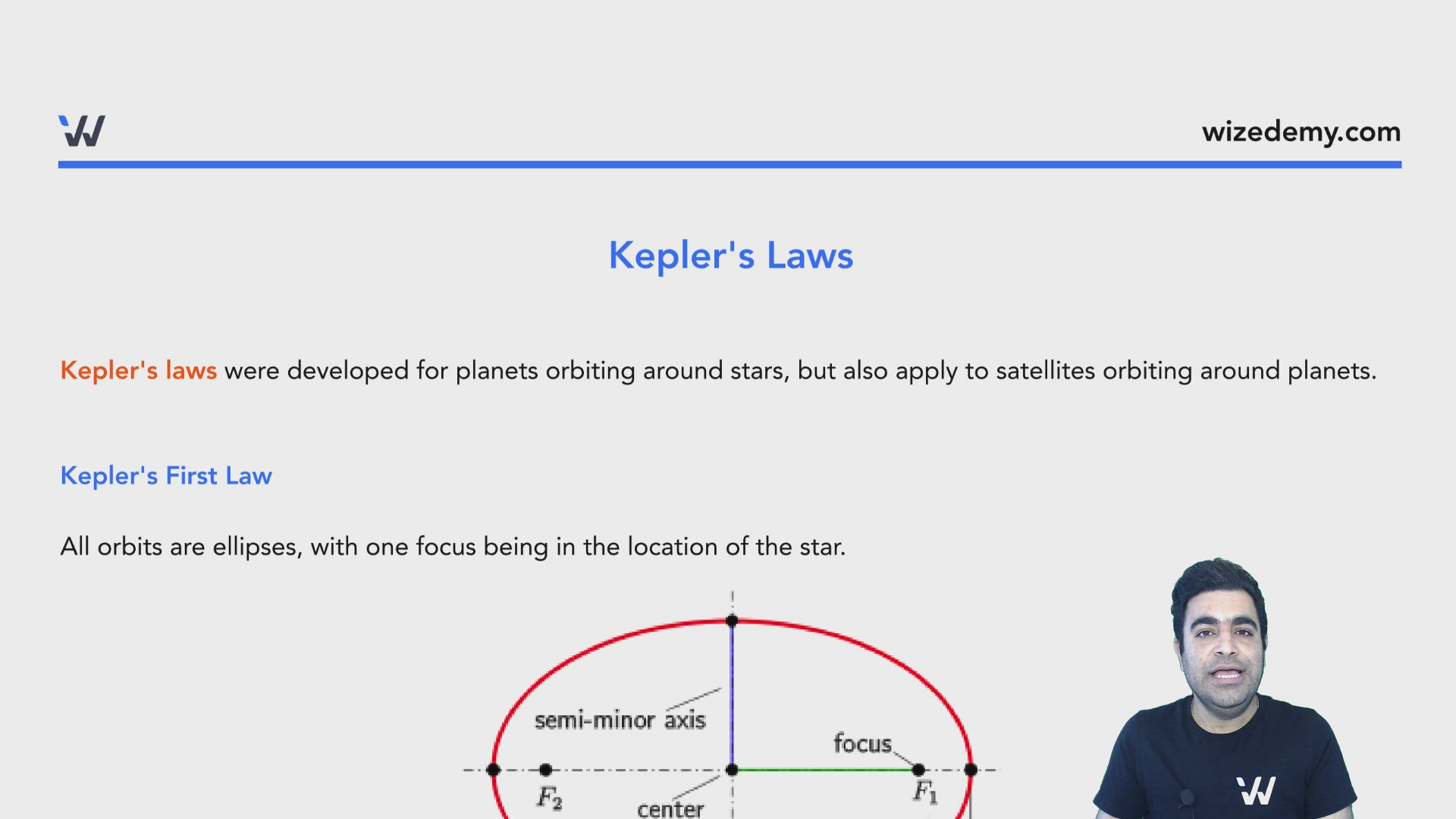
Kepler's laws were developed for planets orbiting around stars, but also apply to satellites orbiting around planets.
Kepler's First Law
All orbits are ellipses, with one focus being in the location of the star.
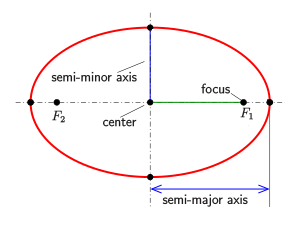
A circle is technically an ellipse with both foci in the same place. The semi-major/minor axis for a circle is just the radius.
Kepler's Second Law
In an orbit, if the planet is closer to the star, it's speed will increase. When further from the star, it's speed will decrease. You can understand this as conservation of energy: closer means you lost gravitational potential energy, which must be compensated by the kinetic energy (speed).
Wize Tip
For circular orbits, this means that the orbital speed of the planet is constant - the planet is always the same distance away from its star.
Kepler's Third Law
The square of the period of a planet is proportional to the cube of the semi-major axis of the orbit (or the radius for a circlar orbit). The exact relation is
where M is the mass of the star/planet (not of the satellites).
Wize Tip
We can simply say , or
Watch Out!
Be careful with these variables:
- If you have a planet orbiting a star, r is the distance between the planet and the star (NOT the radius of the star or planet), and M is the mass of the star.
- If you have a satellite orbiting a planet, r is the distance between the satellite and the center of the planet (NOT the radius of the planet), and M is the mass of the planet (NOT the satellite).
Escape Speed
Escape speed is the exact speed that's needed for an object to escape the gravitational pull of that planet.
- Gravitational force (and therefore acceleration) changes with respect to the height above the planet
- To solve for this velocity (speed) we cannot use out constant acceleration kinematics equations
- We have to use Energy!
- This object will have KEfinal + PEfinal = 0 as the distance is assumed to be infinitely far away to escape the gravitational force AND the object does not need a final velocity (only initial)
- Thus the equation simplifies to:
- Subbing in KE and PE we get:
Solving for the speed, we have the escape velocity of any mass causing a gravitational field
For Earth, you should plug in values to find the escape speed is about 11.2 km/s. Notice how it does not depend on the mass of your object!