Wize University Statistics Textbook > Discrete Probability Distributions
Binomial Distribution
Popular Courses
COMM 214
Concordia University
AP Statistics Exam Prep Course
AP Exam Prep
Statistics
General Course
Intro to Statistics
University Study Guides
COMM 215
Concordia University
Geometry
US High School
STAT 213
University of Calgary
COMM 191
University of British Columbia
STA 100
University of California - Davis
Grade 12 Data Management
Ontario High School
High School Statistics
US High School
STATS 2244A/B
Western University
STAT 200
University of British Columbia
Intro to Statistics
University Study Guides
STATS 2035
Western University
STAT 161
University of Alberta
QMS 210
Toronto Metropolitan University
STAT 263
Queen's University
STAT*2040
University of Guelph
ENDG 319
University of Calgary
0:00 / 0:00
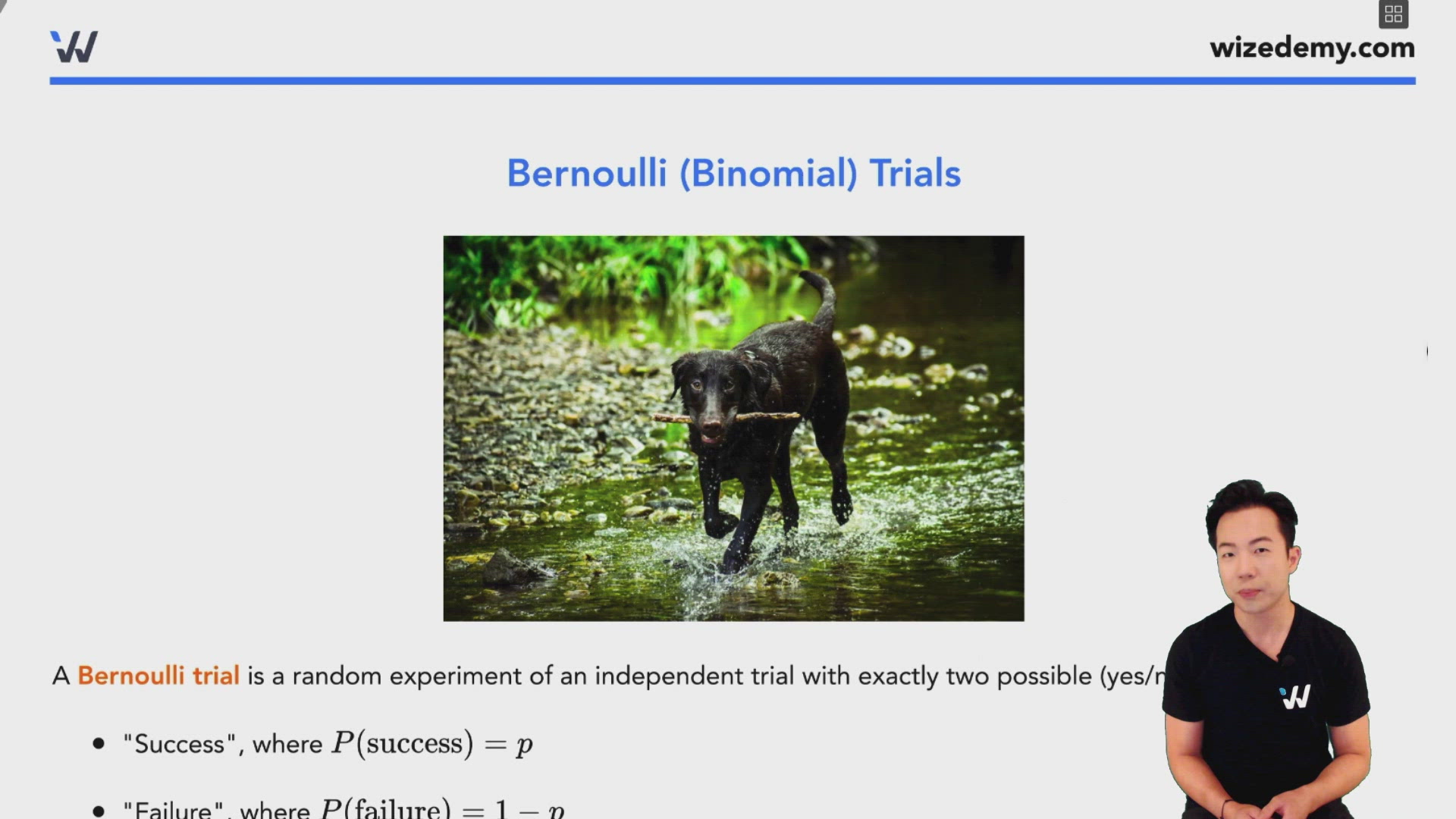
Bernoulli (Binomial) Trials

A Bernoulli trial is a random experiment of an independent trial with exactly two possible (yes/no) outcomes:
- "Success", where
- "Failure", where
Examples
- Hit/Miss
- Pass/Fail
- Approve/Decline
Bernoulli formula
where
Bernoulli Mean
Proof:
Bernoulli Variance
Proof:
Bernoulli Standard Deviation
Proof:
When Ben asks a girl for her number, he gets it 20% of the time.
0:00 / 0:00
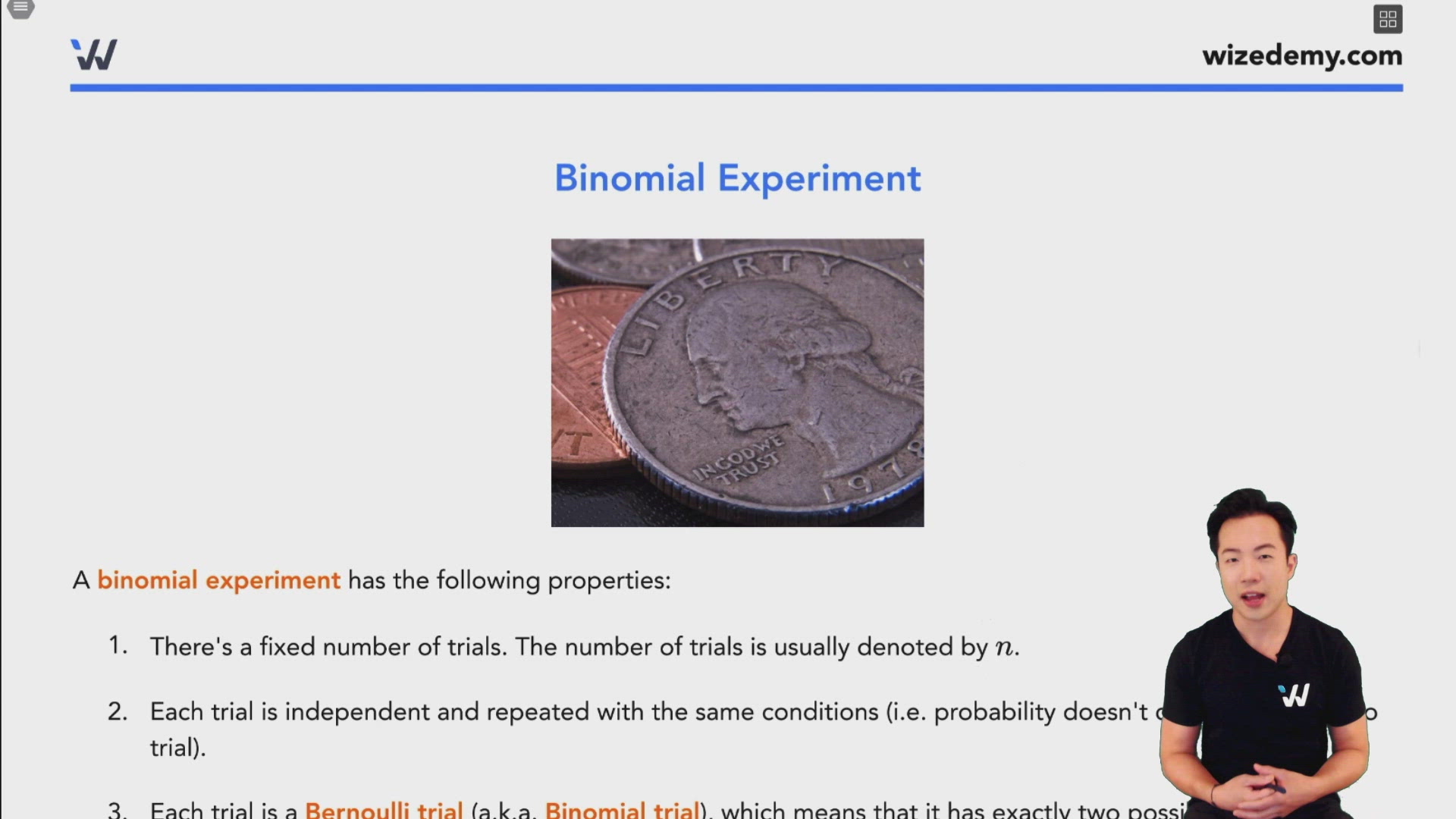
Binomial Experiment

A binomial experiment has the following properties:
- There's a fixed number of trials. The number of trials is usually denoted by .
- Each trial is independent and repeated with the same conditions (i.e. probability doesn't change from trial to trial).
- Each trial is a Bernoulli trial (a.k.a. Binomial trial), which means that it has exactly two possible outcomes
- "Success" →
- "Failure" → where or
Watch Out!
"Success" just denotes the outcome that you are interested in.
"Failure" just denotes the opposite outcome (i.e. complement).
For example, these could be "male or female", "win or lose", "greater than 1 or not greater than 1", etc.
Examples
Determine if the following are binomial experiments:
1. Flipping a coin 10 times and seeing if a "Heads" or "Tails" appears →
YES
There are 10 trials (flips):
Each flip is independent of one another.
Let "success" = flipping Heads, then .
Let "failure" = flipping Tails, then
2. Rolling a dice 12 times and seeing if the number is larger than 2 or less than or equal to 2 →
YES
There are 12 trials (flips):
Each roll is independent of one another.
Let "success" = rolling a number larger than 2, then .
Let "failure" = rolling a number less than or equal to 2, then
3. Drawing a card 7 times from a standard 52-card deck without replacement and seeing if it's a "King" →
NO
Each draw is NOT independent - as you draw cards from the deck, the total number of cards changes and the probability of drawing a "King" changes.
*Note: this would be a binomial experiment if the cards are drawn with replacement.
0:00 / 0:00
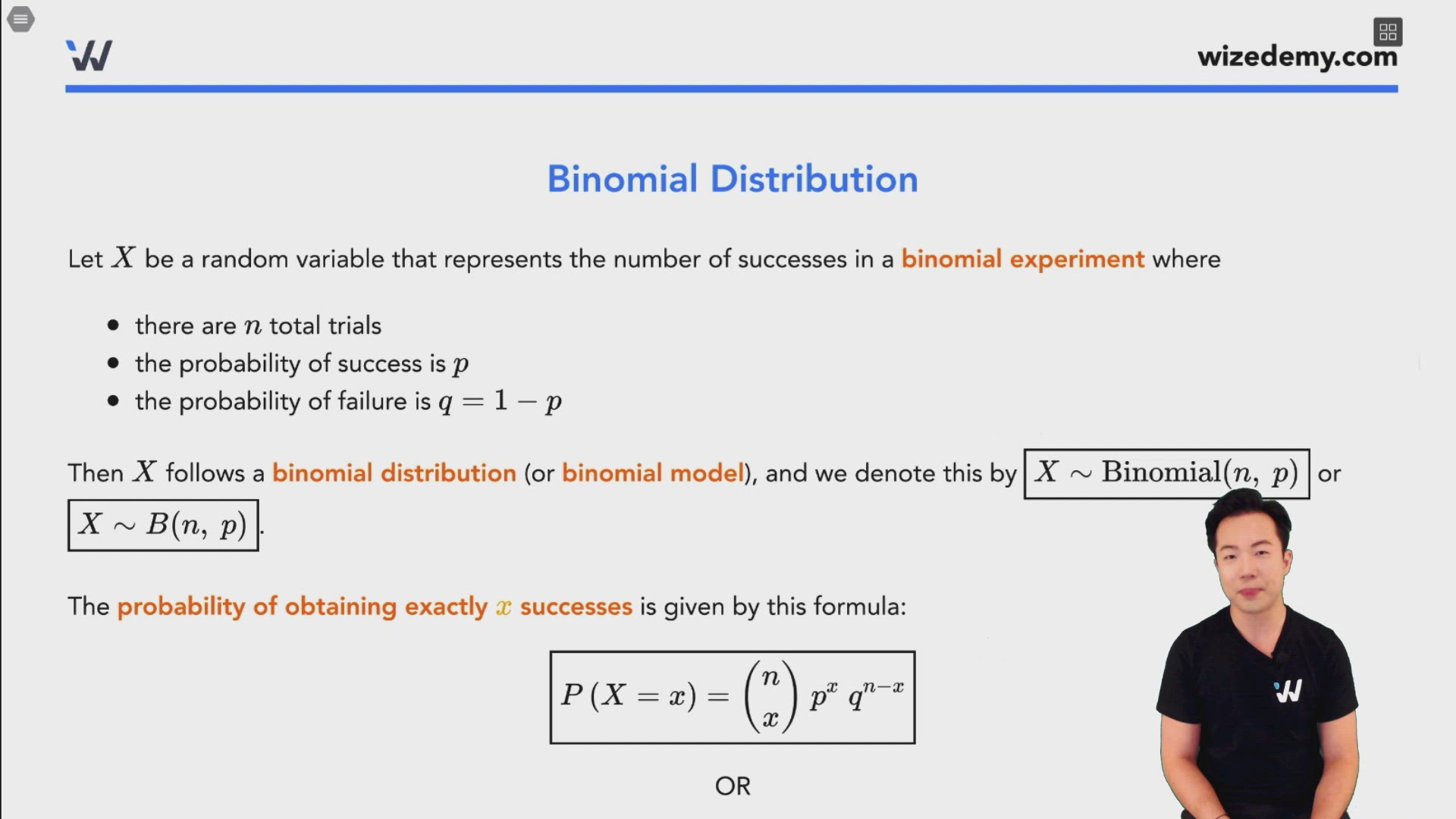
Binomial Distribution
Let be a random variable that represents the number of successes in a binomial experiment where
- there are total trials
- the probability of success is
- the probability of failure is
Then follows a binomial distribution (or binomial model), and we denote this by or .
The probability of obtaining exactly successes is given by this formula:
OR
Wize Tip
Some textbooks and profs will use instead of . Just know that is the probability of "success", and is the probability of "failure" (i.e. the complement).
Probability Distribution Function (Table)
You can complete the probability distribution table using the formula for the number of successes of a binomial experiment:
Example
When Ben throws a stick to his old dog, Percy, he catches it 10% of the time.
(a) What is the probability of Percy catching a stick in one trial?
probability of success
(b) What is the probability of Percy not catching a stick in one trial?
probability of failure
(c) Let for the value of failure (not catching the stick) and for the value of success (catching the stick).
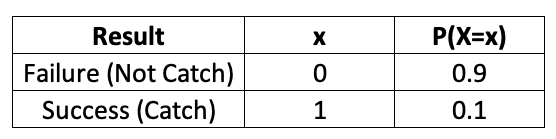
Determine the probability distribution to find the mean, variance, and standard deviation of one trial (i.e. Bernoulli Trial).
Mean:
Also known as "expected value":
Variance:
Standard deviation:
If you multiply the above mean and variance of one trial by , you get the following:
- Binomial mean of trials
- Binomial variance trials
- Binomial standard deviation of trials
Mean, Variance, and Standard Deviation (Binomial Distribution)
If a random variable follows a binomial distribution, we have very short formulas for the mean, variance, and standard deviation of the random variable.
- Mean:
- Variance:
- Standard deviation:

0:00 / 0:00
Example: Binomial Probability
A fair dice is rolled 5 times. Find the probability that we get
a) exactly 3 even numbers
There are 5 trial: .
Let "success" = the outcome of rolling an even number → .
Let "failure" = the outcome of rolling an odd number → .
Using our formula:
Therefore, the probability of getting exactly 3 even numbers is
b) more than 3 even numbers
"More than 3 even numbers" means getting "4 or 5 even numbers".
Therefore, the probability of getting more than 3 even numbers is .
c) at least 1 even number
"At least 1 even number" means getting "1, 2, 3, 4, or 5 even numbers". Using the complement, this means "the opposite of getting zero even numbers"
Therefore, the probability of getting at least 1 even number is .
0:00 / 0:00
Example: Binomial Distribution
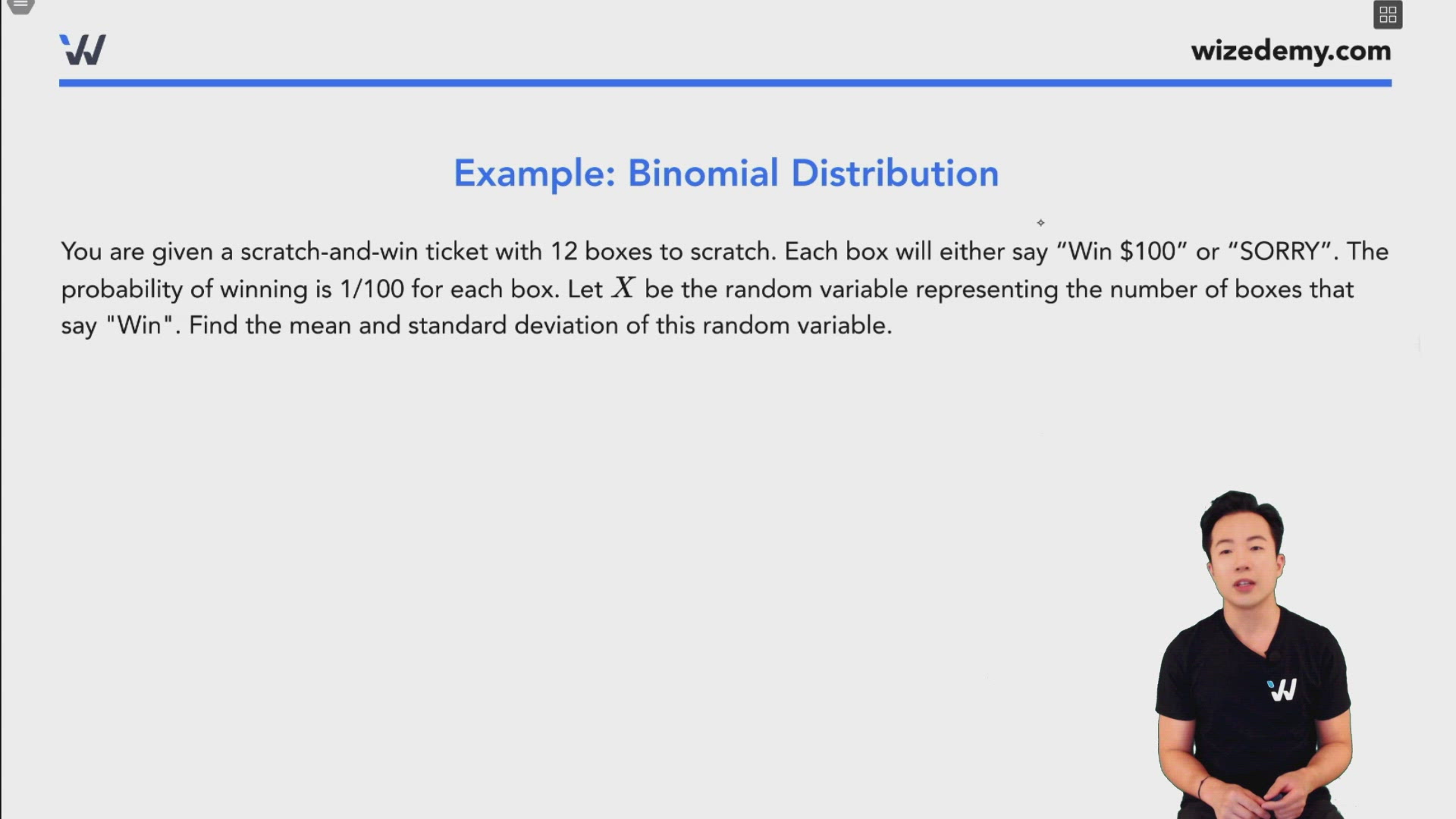
You are given a scratch-and-win ticket with 12 boxes to scratch. Each box will either say “Win $100” or “SORRY”. The probability of winning is 1/100 for each box. Let be the random variable representing the number of boxes that say "Win". Find the mean and standard deviation of this random variable.
Check if follows a binomial distribution:
- The number of trials is
- Each box is independent of one another with constant probability
- and
So, this is a binomial experiment and .
Therefore, the mean is and the standard deviation is approximately .
Leo can shoot a bull’s eye 60% of the time. He has 10 bullets.
a) What’s the probability that he will shoot a bull’s eye exactly 8 of the 10 times?
b) What’s the probability that he will shoot a bull’s eye at most 8 times?
Practice: Binomial Distribution
A member of the parliament knows that the probability that any one of her bills will be made into a law is 0.4 . During a sitting of parliament, she submits 200 different bills. Compute the mean and standard deviation for the random variable, , which represents the number of bills that will be made into laws.