Wize University Statistics Textbook > Estimating with Confidence Intervals
Introduction to Confidence Intervals
Popular Courses
COMM 214
Concordia University
STAT 151
University of Alberta
AP Statistics Exam Prep Course
AP Exam Prep
Statistics
General Course
Intro to Statistics
University Study Guides
COMM 215
Concordia University
STAT 213
University of Calgary
COMM 191
University of British Columbia
DATASCI 1000A/B
Western University
STA 100
University of California - Davis
Grade 12 Data Management
Ontario High School
STATS 2244A/B
Western University
STAT 200
University of British Columbia
Intro to Statistics
University Study Guides
STATS 2035
Western University
STAT 161
University of Alberta
QMS 210
Toronto Metropolitan University
STAT 263
Queen's University
STAT*2040
University of Guelph
ENDG 319
University of Calgary

0:00 / 0:00
Intro to Confidence Intervals

Typically, the population parameter of interest is unknown.
Examples
- Do you know the mean number of pages students read on the weekend?
- Do you know the proportion of students who work part-time?
Why do we Need Confidence Intervals?
We may never know the true mean or true proportion of the population, but we can work around that by using information from samples to infer about the population.
Specifically, we use the sample statistic to estimate the unknown population parameter by constructing confidence intervals.
What is a Confidence Interval?
A confidence interval gives us a range of values, and we believe that the unknown parameter falls somewhere within that range.
Examples
- I can say "I am confident that students read between 9 and 15 pages on the weekend".
- I can say "I am confident that between 32% and 38% of students work part-time".
This is useful information, even if we don't know the true mean or true proportion.
Population Parameter VS Sample Statistic
The population mean is the parameter we are trying to estimate using the sample mean , which is the statistic or point estimate.
The population proportion is the parameter we are trying to estimate using the sample proportion , which is the statistic or point estimate.
A confidence interval is a range of values, based on the sample data, that is used to estimate an unknown population parameter – in this case, the population mean – at a given confidence level – usually 90%, 95%, or 99%.
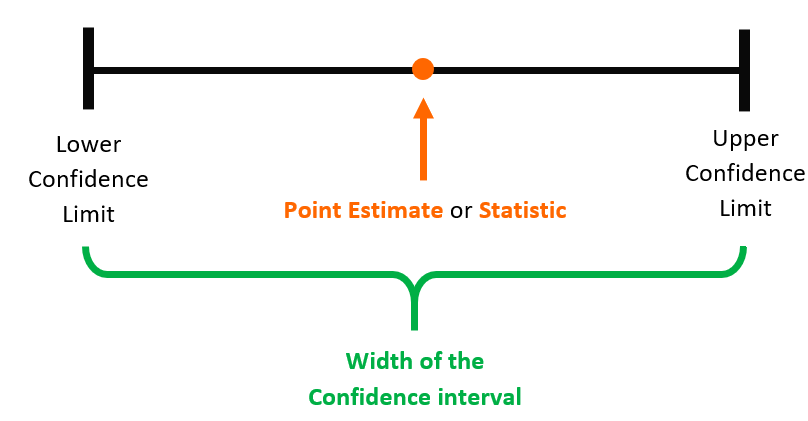
If we are trying to estimate the population mean with a 95% confidence interval, we can say:
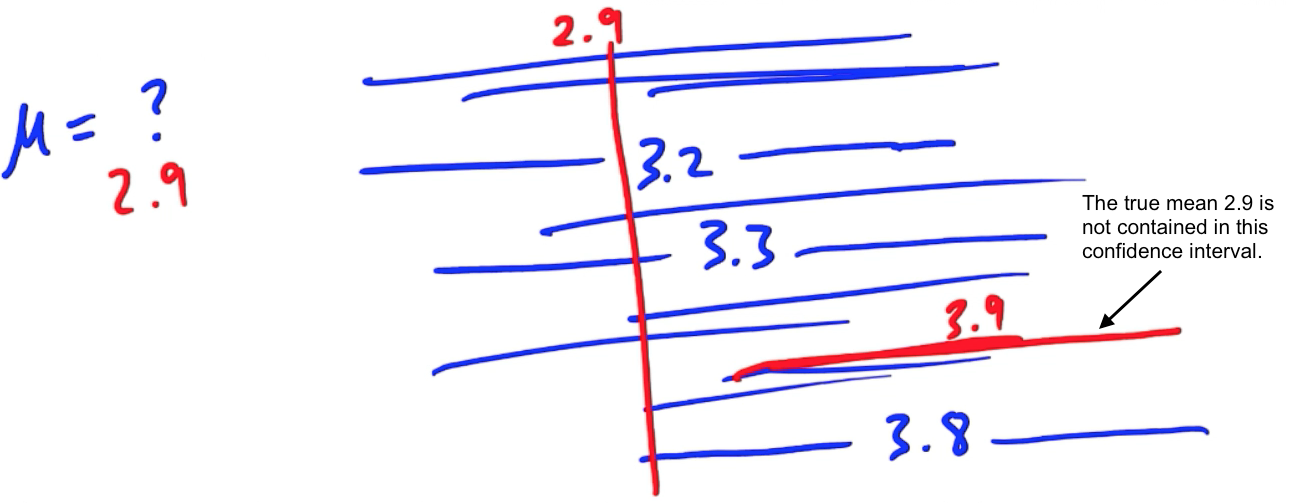
“We are 95% confident that this interval contains the population mean in question”
Thus, when we construct 100 different confidence intervals (based on 100 different sample sets drawn from the same population), 95 of the 100 confidence intervals will contain the true population mean.
We may never know what the true population mean is, but we are 95% confident that the confidence interval contains it.
Example:
If you want to be surer than 95%, then use a 99% confidence interval, which is wider due to a larger margin of error.
The higher the confidence level , the larger the margin of error .
Can we be 100% confident? Can we construct a 100% confidence interval?
There are only a few ways to be 100% confident:
- You are psychic.
- Your confidence interval ranges from a clear minimum and a clear maximum.
- Example: "The average midterm grade ranges from 0% and 100%." That you can 100% confident about!
- You have a census, in which case you can determine the true population parameter and do not need to construct a confidence interval to estimate it.