Wize University Statistics Textbook > Inference for Linear Regression
Hypothesis Testing for Linear Regression
Popular Courses
COMM 214
Concordia University
AP Statistics Exam Prep Course
AP Exam Prep
Statistics
General Course
Intro to Statistics
University Study Guides
COMM 215
Concordia University
COMM 191
University of British Columbia
STA 100
University of California - Davis
STATS 2244A/B
Western University
Intro to Statistics
University Study Guides
STATS 2035
Western University
QMS 210
Toronto Metropolitan University
STAT 263
Queen's University
MGCR 271
McGill University
STAT 251
University of British Columbia
STATS 2B03
McMaster University
STAT 217
University of Calgary
COMM 162
Queen's University
MGTSC 212
University of Alberta
STAT 1060
Dalhousie University
ECON 227
McGill University

0:00 / 0:00
Hypothesis Testing for Linear Regression
We can assess the linear regression model to determine if there is a significant linear relationship between and . Specifically, we test the slope .
Wize Tip
Review Hypothesis Testing if you need a refresher of the five steps. (See: Hypothesis Testing with One Sample)
If there is no linear relationship between and , then:
- The regression line will be horizontal with the slope .
- That means does not change when changes.
- There is no significant (linear) relationship between and .
Wize Concept
The slope is equal zero when where is no relationship between and
The slope is not equal to zero when where is a relationship between and
As such, the hypotheses for testing the slope are:
There is no linear relationship.”
There is a linear relationship.” negative or positive (two-sided test)
Note: We almost always conduct two-sided tests when testing although it is not odd to ask the following:
“Is there a positive linear relationship?”
“There is not a positive linear relationship.”
“There is a positive linear relationship.” (one-sided test)
“Is there a negative linear relationship?”
“There is not a negative linear relationship.”
“There is a negative linear relationship.” (one-sided test)
Watch Out!
Remember to multiply the p-value by 2 for two-sided test! [Use the two-tail row in the t-table.]
Recap of t-table:

T-Test for Slope
A regression model is useful when and have a statistically significant relationship that is either a positive or a negative relationship. In other words, we test if the coefficient is significantly different from zero.
To test the significance of the slope coefficient, we must perform a t-test:
Test statistic
where the is standard error of the slope :
Degrees of freedom
Watch Out!
Your textbook may use . That’s fine when in simple linear regression. It is not correct for multiple regression where . To avoid confusion, we will always use .

0:00 / 0:00
Example: Hypothesis Testing for Linear Regression
We want to see if there is a relationship between how many hours a student studies the day before the exam and the exam grade. We randomly sampled 8 students.
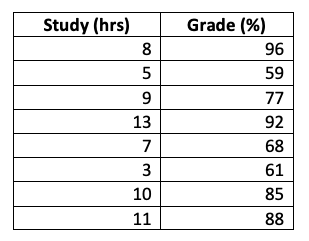
(a) What is the explanatory variable?
Hours of study Grade
Hours of study
(b) What is the response variable?
Hours of study Grade
Grade
(c) Before we test the linear model for the relationship between grade and number of hours of studying, state the hypotheses.
Ho: "There is no linear relationship."
Ha: "There is a linear relationship"
(d) Is this a one-sided or two-sided test?
One-sided Two-sided
Two-tailed test
This is the output for the linear model:
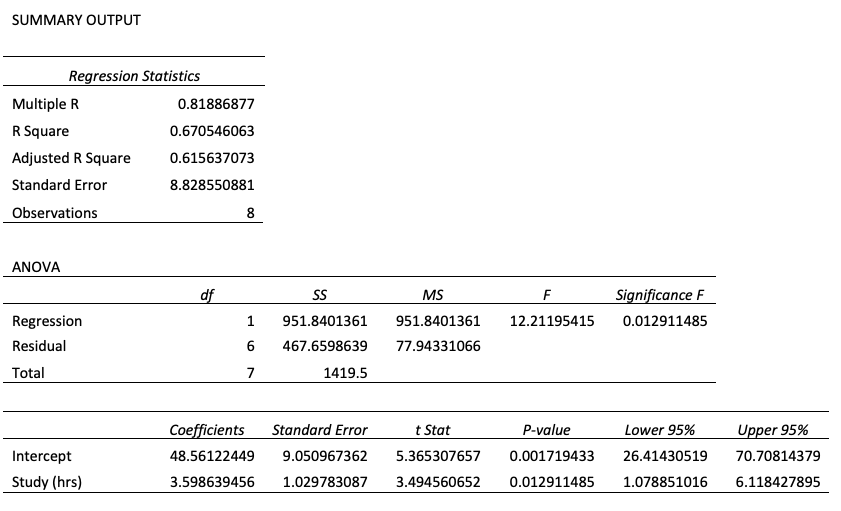
(e) Write down the numeric values for the following:
48.56
3.599
1.02978
(f) What is the simple linear regression equation?
(g) Interpret the Hours coefficient.
Each additional hour of studying
increases
grade by 3.599
percent, on average.Each (one) hour of studying increases grade by 3.599 percent, on average.
(Do not just say that it is the slope!)
(h) What is the test statistic?
(i) What’s the df?
(j) What is the p-value?
Using t-table: p-value is between 0.01 and 0.02.
Using software: p-value = 0.013
(n) At the 5% significance level, is there evidence of a linear relationship between grade and hours of studying?
We reject/fail to reject we conclude that studying does/does not contain information that can be used to predict grade.
The p-value is less than We reject Ho and conclude that there is a linear relationship between grade and hours of studying.
0:00 / 0:00
Example: Hypothesis Testing for Linear Regression (Sxy, Sxx, Syy Method)
Savage Question!
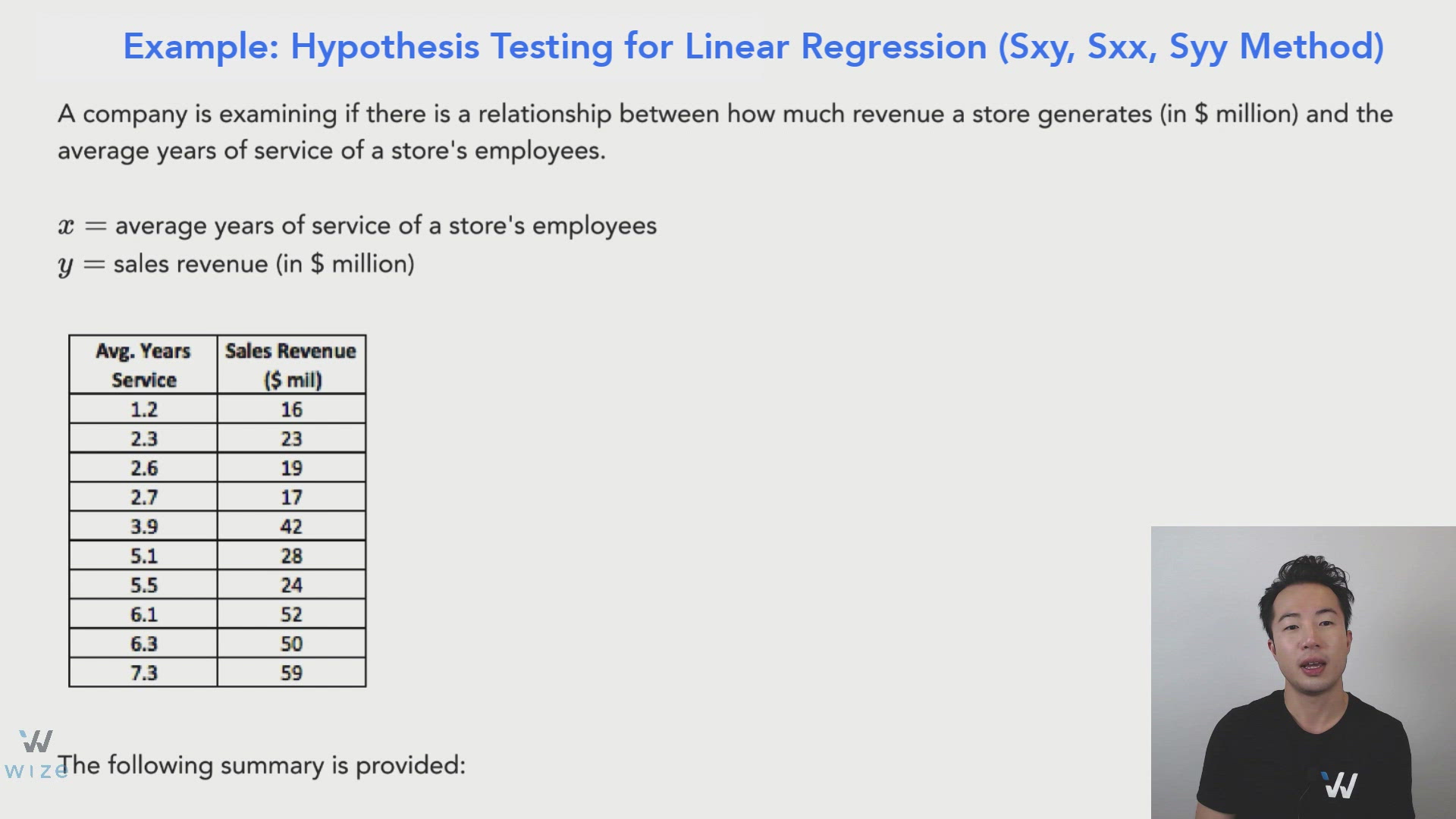
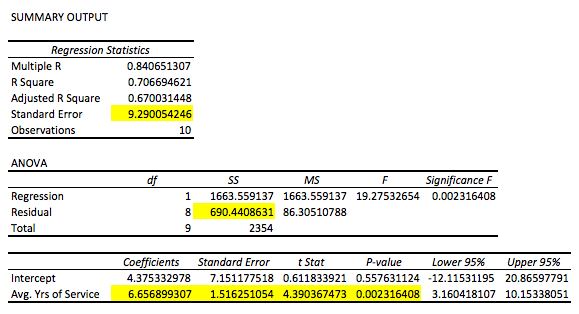
A company is examining if there is a relationship between how much revenue a store generates (in $ million) and the average years of service of a store's employees.
average years of service of a store's employees
sales revenue (in $ million)
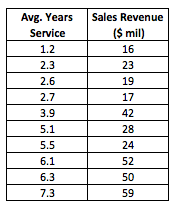
The following summary is provided:
At the 5% significance level, test for the significance of the linear relationship between and .
There is no linear relationship.”
There is a linear relationship.”
Test statistic:
where the is standard error of the slope :
First, we need to solve for the slope coefficient :
For , we need to find :
requires ...
requires , , and ...
We already have:
Find :
There is no linear relationship.”
There is a linear relationship.” (2-tail test)
The null hypothesis that there is no significant relationship between and is rejected if:
- |t-score| > |critical value|
- the p-value < significance level (5%)
0.002 < p-value < 0.01
p-value is less than the significance level (0.05)
Reject Ho, there is a significant linear relationship between the average years of service and revenue.
T-table:
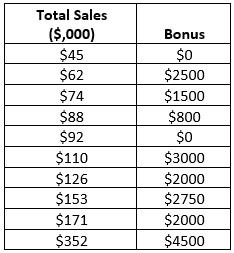
Abby is a sales associate at Dana’s, a high-end retail store. Sales associates do not get commission but are entitled to year-end bonuses, depending on sales.
Abby wants to see if how much one sells has an affect on the bonus they get. She samples 2 sales associates from each department (women’s, men’s, jewelry, shoes, and cosmetics) who are willing to disclose how much they sold last month (in $ thousands) and what their bonus was.
Results:
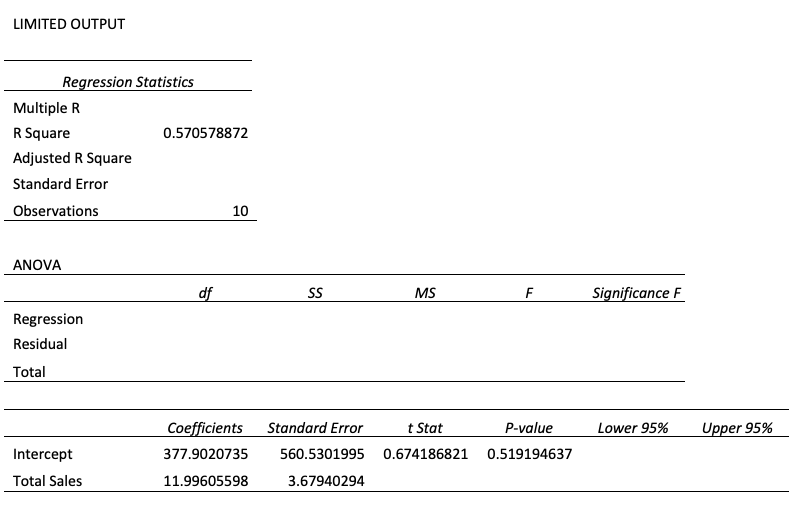
(i) State the hypotheses.