Wize University Statistics Textbook > Probability
Tools for Probability
Popular Courses
MATH 208
Concordia University
COMM 214
Concordia University
STAT 151
University of Alberta
AP Statistics Exam Prep Course
AP Exam Prep
Statistics
General Course
Intro to Statistics
University Study Guides
COMM 215
Concordia University
Geometry
US High School
STAT 213
University of Calgary
DATASCI 1000A/B
Western University
STA 100
University of California - Davis
Grade 12 Data Management
Ontario High School
High School Statistics
US High School
STAT 200
University of British Columbia
Intro to Statistics
University Study Guides
STATS 2035
Western University
STAT 161
University of Alberta
STAT 263
Queen's University
STAT*2040
University of Guelph
ENDG 319
University of Calgary

0:00 / 0:00
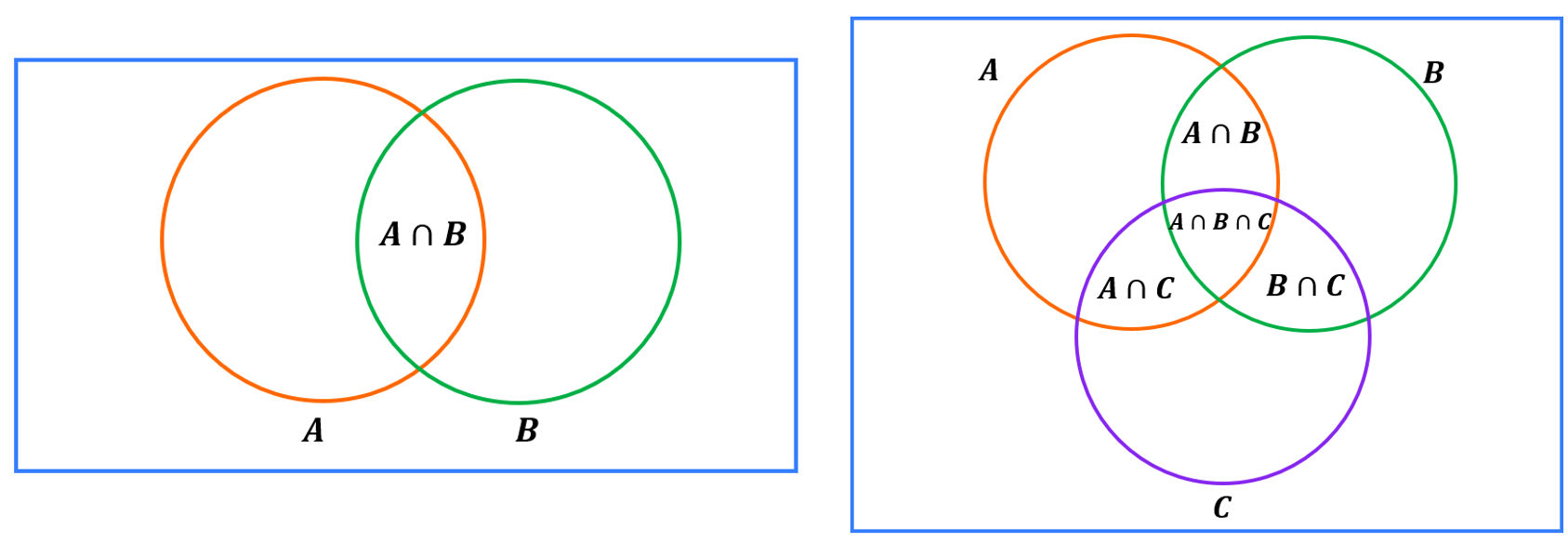
Venn Diagrams
A Venn diagram shows all the outcomes in a picture. It is particularly helpful if events overlap.
Example
You have a deck of 52 cards. What is the probability of drawing a queen or a spade?
P(queen) =
P(spade) =
P(queen and spade) =
Thus, P(queen or spade) = P(queen) + P(spade) P(queen and spade)
0:00 / 0:00
Tree Diagrams
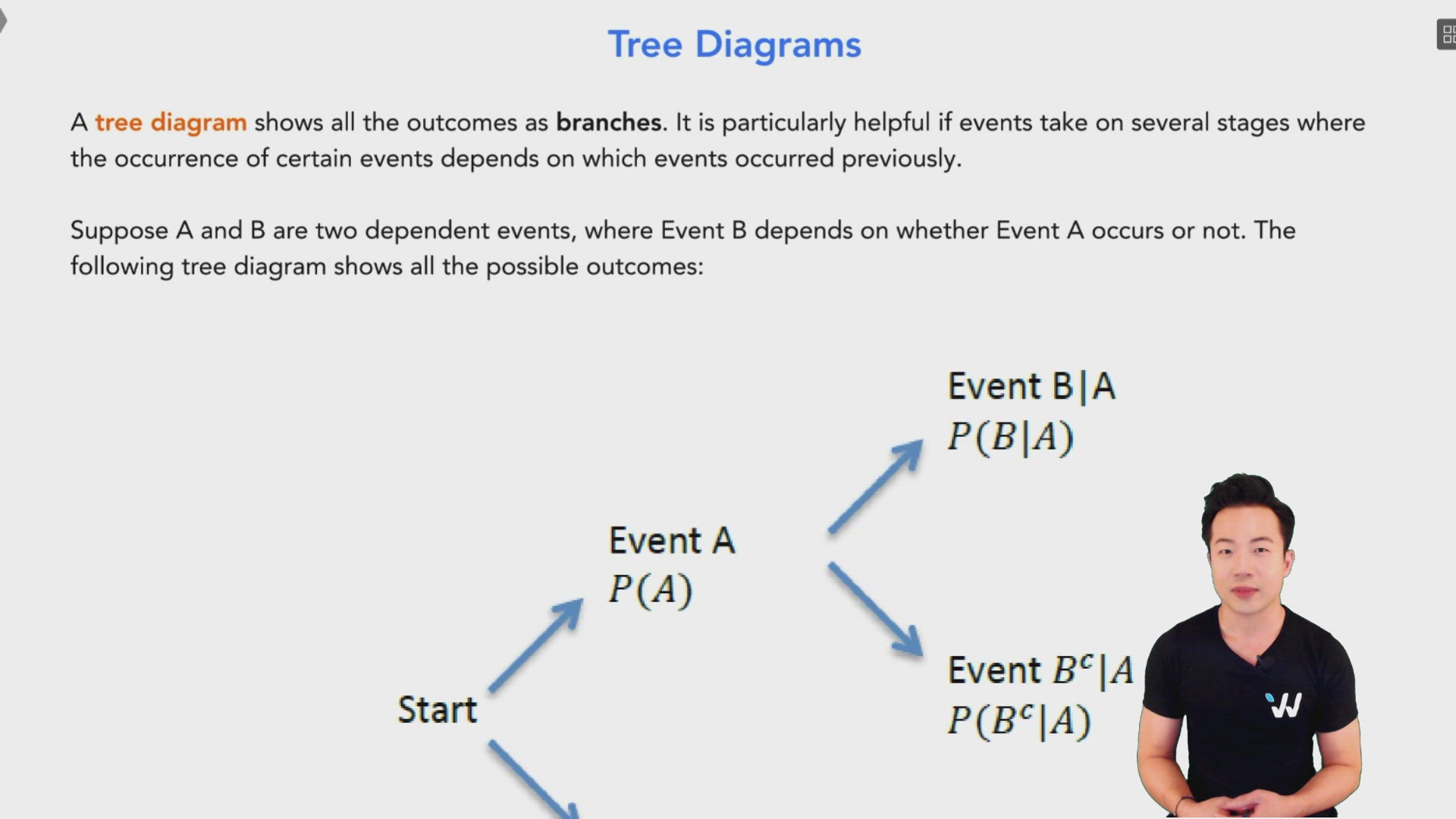
A tree diagram shows all the outcomes as branches. It is particularly helpful if events take on several stages where the occurrence of certain events depends on which events occurred previously.
Suppose A and B are two dependent events, where Event B depends on whether Event A occurs or not. The following tree diagram shows all the possible outcomes:

Example
The faculty has 60% tenured professors and 40% junior professors.
The probability that a professor wins a teaching award, given that they are a tenured professor, is 37%:
The probability that a professor wins a teaching award, given that they are a junior professor, is 45%:
We can organize this information in a tree diagram:


0:00 / 0:00
Contingency Table (Two-way Table)
A contingency table or two-way table is great for helping you with questions that calculating probabilities involving two events A and B. The row totals and column totals always add up to 1:

Notes
Example
Event A and Event B are two events where and .

must be between
0.2
and 0.5
, inclusive. 