Wize High School Grade 11 Biology Textbook > Energy & The Biosphere [Under construction]
The Importance of Water & Carbon
0:00 / 0:00
Unique Properties of Water
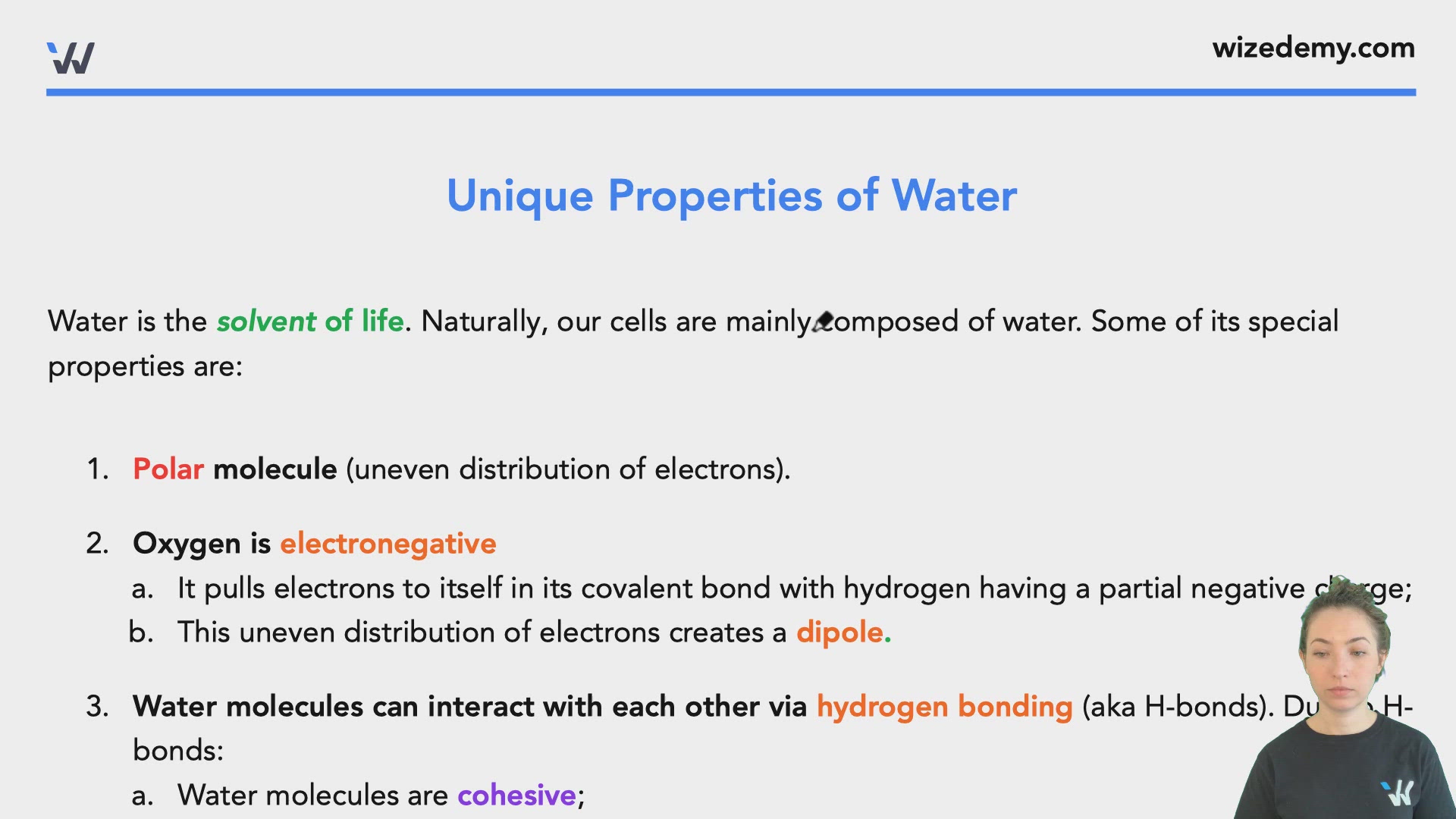
Water is the solvent of life. Naturally, our cells are mainly composed of water. Some of its special properties are:
- Polar molecule (uneven distribution of electrons).
- Oxygen is electronegative
- It pulls electrons to itself in its covalent bond with hydrogen having a partial positive charge;
- This uneven distribution of electrons creates a dipole.
- Water molecules can interact with each other via hydrogen bonding (aka H-bonds). Due to H-bonds:
- Water molecules are cohesive;
- Water has a high heat capacity and boiling point;
- Water will associate with other uncharged molecules that have polar covalent bonds and/or full charges on ions.

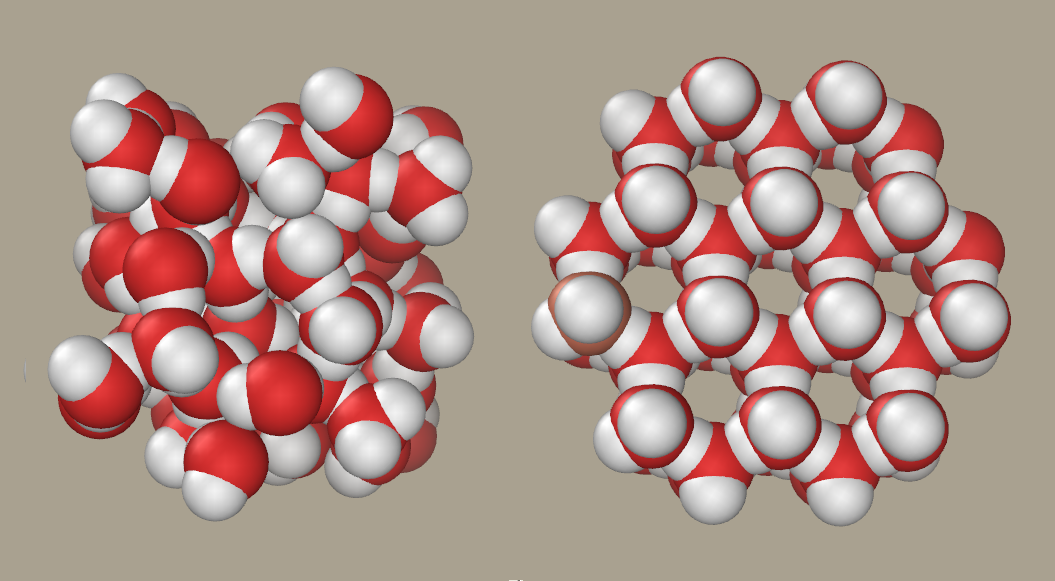
- Solid less dense than liquid
- Water assumes a lattice structure when solid;
- This orderly arrangement allows for spaces between molecules;
- Ice is 10% less dense than water.
- "Universal solvent"
- Water can surround polar or charged molecules to dissolve them. Example: in water, NaCl is broken into Na+ and Cl- ions, with water's negative partial charge surrounding the Na+, and positive partial charge surrounding the Cl-.
- Substances that easily dissolve in water are hydrophilic: water loving.
- Substances that do not dissolve well in water are hydrophobic.


Mark Yourself Question
- Grab a piece of paper and try this problem yourself.
- When you're done, check the "I have answered this question" box below.
- View the solution and report whether you got it right or wrong.
What are 3 properties of water that make it unique as a life-bearing molecule?
Mark Yourself Question
- Grab a piece of paper and try this problem yourself.
- When you're done, check the "I have answered this question" box below.
- View the solution and report whether you got it right or wrong.
Mark Yourself Question
- Grab a piece of paper and try this problem yourself.
- When you're done, check the "I have answered this question" box below.
- View the solution and report whether you got it right or wrong.