
Dalton's Law of Partial Pressures
- Gases mix in a homogeneous manner due to their low particle density.
- If we assume ideal behavior, then the gas particles are not interacting with each other.
- The partial pressure of a gas is the pressure that the gas would exert if it were the only gas present in the mixture
- This means that each gas in the mixture will have its own contribution total pressure of the system
- This is known as Dalton's Law of Partial Pressures
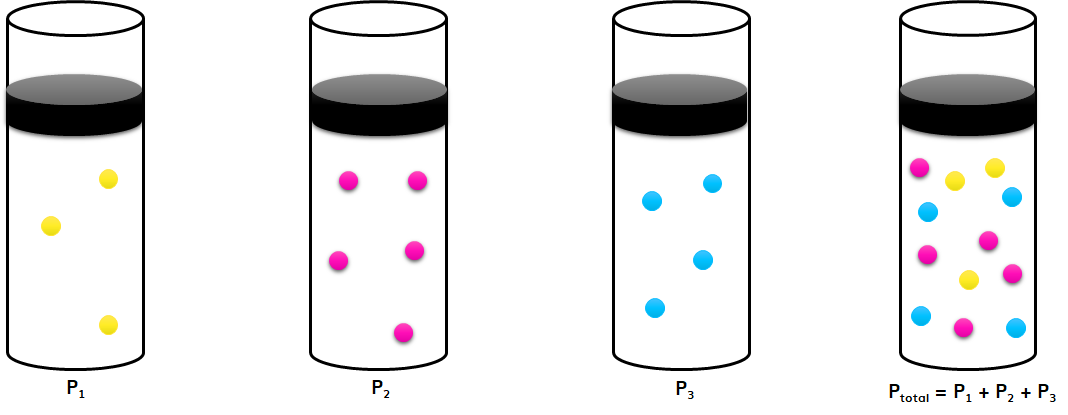

Example: Gas Mixtures
If a gas sample is 1/3 oxygen and 2/3 argon with a total pressure of 120 kPa, what is the pressure of each gas?