Wize High School Grade 11 Chemistry Textbook > Quantities in Chemistry
The Mole and Molar Mass

0:00 / 0:00
Moles and Molar Mass
- A mole is the exact number of atoms in 12g of carbon
- If we know that: , then
- The above value, 6.02x10²³ is referred to as Avogadro's number (NA)
Molar Mass
- Molar mass is the mass of one mole of particles of that substance
- Units for molar mass are g/mol.
- Molar mass is abbreviated using the symbol M Example: Molar mass of elemental oxygen can be represented as
Molar Mass of Elements
- Found in periodic table. Example: Molar mass of sodium
- When looking at molar mass of molecular elements, you have to multiply the molar mass of the element by the number of atoms per molecule Example:Molar mass of elemental chlorine
Molar Mass of Ionic and Molecular Compounds
- The molar mass of a compound is equal to the sum of the molar mass of each entity in the compound. Example: Molar mass of sulfuric acid, H2SO4

0:00 / 0:00
Example: Using Avogadro's Number
Calculate the number of Cu atoms if you have 0.635g of Cu.
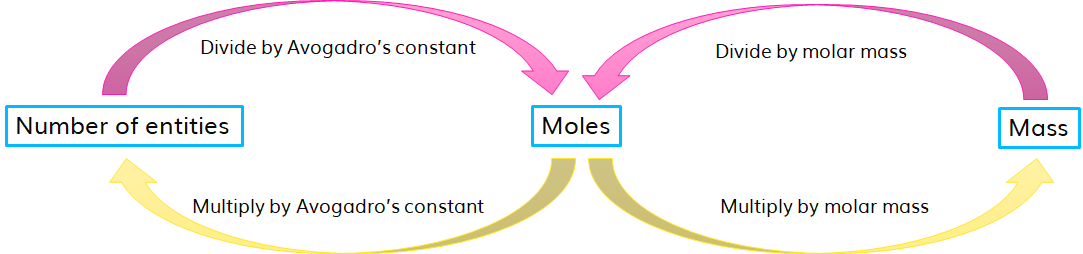
1) Find number of moles given that mass
= Mass of Cu/Atomic mass
= 0.635/63.5
=0.01 mole
2) Now we can find the # of Cu atoms (here N will = # of atoms)
N= No. of moles × Avogadro constant
= 0.01 × 6.02× 1023
= 6.02 × 10²¹ Cu atoms.
Practice: Calculating Molar Mass
Calculate the molar mass of H2O. Give your answer rounded to the nearest whole integer; do not include units.
Practice: Using Avogadro's Number and Molar Mass
If we are told that a sample of CO2(s) weighs 11g, how many moles of CO2 are present in the sample?
Practice: Converting Mass to Number of Atoms
Calculate the number of nitrogen atoms in 2.25 g of Bi(NO3)3.