Wize High School Grade 11 Chemistry Textbook > Chemical Reactions
Expressing Chemical Reactions

0:00 / 0:00
Balancing Chemical Reaction Equations
- A balanced chemical equation tells us the correct proportions of chemicals in a chemical reaction.
Steps to Balance Chemical Equations
Example: Nitrogen gas reacting with hydrogen gas to give us ammonia
- Count the number of entities (atoms / ions / polyatomic ions) of each type on either side of the arrow. Look at subscripts to see exactly how much of an entity we have on each side.

- Multiply the chemical formulas by an appropriate coefficient until all entities are balanced.
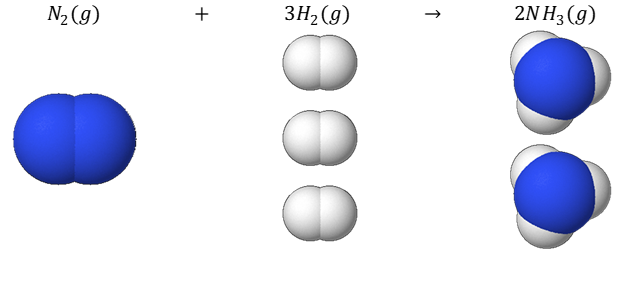
- Check whether the numbers of each entity on both sides are balanced.

0:00 / 0:00
Ways to Write Out Chemical Reactions
Formula Equation
- This is the way we are most familiar with
Total Ionic Equation
- To write the complete ionic equation, we need to look at the formula equation and identify which of the product and reactants can dissociate or ionize. Then write out the equation with all of the ions.
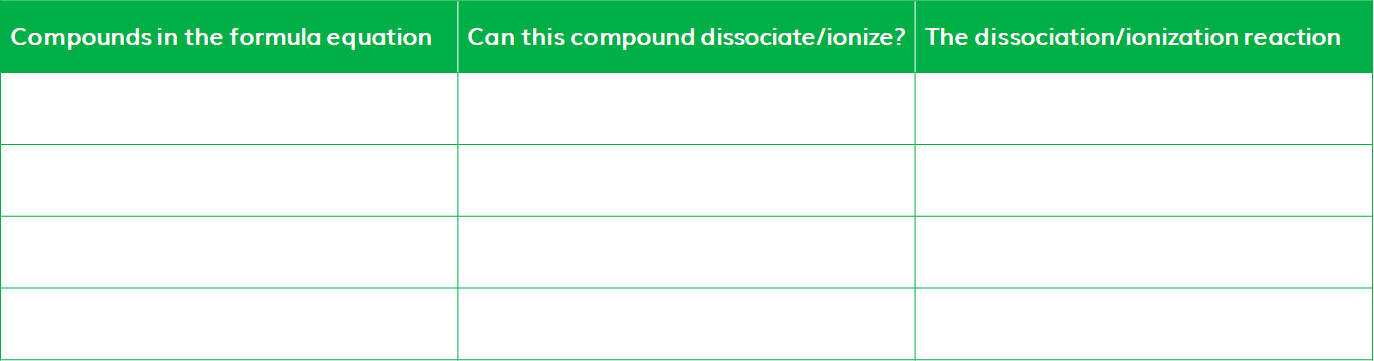
- Next, since we figured out all the molecules that dissociate or ionize and balanced the equations, we need to put everything back into the formula equation:
Net Ionic Equation:
- For this equation, we take the total ionic equation and cross anything out that appears in equal quantities on both sides so that we are left with the net ionic equation.
- Spectator ions are the ions that are not involved in the chemical reaction. These are the ions that appear as both reactants and products and remain unchanged. In this case, the spectator ions areSO42-andNa+.

0:00 / 0:00
Example: Balancing Chemical Equations with Polyatomic Ions
Balance the following chemical equation:
Practice: Identifying Balanced Chemical Reactions
Which of the following are balanced chemical equations? Select all that apply.

Mark Yourself Question
- Grab a piece of paper and try this problem yourself.
- When you're done, check the "I have answered this question" box below.
- View the solution and report whether you got it right or wrong.
Practice: Balanced Equations
When given the unbalanced chemical equation:
Student A balanced it as follows:
Student B balanced it as follows:
Both are balanced, but which is correct and why?
Practice: Balancing Chemical Equations
Balance the following chemical equations. If the coefficient is 1, please include it as well.
- Mg(OH)2 + HBr → MgBr2 + H2O
- Fe2O3 + H2 → Fe + H2O
- P + Cl2 →PCl3
- NaHCO3 → Na2CO3 + CO2 + H2O