Wize University Chemistry Textbook > Quantum Numbers and Electron Configurations
Orbital Filling Diagrams
Popular Courses
MCAT
General Course
Grade 12 Chemistry
Ontario High School
Grade 12 Chemistry
Canada High School
CHEM 1301A/B
Western University
CHEM 201
University of Calgary
General Chemistry
University Study Guides
AP Chemistry Exam Prep Course
AP Exam Prep
CHEM 101
University of Alberta
CHEM 112
Queen's University
CHEM 121
University of British Columbia
High School Chemistry
US High School
Chemistry
General Course
DAT
General Course
General Chemistry
University Study Guides
CHEM 103
University of Alberta
CHEM 110
McGill University
CHEM 1E03
McMaster University
ENGG 204
University of Calgary
CHM135H1
University of Toronto
CHEM 120
University of Waterloo

0:00 / 0:00
Relative Energies of Atomic Orbitals
One-Electron Species
- For a one-electron species like the hydrogen atom, there is no electron-electron repulsion. Therefore, all the subshells of the same n are degenerate.
- Orbitals at the same energy level are called degenerate.

Wize Tip
It will be helpful to understand the difference between a shell, a subshell, and an orbital.
We will label these in the diagram above!
Multi-Electron Species
- With multi-electron species, there are interactions between electrons (electron-electron repulsion)
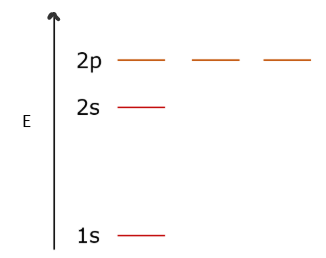
- The energy level diagram of the orbitals looks like this:

Wize Concept
- S subshells hold a maximum of2electrons
- P subshells hold a maximum of6electrons
- D subshells hold a maximum of10electrons
- F subshells hold a maximum of14electrons
Example:
If n=2, what is the total number of orbitals in that shell?
- 22=4, circle the4orbitals that have n=2 above
What if we wanted to know the maximum number of electrons we could have if n=2?
- We already found that total number of orbitals for this shell (4)
- What is the maximum number of electrons we could have in each orbital?2
- Therefore the maximum number of electrons possible when n=2 is8
0:00 / 0:00
Rules for Orbital Filling
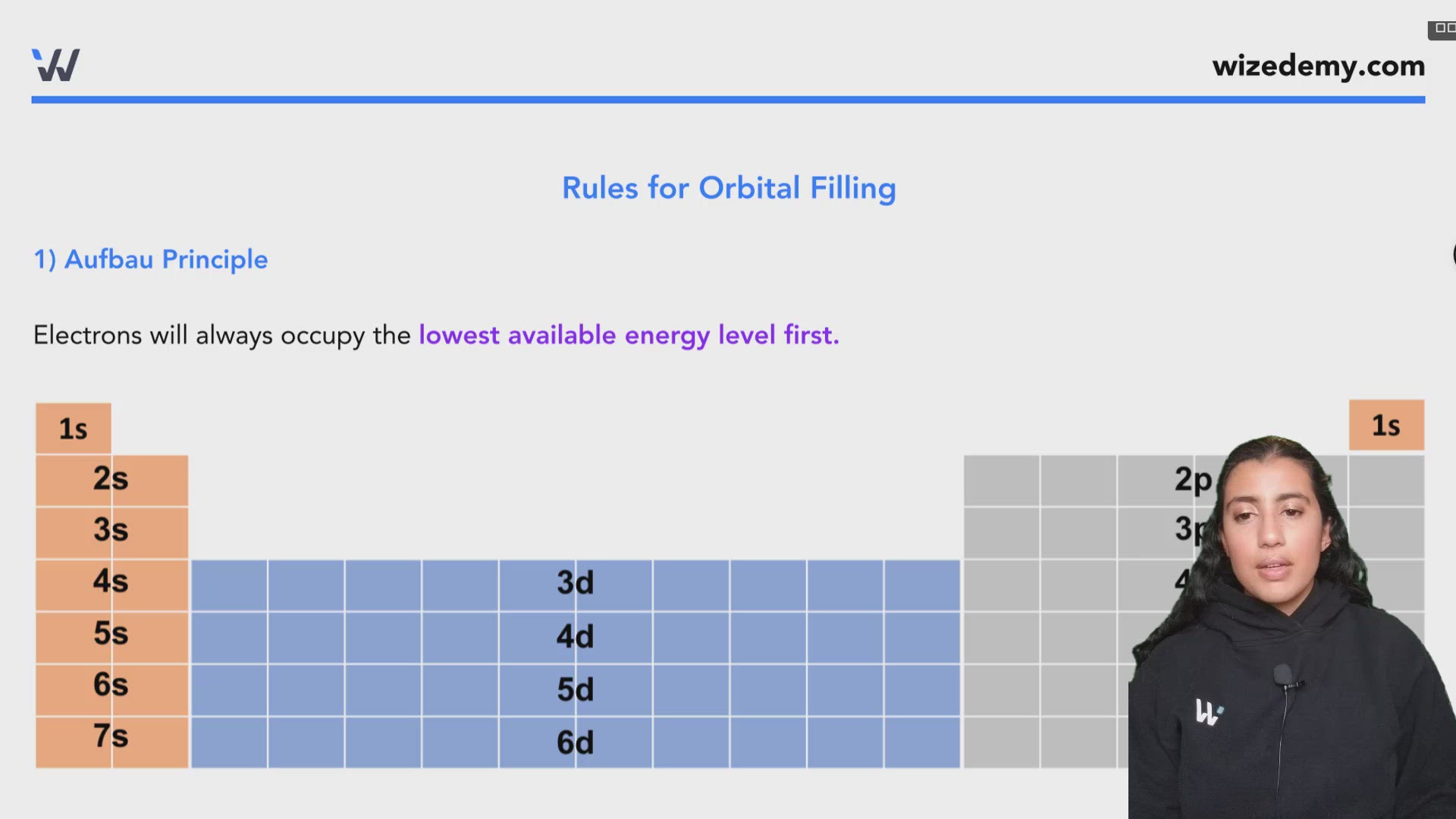
1) Aufbau Principle
Electrons will always occupy the lowest available energy level first.

Watch Out!
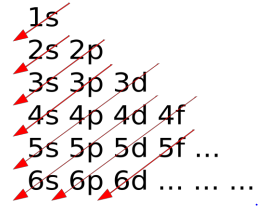
Memorize the order of orbital filling (or just familiarize yourself enough with the periodic table to know the order!): 1s, 2s, 2p, 3s, 3p, 4s, 3d, 4p...
2) Hund’s Rule
Due to electron-electron repulsion, electrons will fill orbitals of the same energy singly before pairing up
Electrons don't want to be next to each other unless they have to be!
Example: Fill out the following orbital diagram for C
3) Pauli Exclusion Principle
No two electrons in an atom will have the same set of 4 quantum numbers.

0:00 / 0:00
Example: Orbital Filling Diagrams
Draw the orbital diagram for oxygen.
0:00 / 0:00
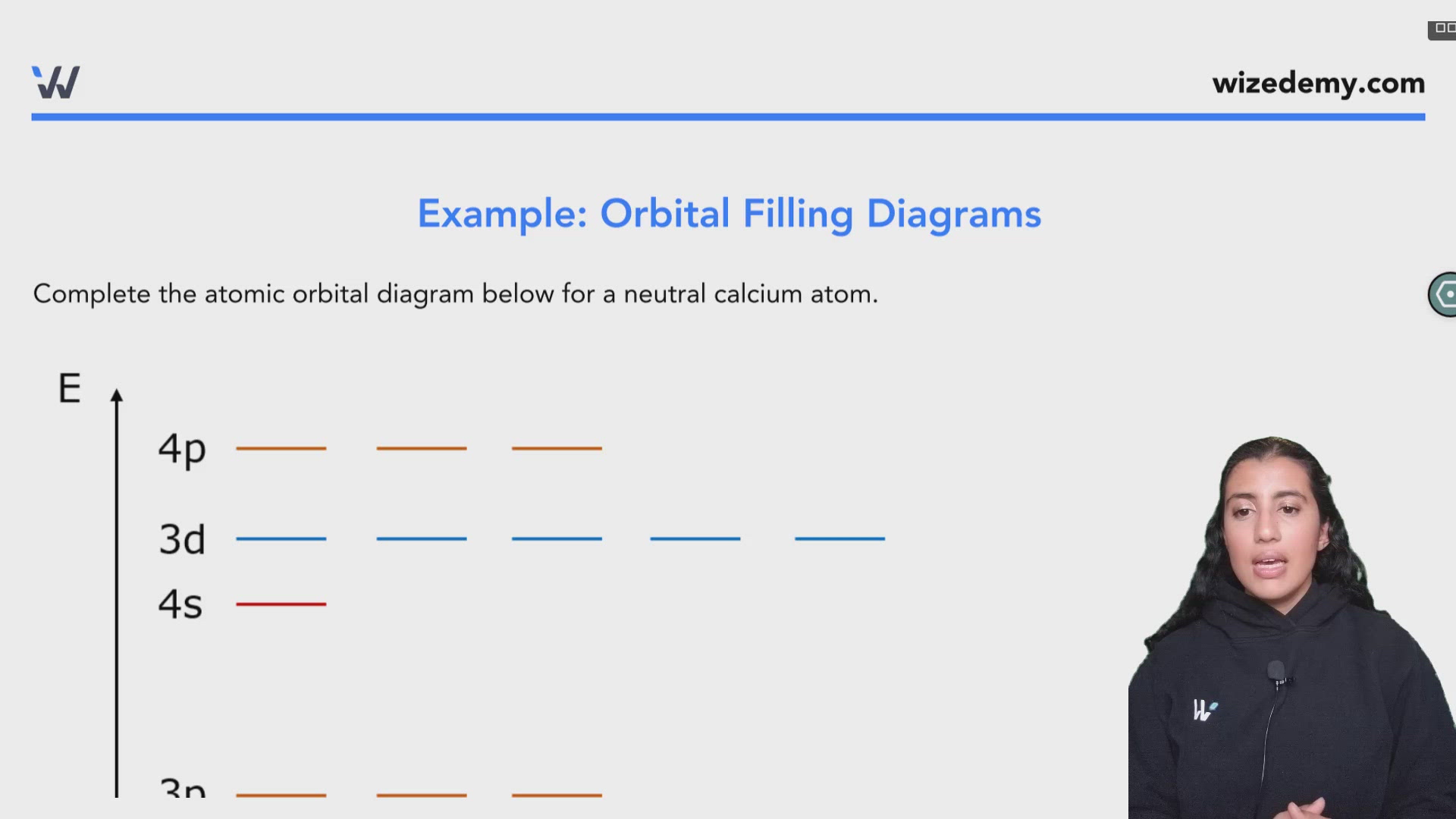
Example: Orbital Filling Diagrams
Complete the atomic orbital diagram below for a neutral calcium atom.


Practice: Orbital Filling Diagrams
Which of the orbital diagrams gives the correct electron configuration for an atom of boron, in the ground state?
Practice: Number of Orbitals
How many different atomic orbitals exist where n = 3?