Wize University Chemistry Textbook > Quantum Numbers and Electron Configurations
Radial and Angulor Nodes
Popular Courses
CHEM 1301A/B
Western University
CHEM 201
University of Calgary
General Chemistry
University Study Guides
CHEM 101
University of Alberta
CHEM 112
Queen's University
CHEM 121
University of British Columbia
Chemistry
General Course
DAT
General Course
General Chemistry
University Study Guides
CHEM 103
University of Alberta
CHEM 110
McGill University
CHEM 1E03
McMaster University
CHM135H1
University of Toronto
CHEM 120
University of Waterloo
CHEM 121
Simon Fraser University
APSC 131
Queen's University
CHEM 1100
University of Manitoba
CHEM 1481
Texas A & M University
CEM 141
Michigan State University
CHMA10H3
University of Toronto
0:00 / 0:00
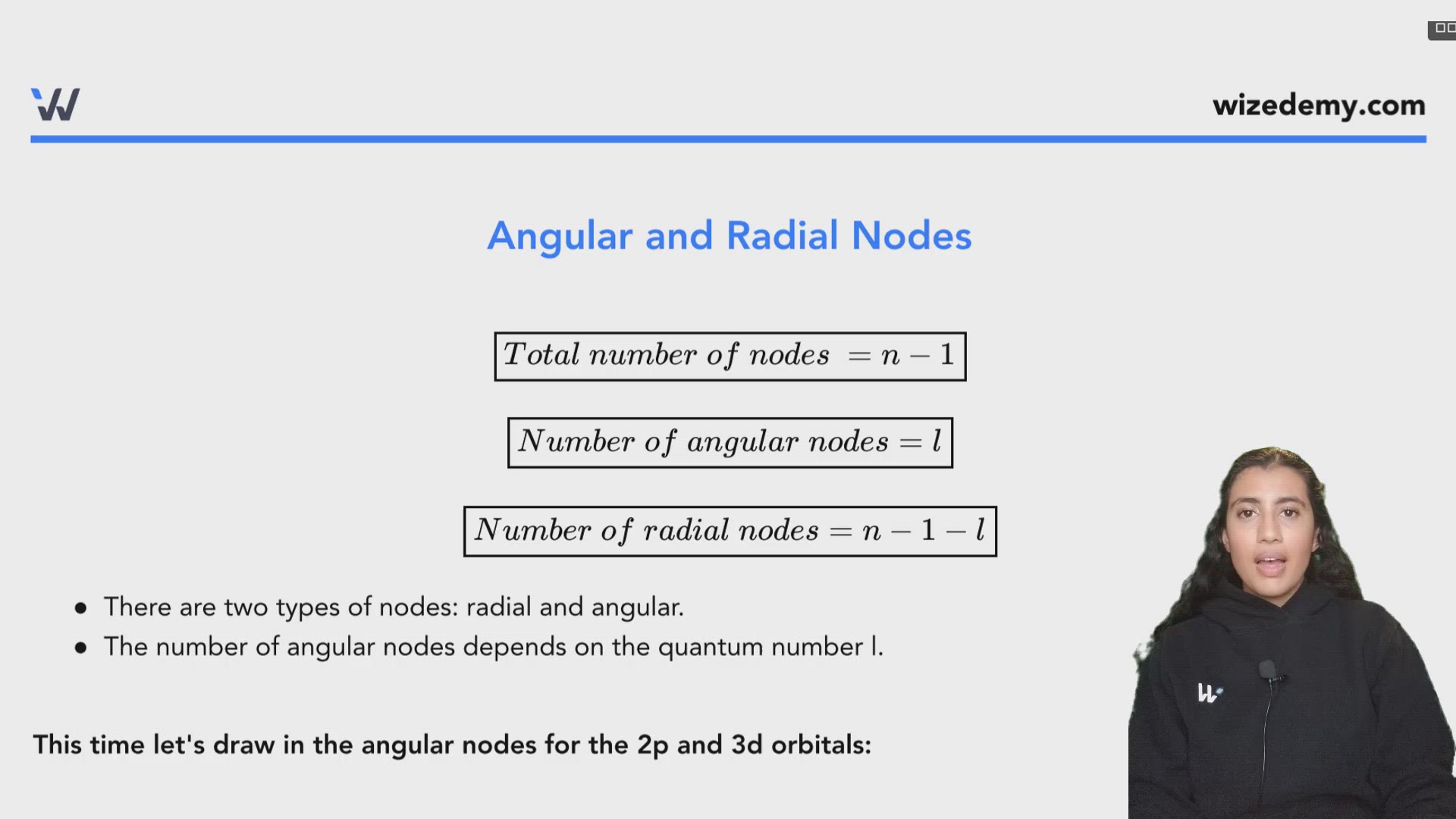
Angular and Radial Nodes
- There are two types of nodes: radial and angular.
- The number of angular nodes depends on the quantum number l.
This time let's draw in the angular nodes for the 2p and 3d orbitals:


Another View of the Nodes
- Nodes are regions in space where the probability of finding an electron is zero.
- In p orbitals and d orbitals, we have planar nodes between the lobes of electron densities.
- We will take a look at s orbitals and their nodes soon...


0:00 / 0:00
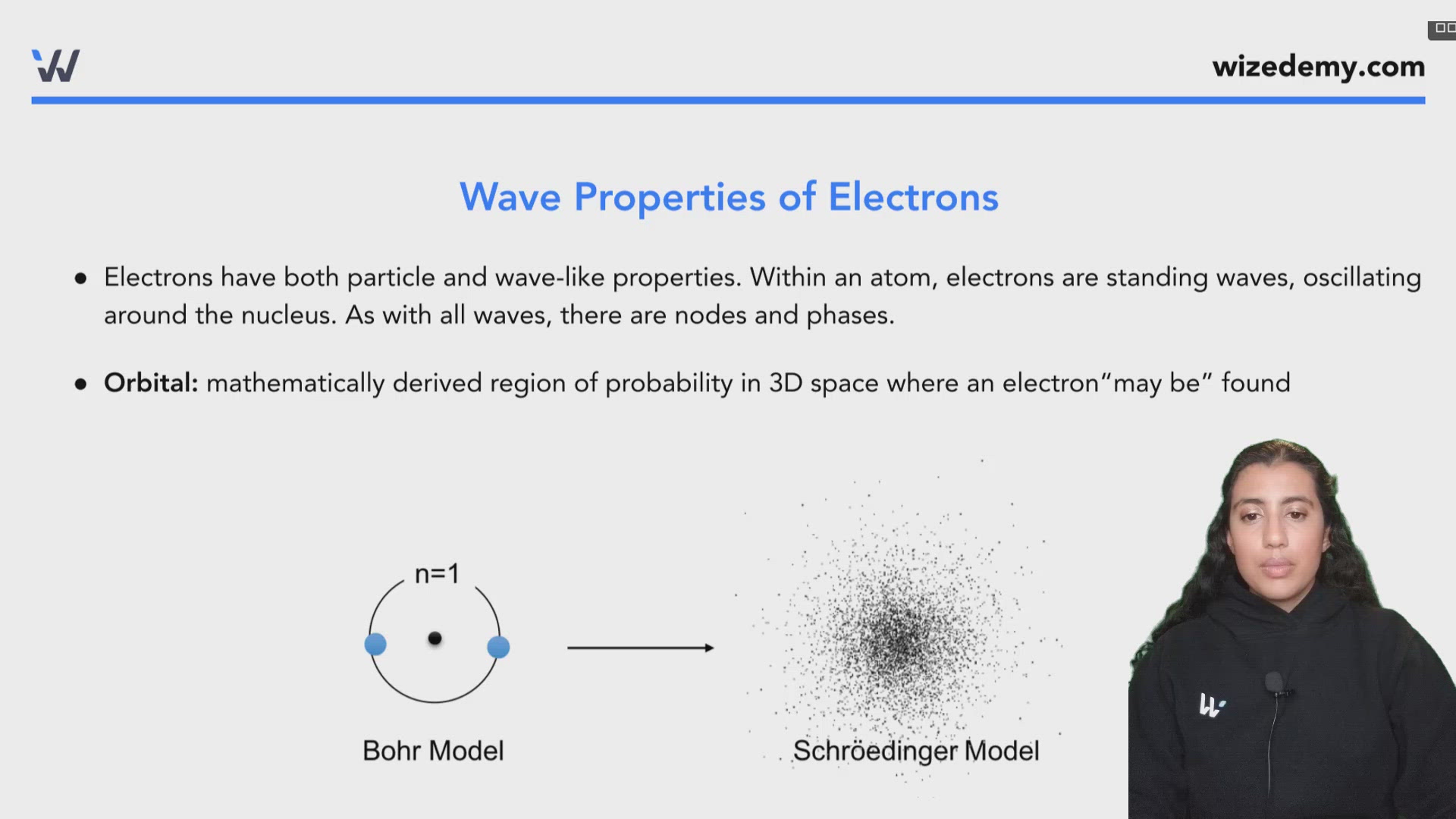
Wave Properties of Electrons
- Electrons have both particle and wave-like properties. Within an atom, electrons are standing waves, oscillating around the nucleus. As with all waves, there are nodes and phases.
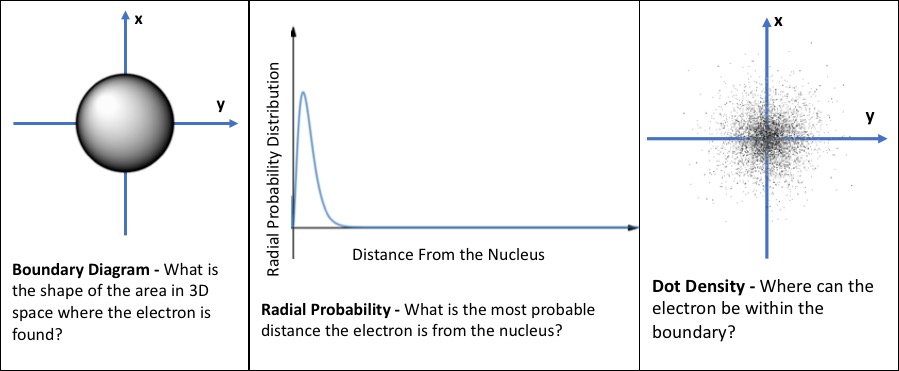
- Orbital: mathematically derived region of probability in 3D space where an electron“may be” found

Representations of Atomic Orbitals
0:00 / 0:00
Plotting the Radial Probability
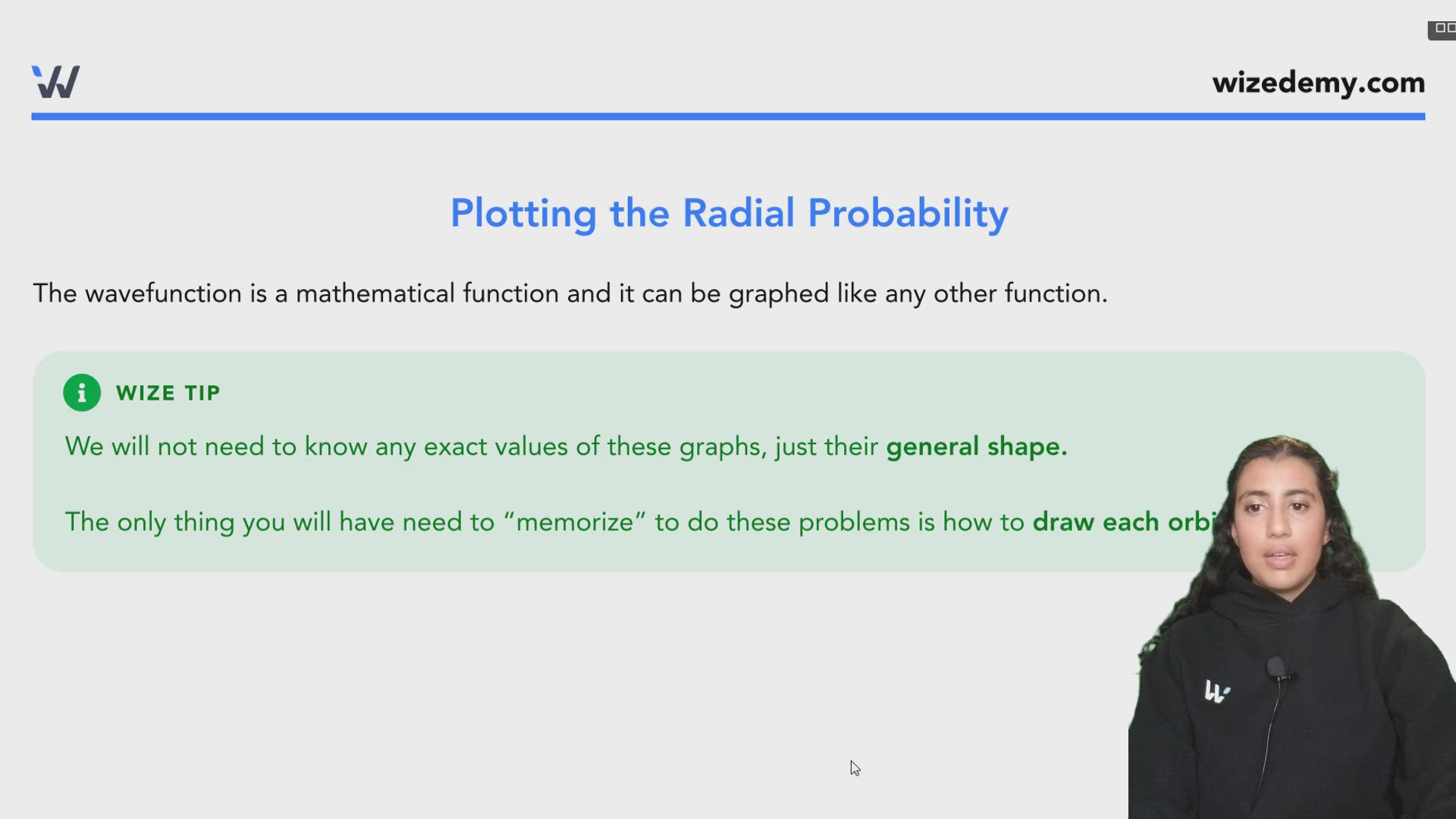
The wavefunction is a mathematical function and it can be graphed like any other function.
Wize Tip
We will not need to know any exact values of these graphs, just their general shape.
The only thing you will have need to “memorize” to do these problems is how to draw each orbital.
Although the wavefunction has no physical meaning, the square of the wavefunction is related to the probability of finding an electron at a given point in space.
Wize Concept
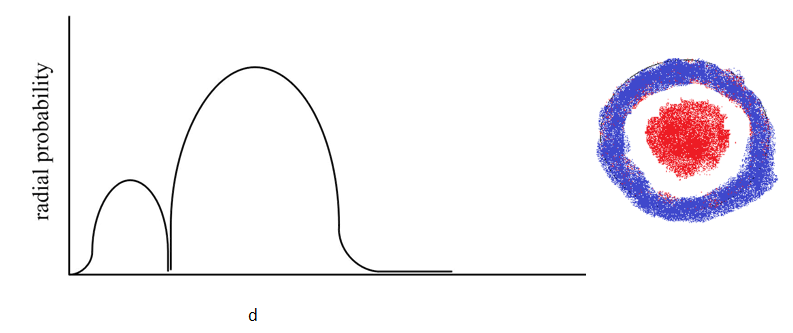
→ Each radial node will be indicated by a zero point on a radial probability graph
→ Each graph begins at zero (no probability of finding the electron in the nucleus)
→ Each graph trails off to infinity (no “edge” of an orbital”)
Example: 2s Orbital
Watch Out!
The point where the distance from the nucleus = 0 is NOT a radial node!
This is a common mistake students make on exams.
Aside from that point, every other point that touches the x axis represents a radial node!
Wize Tip
The most important piece of information we can get from the radial probability plot is the number of radial nodes!
0:00 / 0:00
Example: Calculate the Number of Radial and Angular Nodes
How many radial and angular nodes are present in the following orbitals?
a) 7p
total = n - 1 = 6
angular = l = 1
radial = n - l - 1 = 5
b) 3d
total = n - 1 = 2
angular = l = 2
radial = n - l - 1 = 0
c) 4s
total = n - 1 = 3
angular = l = 0
radial = n - l - 1 = 3
0:00 / 0:00
Example: Sketching Radial Probability
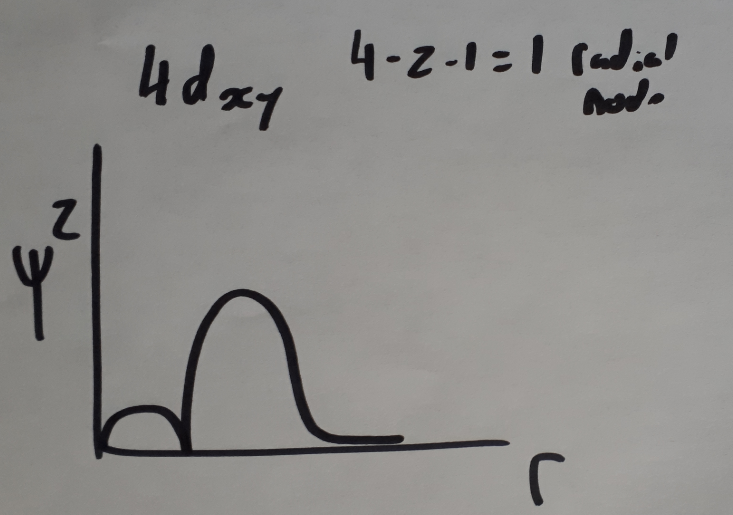
Sketch the radial probability of a 4dxy orbital starting at r=0
1) Calculate the number of radial nodes
(n-1-l=radial nodes)
Here there is 1 radial node.
2) Draw the radial probability plot showing 1 radial node
Remember that the point r=0 is not a radial node
The second part of the plot after the radial node should have a larger area since there is a greater probability of finding an electron there.
0:00 / 0:00
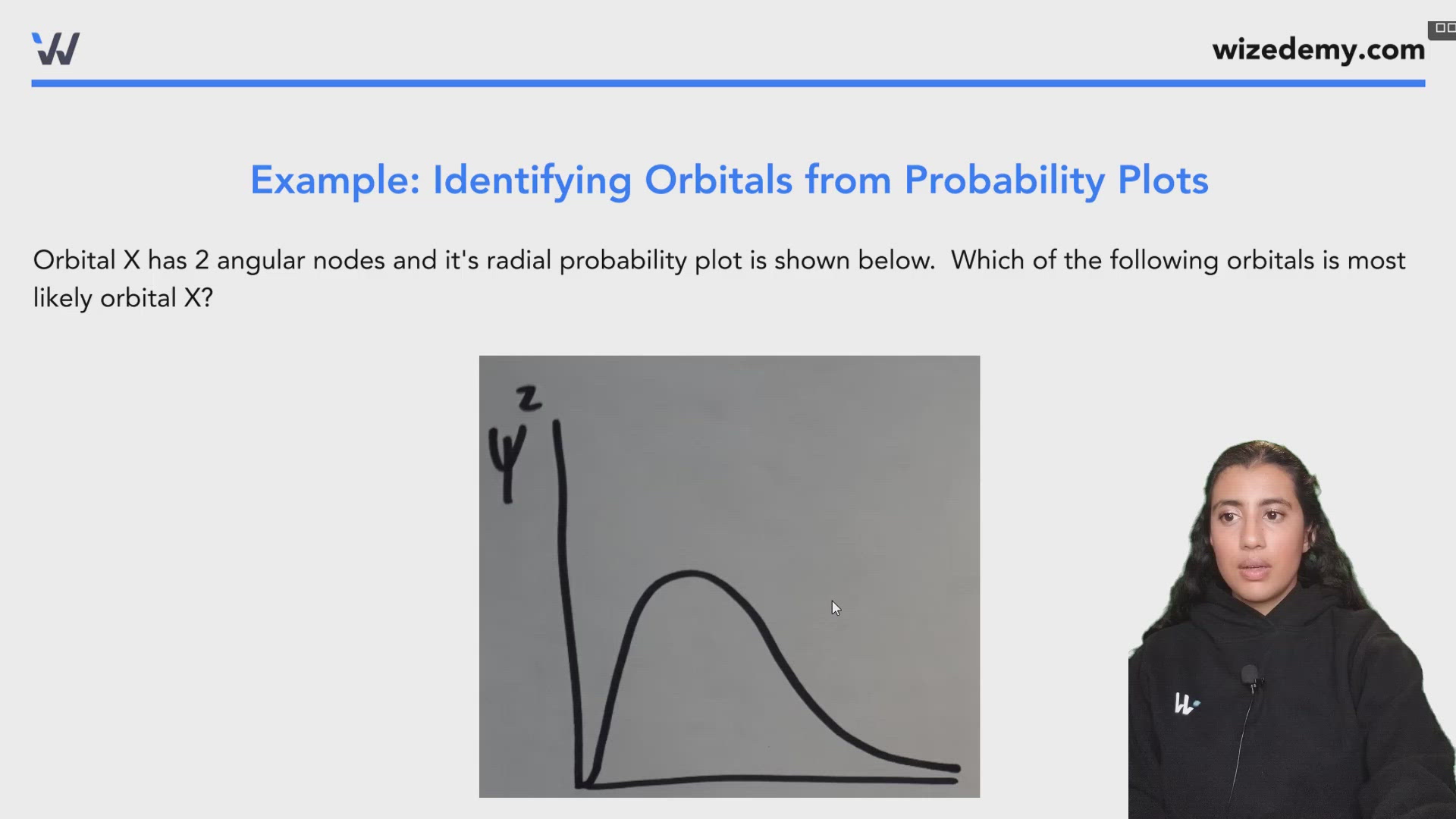
Example: Identifying Orbitals from Probability Plots
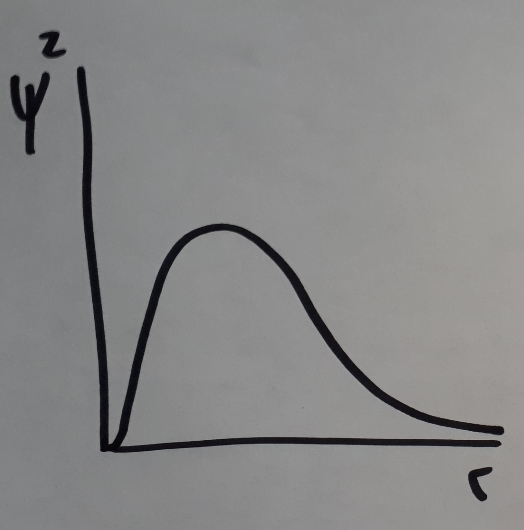
Orbital X has 2 angular nodes and it's radial probability plot is shown below. Which of the following orbitals is most likely orbital X?
a) 3dz2
b)1s
c) 4px
d) 3s
e) 2py
The question tells us that orbital X has two angular nodes so it must be a d-orbital since l=2.
The radial probability plot hows no radial nodes.
n-l-1=radial nodes
n-l-1=0 Solve for n where l=2
n-2-1=0
n-3=0
n=3
Therefore, n=3 l=2 to get no radial nodes.
This corresponds to a 3d orbital!
Answer a)
Practice: Identifying Orbitals from Probability Plots
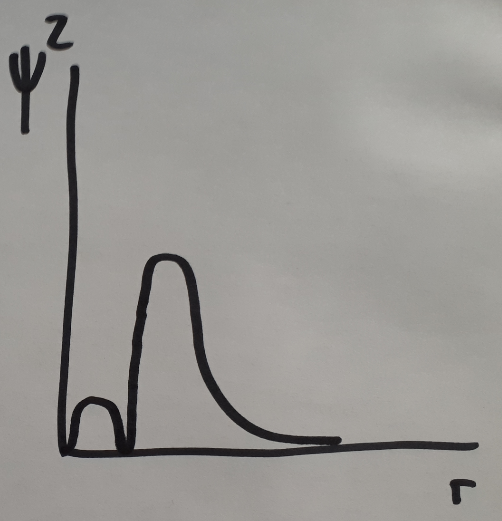
An orbital has only one angular node which lies along the yz plane. The radial probability plot is shown below, please identify the orbital.
0:00 / 0:00
Nodes
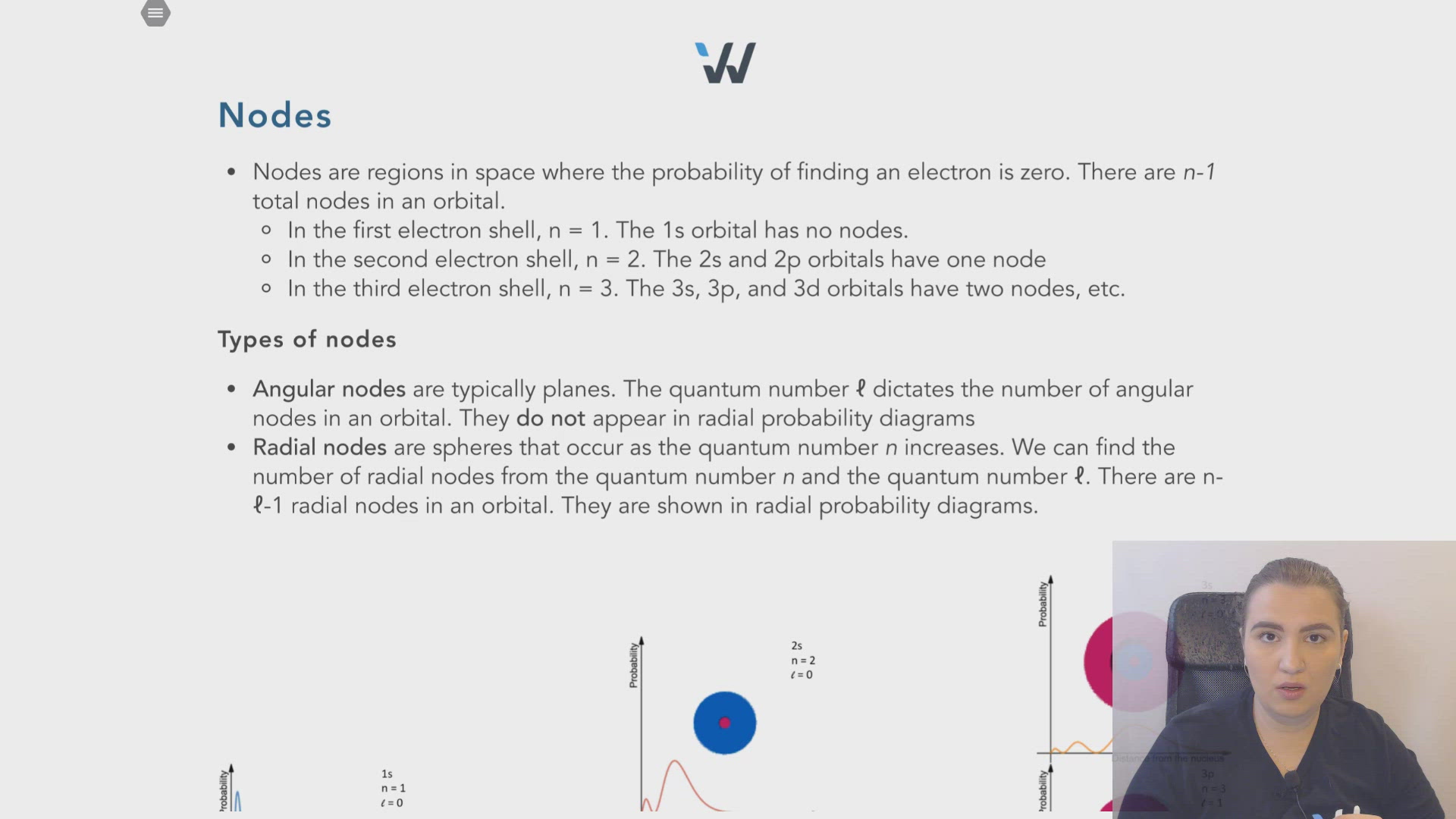
- Nodes are regions in space where the probability of finding an electron is zero. There are n-1 total nodes in an orbital.
- In the first electron shell, n = 1. The 1s orbital has no nodes.
- In the second electron shell, n = 2. The 2s and 2p orbitals have one node
- In the third electron shell, n = 3. The 3s, 3p, and 3d orbitals have two nodes, etc.
Types of nodes
- Angular nodes are typically planes. The quantum number ℓ dictates the number of angular nodes in an orbital. They do not appear in radial probability diagrams
- Radial nodes are spheres that occur as the quantum number n increases. We can find the number of radial nodes from the quantum number n and the quantum number ℓ. There are n-ℓ-1 radial nodes in an orbital. They are shown in radial probability diagrams.
