Wize University Chemistry Textbook > Quantum Numbers and Electron Configurations
Shapes of Atomic Orbitals
Popular Courses
MCAT
General Course
CHEM 1301A/B
Western University
CHEM 201
University of Calgary
General Chemistry
University Study Guides
CHEM 101
University of Alberta
CHEM 112
Queen's University
CHEM 121
University of British Columbia
Chemistry
General Course
DAT
General Course
General Chemistry
University Study Guides
CHEM 103
University of Alberta
CHEM 110
McGill University
CHEM 1E03
McMaster University
ENGG 204
University of Calgary
CHM135H1
University of Toronto
CHEM 120
University of Waterloo
CHEM 205
Concordia University
CHEM 121
Simon Fraser University
SC/CHEM 1000 3.00
York University
APSC 131
Queen's University

0:00 / 0:00
Shapes (aka Boundary Diagrams) of Atomic Orbitals

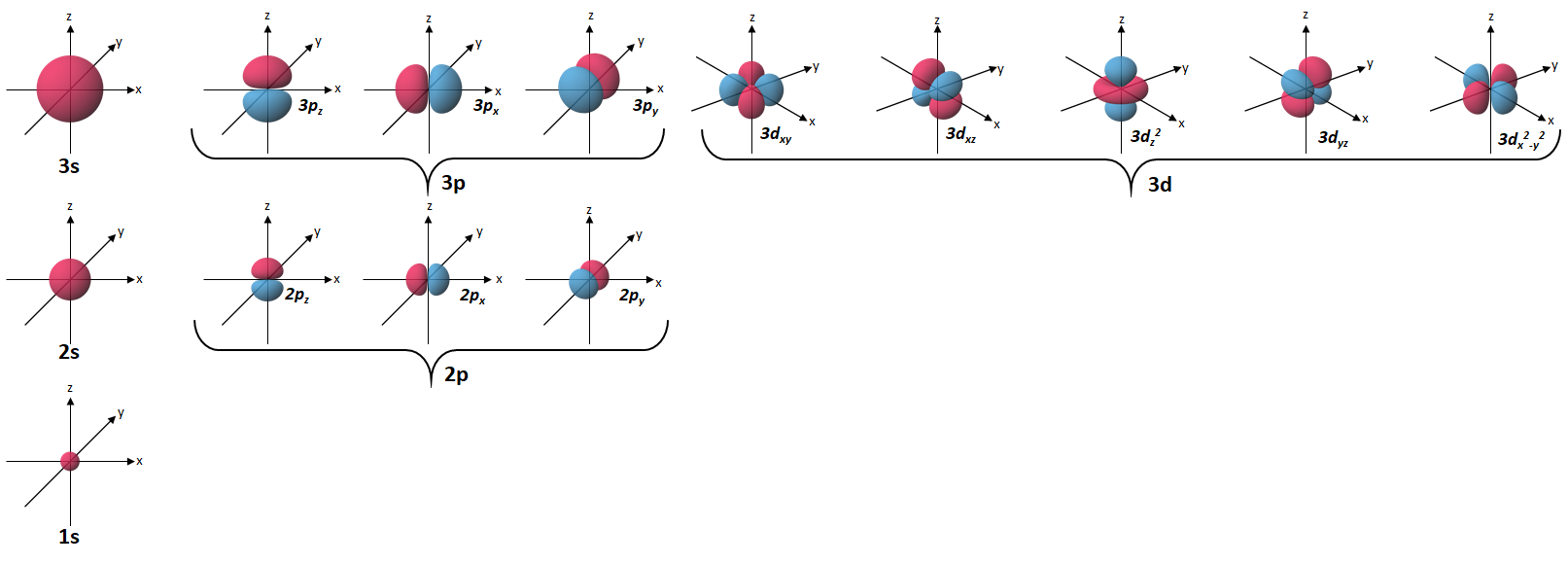
- There is one s orbital in a subshell, which is a sphere
- There are three p orbitals in a subshell, each orientated along an axis (px, py and pz)


- There are five d orbitals in a subshell. The shapes of the d orbitals are more complicated than their s and p counterparts.
- Three orbitals look like 3D cloverleaves, each lying in a plane with the lobes pointed between the axes (dxy, dxz and dyz).
- A fourth orbital is also a cloverleaf, but its lobes point along the axes ().
- The fifth orbital looks quite different with its major lobes pointing along the z- axis, but there is also a “doughnut” of electron density in the xy plane ()
Things to Keep in Mind:
- As the energy level increases, so does the size of the orbitals Example: A 2s orbital is higher in energy and larger than a 1s orbital
- As the energy level increases, so does the number of orbitals Example: when n=1 (lower energy level), we see 1 orbital, whereas when n=2 (higher energy level), there are 4 possible orbitals
- As the number of orbitals increases, so does their complexity Example: d orbitals are more complex than p orbitals
0:00 / 0:00
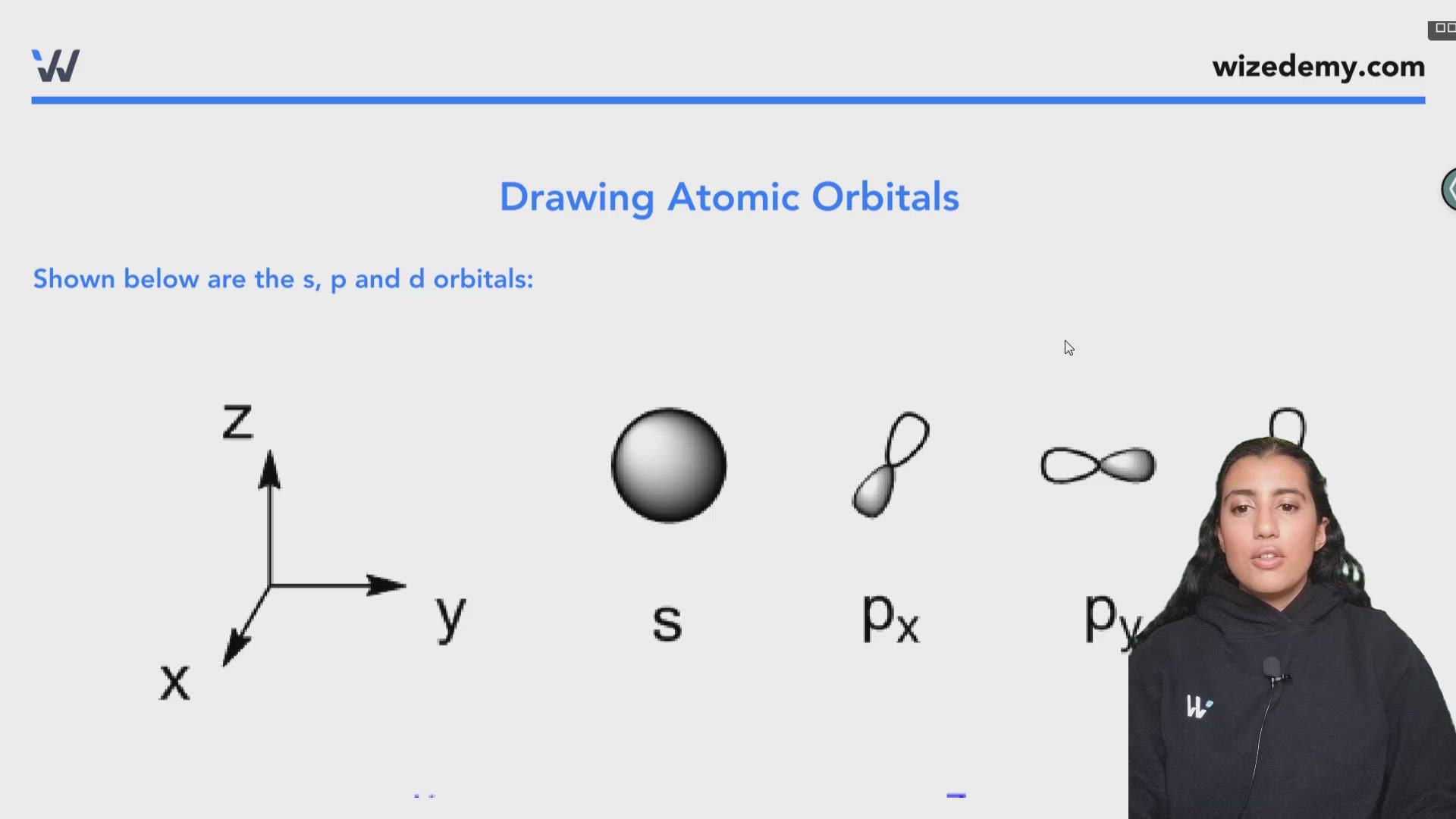
Drawing Atomic Orbitals
Shown below are the s, p and d orbitals:


Wize Tip
Pay attention to whether the lobes are ON an axis or BETWEEN axes!
Also, notice how every other lobe is colored in gray. This gray and white coloring is indicating a "positive" lobe and a "negative" lobe. If you were asked to draw one of these orbitals on an exam, you would be expected to color in the lobes as well (or indicate which are + and which are -).
- The angular momentum quantum number, l, gives us information about the shape of the orbital.
- Note: There are 5 d-orbitals and 5 allowed value for ml. Similarly for s and p the number of orbitals is determined by the # of allowed values of ml.
- Note: Each ml is not associated with a particular orbital (ex. dxy vs dxz). Which means given a set of quantum numbers (n,l,ml) one cannot determine which direction the orbital will be pointing
0:00 / 0:00
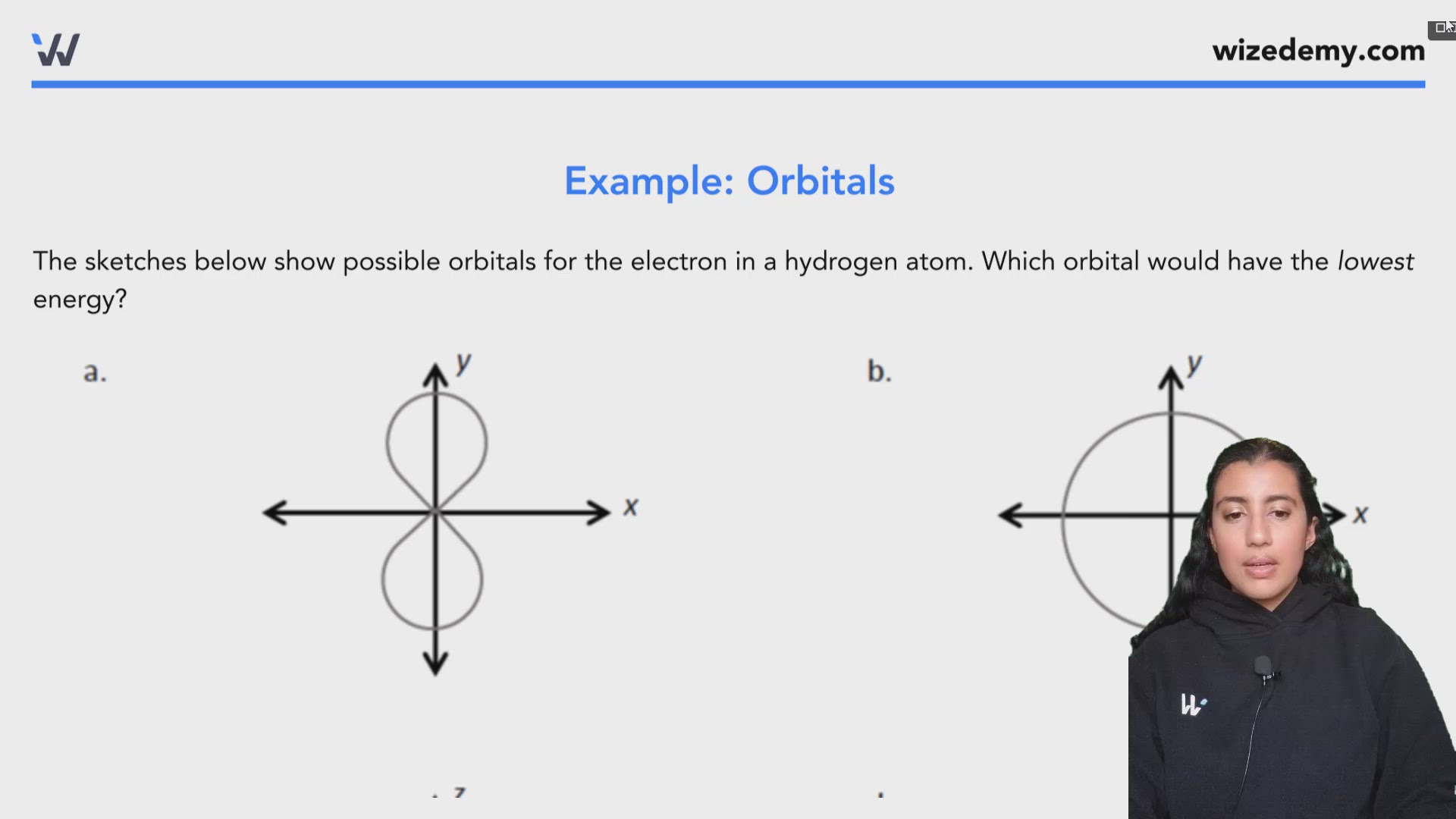
Example: Orbitals
The sketches below show possible orbitals for the electron in a hydrogen atom. Which orbital would have the lowest energy?
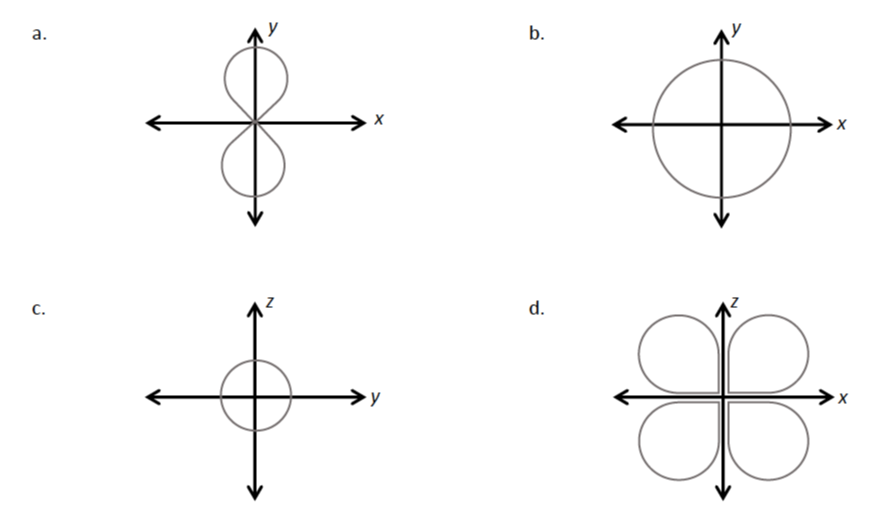
Diagram A represents 2py orbital and diagram B a 2s orbital. We can tell it's a 2s rather than a 3s or 1s based on the relative size compared to diagram A and C. Diagram C represents a 1s orbitals, and diagram D a 3dxz orbital.
s < p < d < f for energy.
Out of b and c (b is a 2s orbital while c is a 1s orbital), we know that the orbital with the smaller size has the lower energy. Therefore c) has the lowest energy!
Answer: C
Practice: Identify the Orbital
Identify the orbital shown below,
