Wize University Chemistry Textbook > Quantum Numbers and Electron Configurations
The Quantum Model & Orbitals
Popular Courses
MCAT
General Course
CHEM 1301A/B
Western University
CHEM 201
University of Calgary
General Chemistry
University Study Guides
CHEM 101
University of Alberta
CHEM 112
Queen's University
CHEM 121
University of British Columbia
DAT
General Course
Chemistry
General Course
General Chemistry
University Study Guides
CHEM 103
University of Alberta
CHEM 110
McGill University
CHEM 1E03
McMaster University
CHM135H1
University of Toronto
CHEM 120
University of Waterloo
CHEM 205
Concordia University
CHEM 121
Simon Fraser University
CHEM 1011
Dalhousie University
APSC 131
Queen's University
CHEM 205
University of British Columbia
0:00 / 0:00
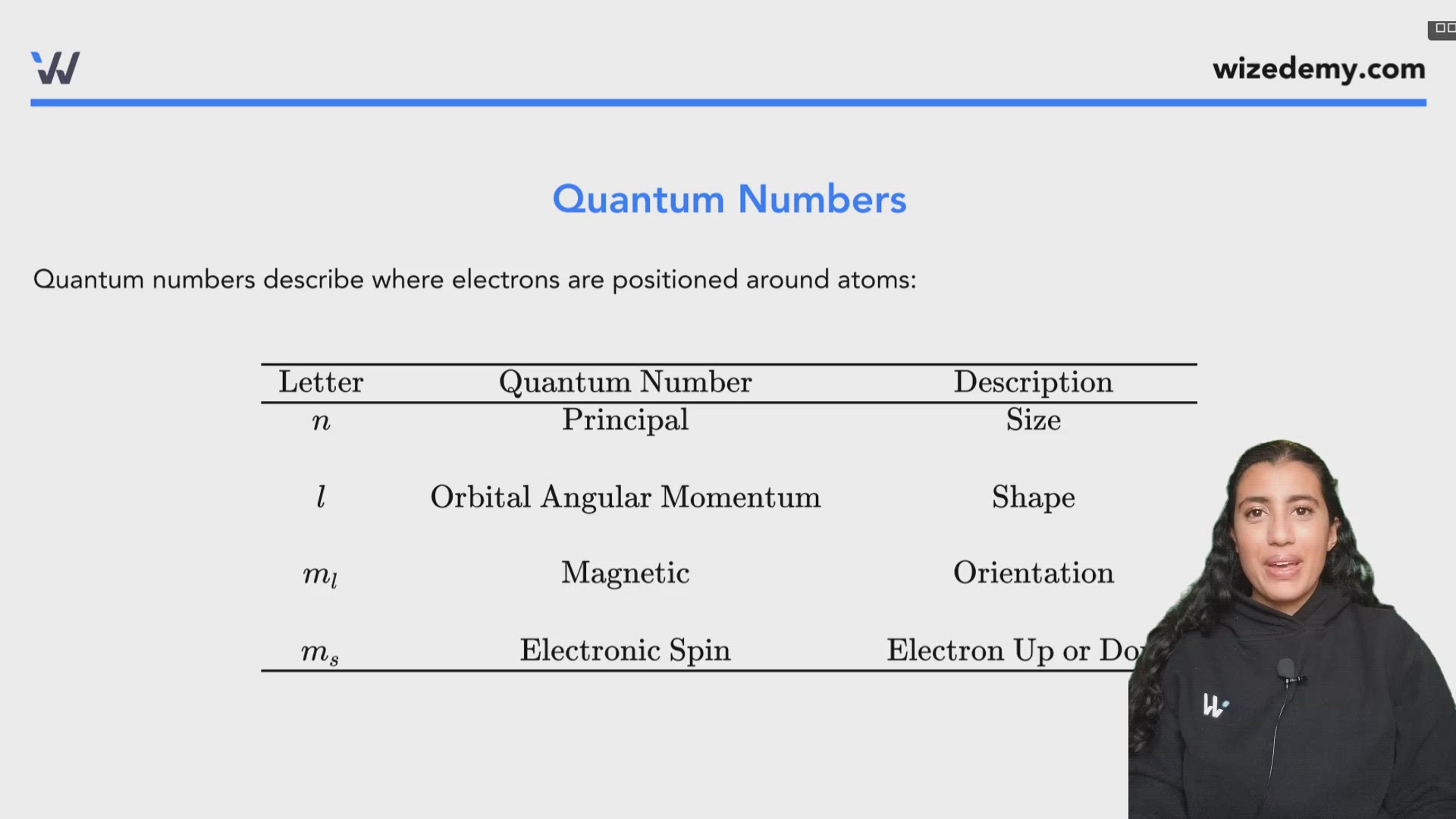
Quantum Numbers
Quantum numbers describe where electrons are positioned around atoms:
Rules:
- Can be any positive integer Example: n = (1, 2, 3, 4…)
- As n increases, energy and size of shellincreases
Wize Tip
n is also called the "principle quantum number"
- Can be any non-negative integer up to n-1 Example: l = (0, 1, 2, 3, …, n-1)
- l (orbital shapes) are described as:

Increasing energy →

- These shapes show us where an electron is most likely to be found
- There is a 90% chance in finding an electron somewhere inside the given shape
Wize Concept
S orbitals are spheres and with increasing "n" the sphere will get larger.
There is one s orbital in a subshell.
P subshells are dumbbell shaped.
There are three p orbitals in a subshell, each orientated along an axis (px, py and pz)
- Can be any integer from –l to +l Example: m1 = (-l, …, 0, …, l)
- This quantum # designates a specific orbital within a given shell Example: if n=2 and l=1, we are looking at 2p.
- ml can be -1, 0, or +1 this designates each of the 2p orbitals: 2px, 2py, and 2pz
- Spin of an electron
- Can only be +1/2 or -1/2
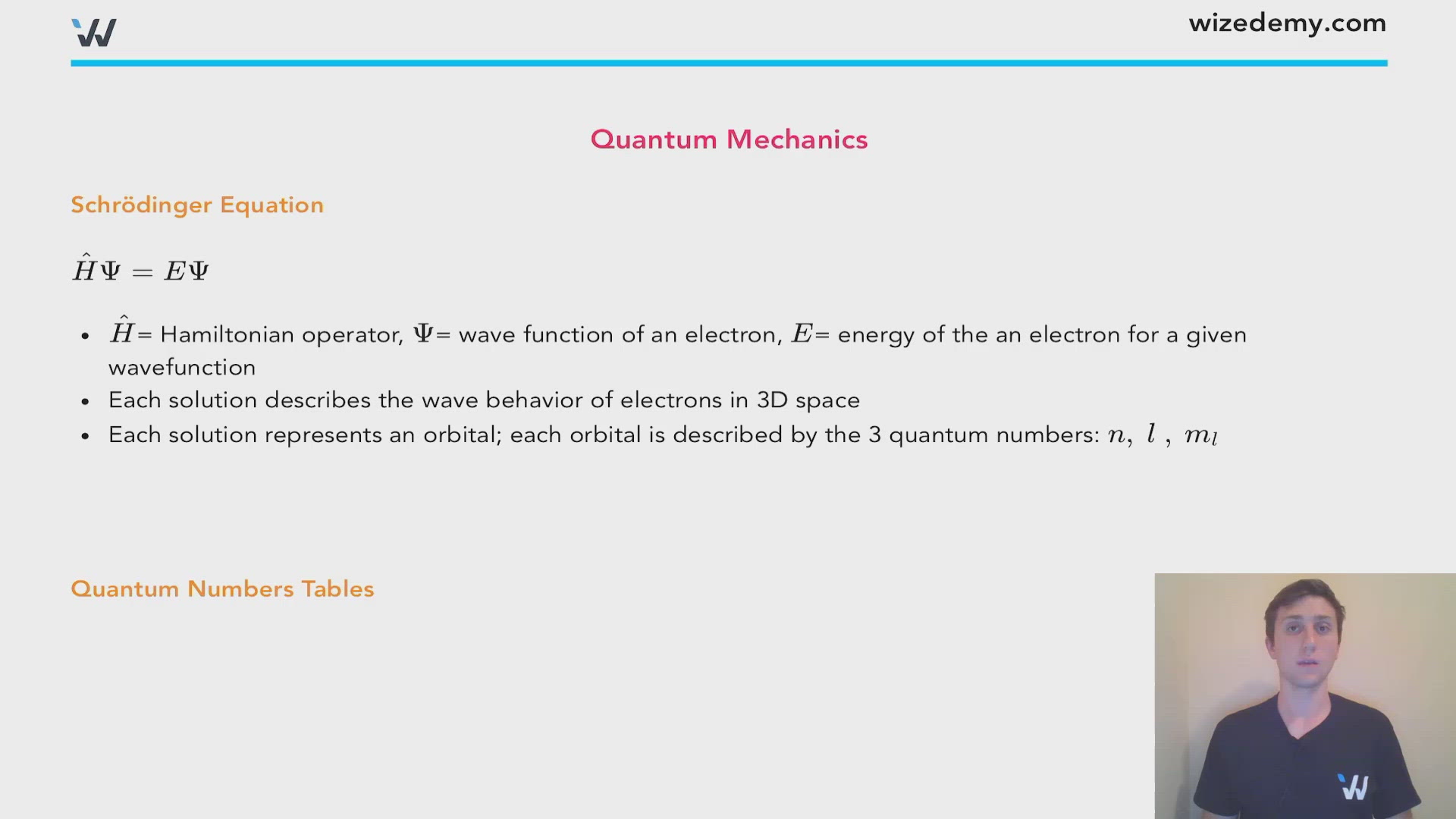
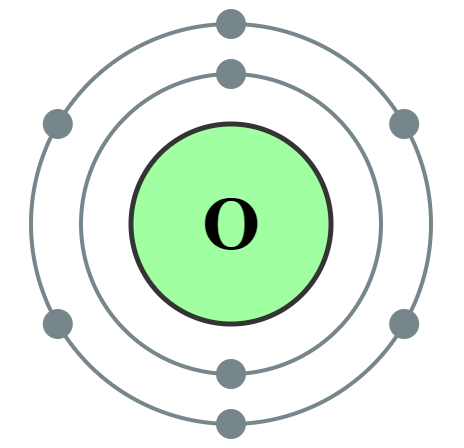
0:00 / 0:00
Quantum Numbers Summary

0:00 / 0:00
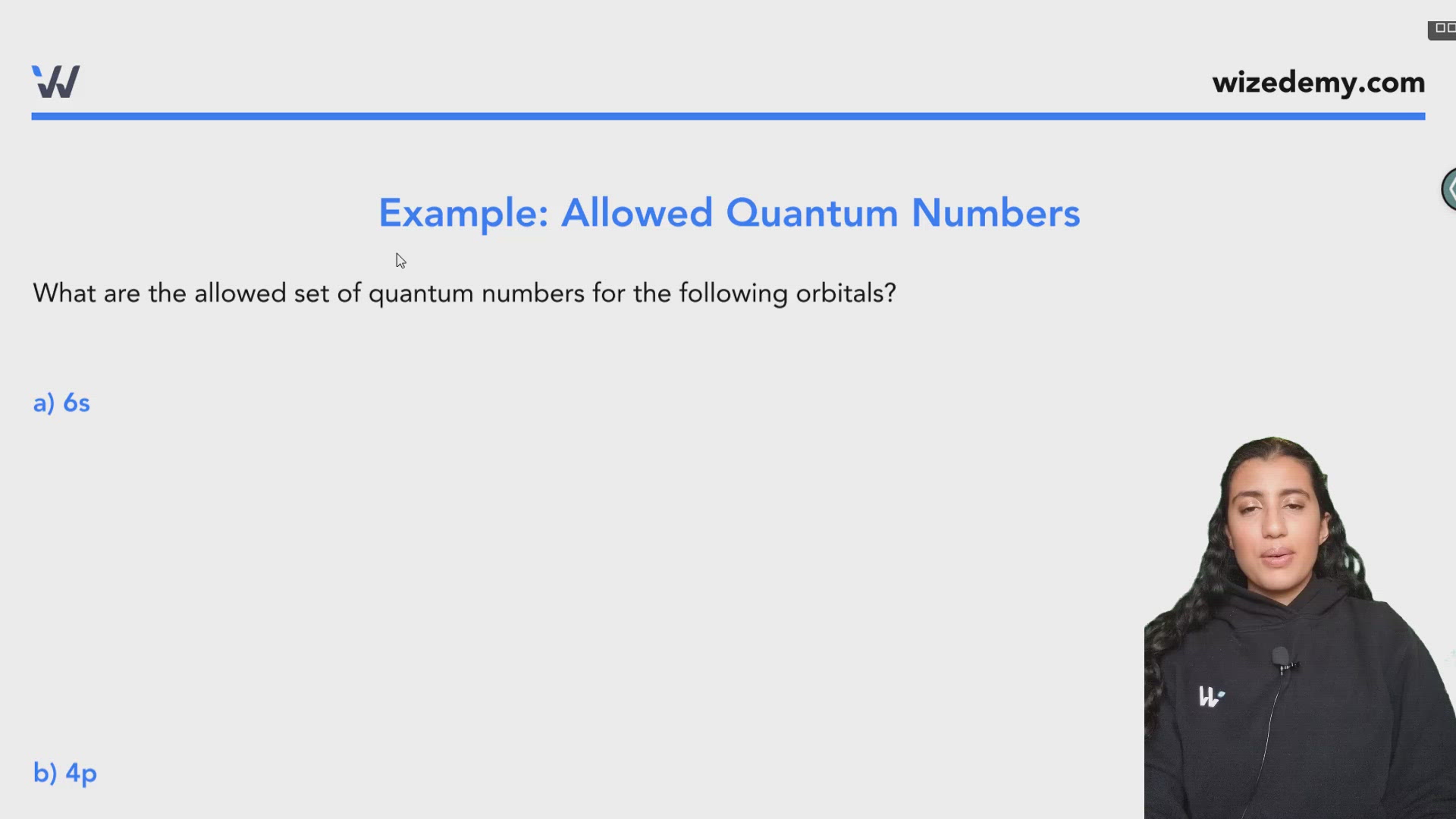
Example: Allowed Quantum Numbers
What are the allowed set of quantum numbers for the following orbitals?
a) 6s
n = 6
l = 0
ml = 0
ms= +1/2 or -1/2
b) 4p
n = 4
l = 1
ml = -1, 0, or 1
ms= +1/2 or -1/2
c) 3d
n = 3
l = 2
ml = -2, -1, 0, 1, or 2
ms= +1/2 or -1/2
0:00 / 0:00
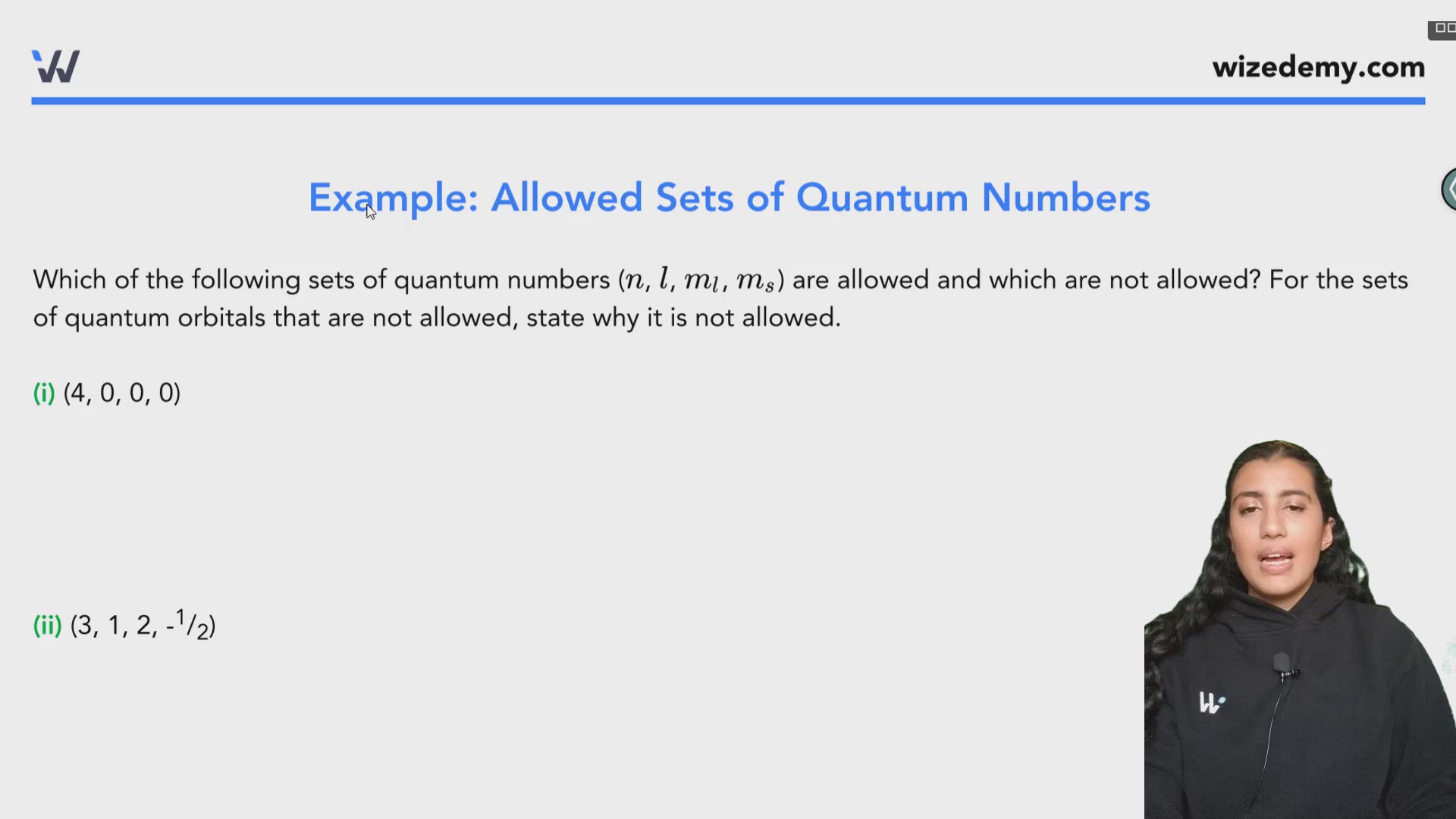
Example: Allowed Sets of Quantum Numbers
Which of the following sets of quantum numbers (, , , ) are allowed and which are not allowed? For the sets of quantum orbitals that are not allowed, state why it is not allowed.
(i) (4, 0, 0, 0)
Not allowed - cannot be equal to 0. Quantum number is always either +1/2 or -1/2.
(ii) (3, 1, 2, -1/2)
Not allowed - cannot be equal to 2 if = 1. Remember that equals all integers from to .
(iii) (5, 3, 0, +1/2)
Allowed. This set of quantum numbers describes a 5f orbital.
(iv) (4, 4, 3, -1/2)
Not allowed - cannot be equal to 4 if = 4. Remember that equals all integers from 0 to .
0:00 / 0:00
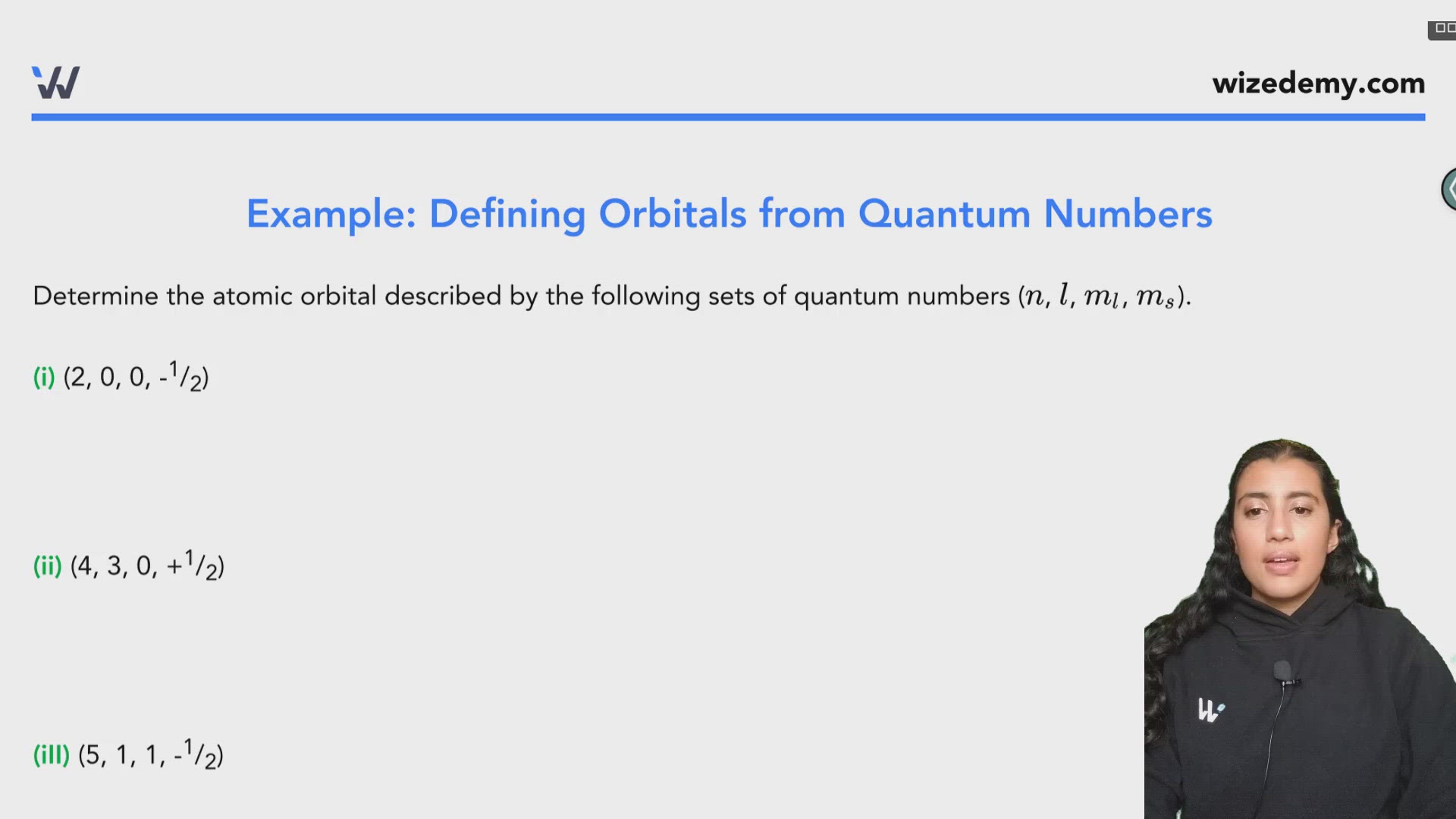
Example: Defining Orbitals from Quantum Numbers
Determine the atomic orbital described by the following sets of quantum numbers (, , , ).
(i) (2, 0, 0, –1/2)
2s orbital
(ii) (4, 3, 0, +1/2)
4f orbital
(iII) (5, 1, 1, –1/2)
5p orbital
Practice: Valid Quantum Numbers
Determine which of the following sets of quantum numbers () is valid for a 3d orbital.