Popular Courses
MCAT
General Course
Grade 12 Chemistry
Ontario High School
Grade 12 Chemistry
Canada High School
CHEM 1301A/B
Western University
CHEM 201
University of Calgary
General Chemistry
University Study Guides
AP Chemistry Exam Prep Course
AP Exam Prep
CHEM 1A03
McMaster University
CHEM 101
University of Alberta
CHEM 112
Queen's University
CHEM 121
University of British Columbia
High School Chemistry
US High School
DAT
General Course
Chemistry
General Course
CHEM 1AA3
McMaster University
CHEM 103
University of Alberta
General Chemistry
University Study Guides
CHEM 110
McGill University
CHM135H1
University of Toronto
CHEM 101
University of Victoria
0:00 / 0:00
Phases of Matter
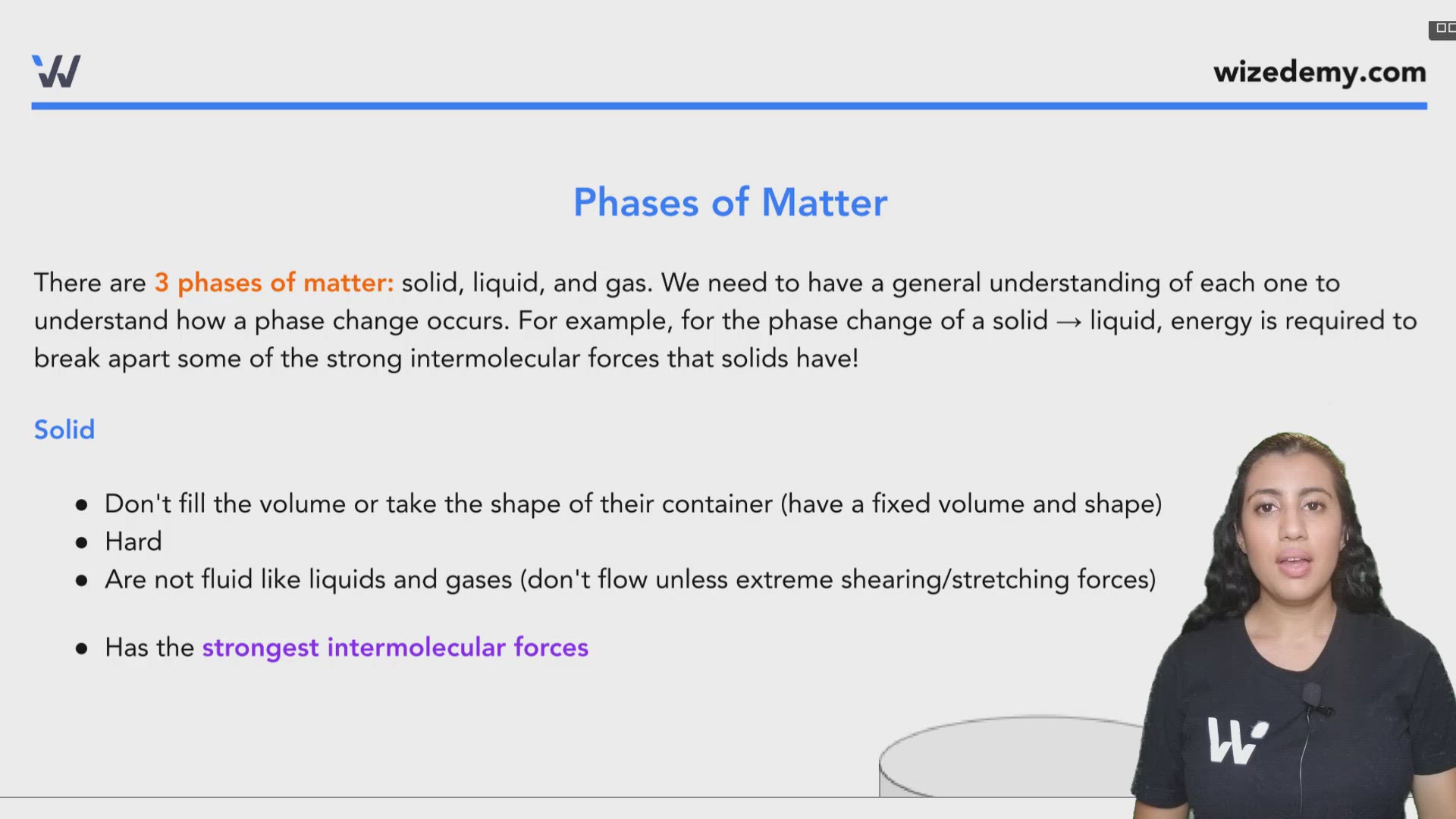
There are 3 phases of matter: solid, liquid, and gas. We need to have a general understanding of each one to understand how a phase change occurs. For example, for the phase change of a solid → liquid, energy is required to break apart some of the strong intermolecular forces that solids have!
Solid
- Don't fill the volume or take the shape of their container (have a fixed volume and shape)
- Hard
- Are not fluid like liquids and gases (don't flow unless extreme shearing/stretching forces)
- Has the strongest intermolecular forces

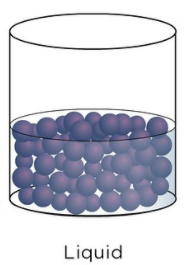
Liquid
- Don't fill the volume of the container, but take the shape of their container
- Fixed volume, not shape since if you transfer the liquid to a different container the volume of liquid will remain the same but the shape of the liquid will change depending on the shape of the container
- Fluid
- Has the weaker intermolecular forces
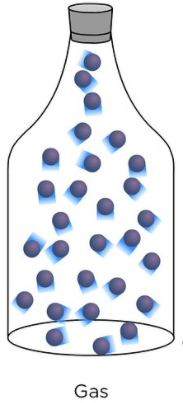
Gas
- Fill the volume and take the shape of their container
- Volume and shape is not fixed, both can change when you change the container that is holding the gas!
- Fluid
- Has the weakest intermolecular forces
- Note how the molecules are very spread apart from each other. This is because the intermolecular forces between them are very weak!
0:00 / 0:00
Intermolecular Forces and Boiling Point
Intermolecular forces define physical properties of compounds (boiling points, melting points, solubility, vapour pressure, viscosities etc)
Boiling Points/Melting Points
In general, if a molecule has the stronger intermolecular forces, would its boiling point be higher or lower?
higher
When trying to determine which molecule has the higher boiling point, we can consider their intermolecular forces.
Example #1: Which of the following molecules has the higher boiling point?
NH3 vs HCl
NH3 has 3 N-H bonds which have hydrogen bonding since H is bound to a N and can interact with a lone pair of electrons on another N on another molecule of NH3.
HCl is polar so the strongest intermolecular forces it has are dipole-dipole forces.
Hydrogen bonding is stronger than dipole-dipole forces so it would take more energy to break apart the hydrogen bonds.
Therefore, the boiling point for NH3 would be higher!
Wize Tip
The stronger the intermolecular forces, the higher the boiling point.
(Highest boiling point) Intramolecular bonding (covalent/ionic) > Hydrogen bonding > Dipole-dipole forces > London dispersion forces (Lowest boiling point)
Example #2: Which of the following has the highest bp?
CH2COO-Na+ vs CH2COOH
CH2COO- and Na+ interact through ionic bonding (aka ion-ion interactions)
CH3COOH has hydrogen bonding
Ionic bonding is stronger than hydrogen bonding
Therefore CH2COO- and Na+ (with ionic bonding) would have a higher bp, since it would take more energy to break it apart
When trying to determine which molecule has the higher bp, what happens when two compounds have the same types of intermolecular forces?
Example #3: Which of the following has the highest bp?
CH3CH2CH3 vs CH3CH2CH2CH3
The strongest intermolecular forces that the molecule on the left has are:
London dispersion forces
The strongest intermolecular forces that the molecule on the right has are:
London dispersion forces
Wize Concept
If two compounds have identical intermolecular forces, the larger molecule will have a higher mp/bp due to increased London dispersion forces forces
Higher MW=More london dispersion forces
Therefore, the molecule on the (left/right)
right
has the stronger intermolecular forces and (lower/higher) higher
boiling point!When trying to determine which molecule has the higher bp, what happens when both compounds have the same number of carbon atoms and the same forces?
Example #4: Which of the following has the higher bp?
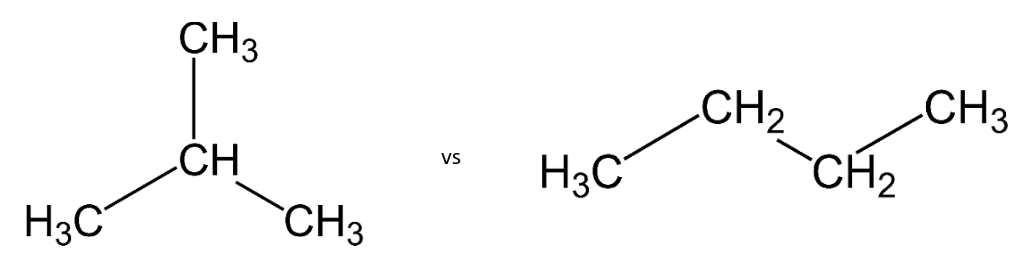
The strongest intermolecular forces that the molecule on the left has are:
London dispersion forces
The strongest intermolecular forces that the molecule on the right has are:
London dispersion forces
The molecule on the left has
4
C atoms and the molecule on the right has 4
C atoms.Analogy: Tree trunk vs branches

Wize Concept
To figure out which molecule has the higher bp (and stronger intermolecular forces) when the molecules have the same forces and the same number of C atoms (so they have the same MW as well), look for branched vs linear chains.
A molecule with branched chains is easier to break apart (just like how small tree branches are easier to break off).
For this reason, molecules with branched chains have lower boiling points than molecules with linear chains
Therefore, the molecule on the (left/right)
right
has the higher bp! 
0:00 / 0:00
Other Physical Properties and Intermolecular Forces
Changes of Phase
Solids have stronger intermolecular forces than liquids and gases.
Solids > Liquids > Gases
Solubility
When one molecule is dissolved in another molecule, typically if the two species have similar types of intermolecular forces, they will mix (be soluble); if not, they will tend not to mix very well (be insoluble).
In general, "like dissolves like"
- Polar molecules are soluble in other polar molecules (but not in non-polar molecules)
- Non-polar molecules are soluble in other non-polar molecules (but not in polar molecules)
Example: Phospholipid bilayer of a cell
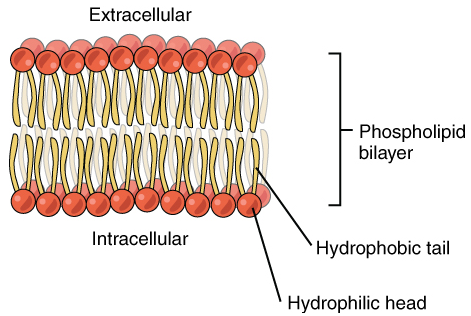
Hydrophilic heads are "water-loving" and contain polar molecules
Hydrophobic tails are "water-fearing" and contain non-polar molecules
Vapor Pressure
Vapor pressure: pressure exerted by the gaseous phase of a liquid that evaporated from the exposed surface of a liquid
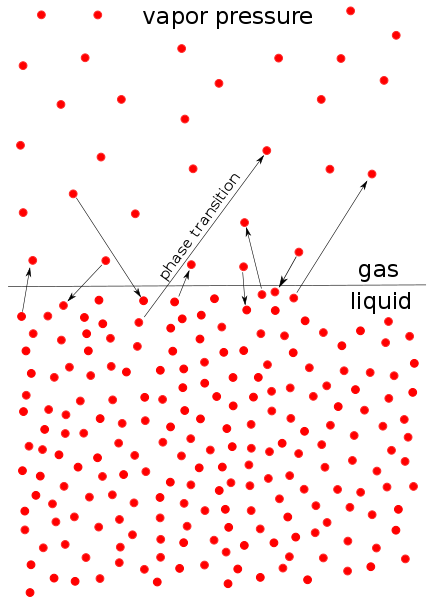
The lower the intermolecular forces the higher or lower the vapor pressure?
higher
We call liquids with high vapor pressures volatile.
The last thing to note is temperature's effect on vapor pressure:
- As temperature increases, do intermolecular forces increase or decrease?Decrease
- As temperature increases, does the vapor pressure increase or decrease?Increase
Wize Tip
If a question on your exam asks you which compound has a lower vapor pressure this is the same as asking which compound has the higher bp.
High B.P. = Low Vapor Pressure
0:00 / 0:00
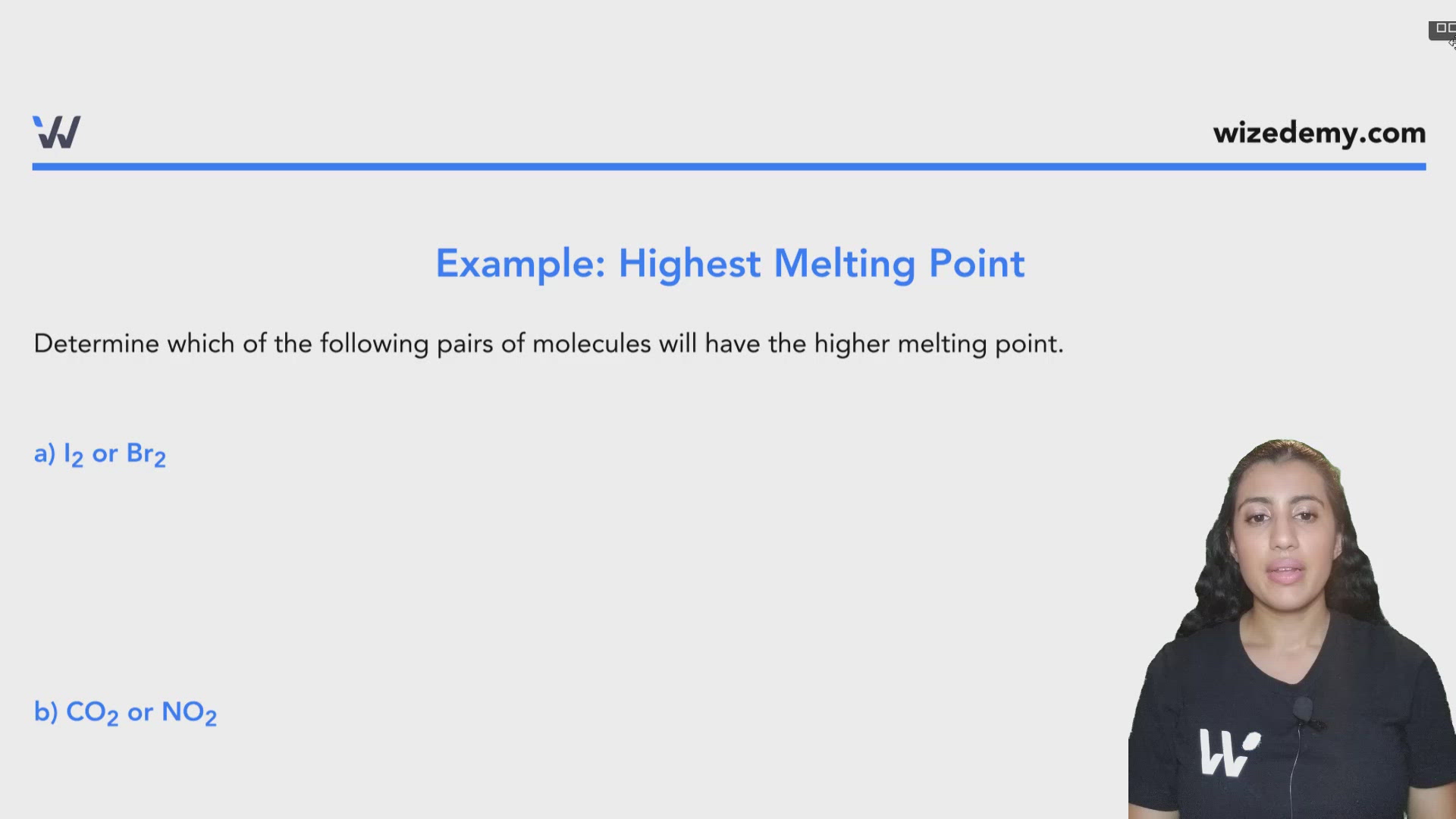
Example: Highest Melting Point
Determine which of the following pairs of molecules will have the higher melting point.
a) I2 or Br2
I2 because it will have the stronger London dispersion forces since it has a higher MW (and more electrons) than Br2.
b) CO2 or NO2–
NO2 because NO2 is polar and CO2 is nonpolar.
Therefore, NO2 has dipole-dipole interactions whereas CO2 does not, giving it the overall stronger intermolecular forces.
c) H2O or H2S
H2O because H2O has hydrogen bonding whereas H2S does not.
H2S does have stronger London dispersion forces, but hydrogen bonding is much stronger than London dispersion forces.
d) NaCl or NH3
NaCl. Anytime you have ion-ion interactions, which NaCl does, it will have stronger intermolecular forces than any covalent molecule, even one that has hydrogen bonding.
0:00 / 0:00
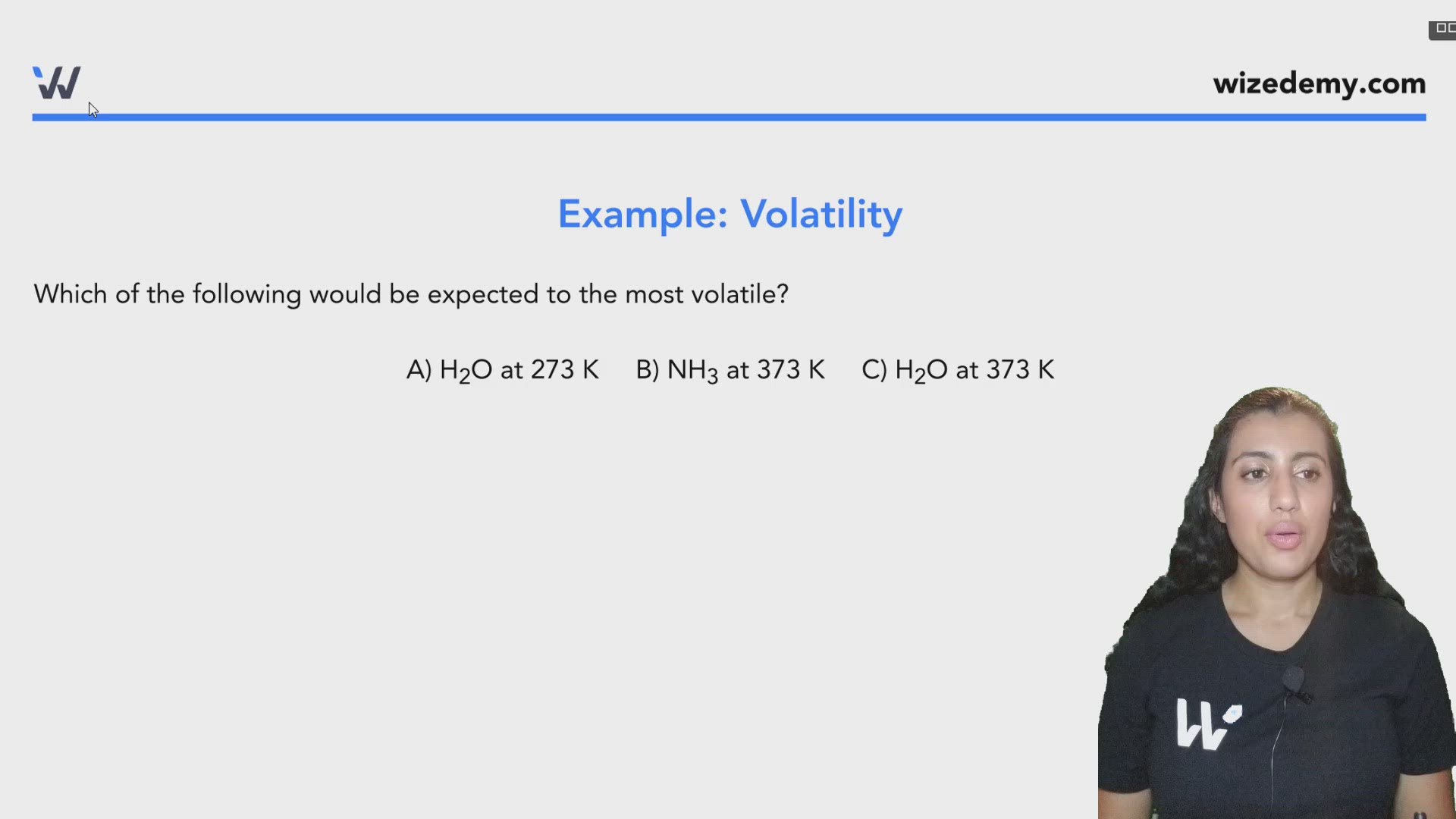
Example: Volatility
Which of the following would be expected to the most volatile?
A) H2O at 273 K B) NH3 at 373 K C) H2O at 373 K
Vaporization depends on two factors: strength of intermolecular forces and the temperature of the material.
H2O is presented at two temperature. As 373 K (C) is higher than 273 K (A), we would expect C to be more volatile.
But NH3 is also at 373 K, which is more volatile. NH3 and H2O both have Hydrogen Bonding interactions, but since O is more electronegative, H2O has a stronger interaction (making it less volatile).
Therefore, the answer is B.
Practice: Boiling Point and Size
The boiling point of hydrocarbons increases as the hydrocarbon gets more carbon atoms added to it. Methane CH4 (–161.5°C), ethane C2H6 (–89°C), propane C3H8 (–42°C). This can best be explained by which of the following?
Practice: Ranking Boiling Points
Please rank the following compounds from lowest boiling point to highest boiling point.
HOCH2CH2OH, CH4, CH3Cl, CH3CH2CH3, CH3OH