Wize University Chemistry Textbook > Acids and Bases
Percent Dissociation
Popular Courses
MCAT
General Course
Grade 12 Chemistry
Ontario High School
Grade 12 Chemistry
Canada High School
CHEM 1302A/B
Western University
General Chemistry
University Study Guides
AP Chemistry Exam Prep Course
AP Exam Prep
High School Chemistry
US High School
Chemistry
General Course
DAT
General Course
General Chemistry
University Study Guides
CHEM 1E03
McMaster University
ENGG 204
University of Calgary
Chemistry 12
British Columbia High School
CHM135H1
University of Toronto
CHEM 102
University of Alberta
CHEM 112B
Queen's University
CHEM 123
University of Waterloo
CHEM 130
University of British Columbia
CHEM 1100
University of Manitoba
CHEM 1481
Texas A & M University
0:00 / 0:00
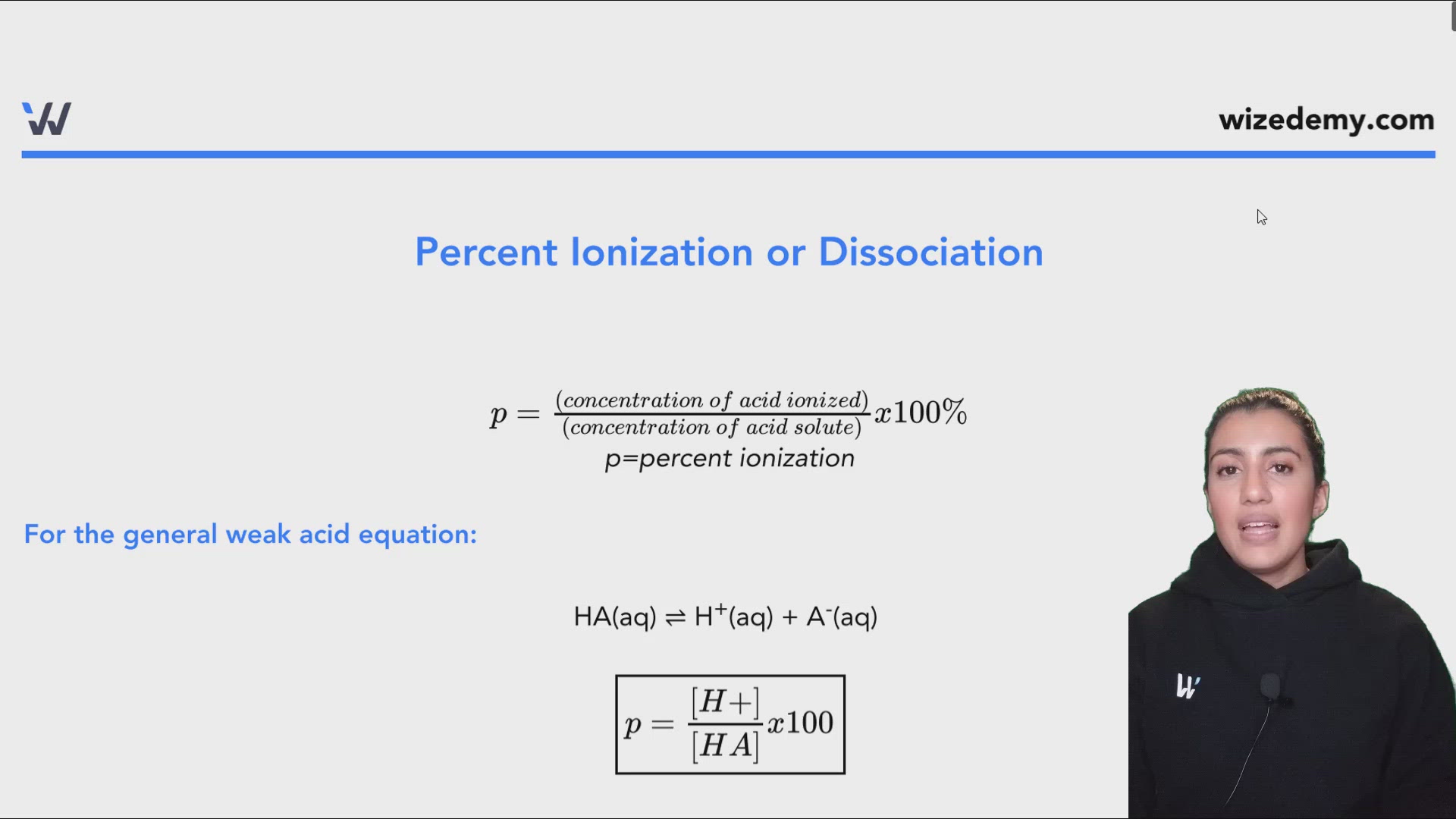
Percent Ionization or Dissociation
p=percent ionization
For the general weak acid equation:
HA(aq) ⇌ H+(aq) + A-(aq)
- Do you think a weak acid would have a high or low percent ionization?Low
- Do you think a strong acid would have a high or low percent ionization?High
0:00 / 0:00
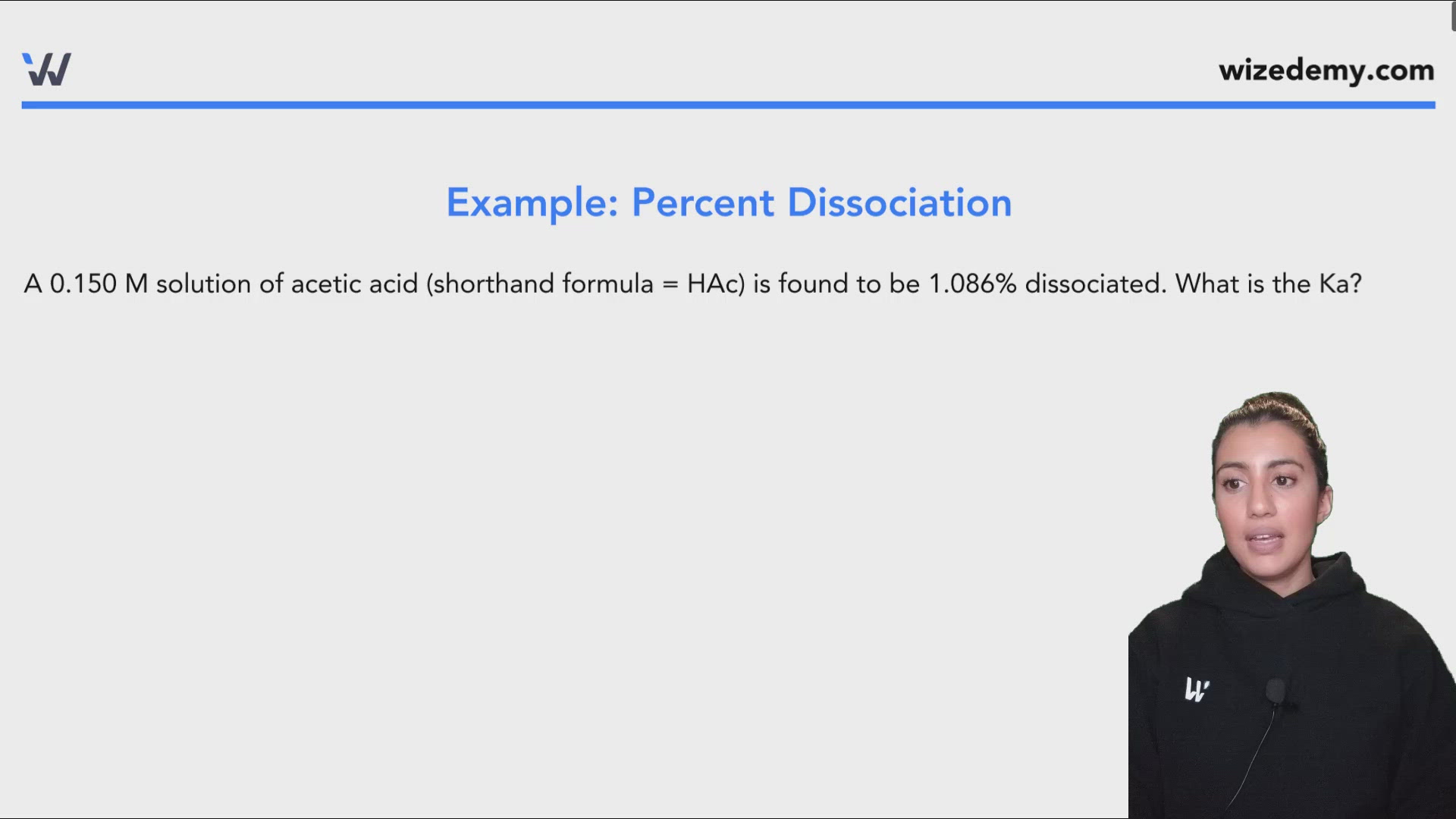
Example: Percent Dissociation
A 0.150 M solution of acetic acid (shorthand formula = HAc) is found to be 1.086% dissociated. What is the Ka?
The equation for the dissociation of HAc is:
HAc ⇌ H+ + Ac¯
The Ka expression is:
The concentration we are given for HAc is the initial concentration but we need to plug in the equilibrium concentration into our Ka expression.
1) Draw out an ICE Table so we can determine equilibrium concentrations
i 0.15M 0 0
C -x +x +x
E 0.15-x x x
2) We find [H+] using the concentration and the percent dissociation:
Use this equation and solve for [H+]:
p=1.086
H+=1.629 x 10¯3 M
3) Solve for [Ac¯]
x= [Ac¯] = [H+] = 1.629 x 10¯3 M
4) Solve for [HAc]
[HAc]=0.15-x
=0.15-1.629x10-3
=0.148371
4) Now, we insert into the Ka expression and solve:
Ka= 1.8x10⁻⁵