Wize University Chemistry Textbook > Acids and Bases
Autoionization of Water (Kw)
Popular Courses
MCAT
General Course
Grade 12 Chemistry
Ontario High School
Grade 12 Chemistry
Ontario High School
Grade 12 Chemistry
Canada High School
Grade 12 Chemistry
Canada High School
CHEM 1302A/B
Western University
General Chemistry
University Study Guides
AP Chemistry Exam Prep Course
AP Exam Prep
CHEM 1A03
McMaster University
CHEM 101
University of Alberta
CHEM 112
Queen's University
High School Chemistry
US High School
High School Chemistry
US High School
Chemistry 30
Alberta High School
DAT
General Course
Chemistry
General Course
CHEM 1AA3
McMaster University
CHEM 103
University of Alberta
General Chemistry
University Study Guides
CHEM 1E03
McMaster University
0:00 / 0:00
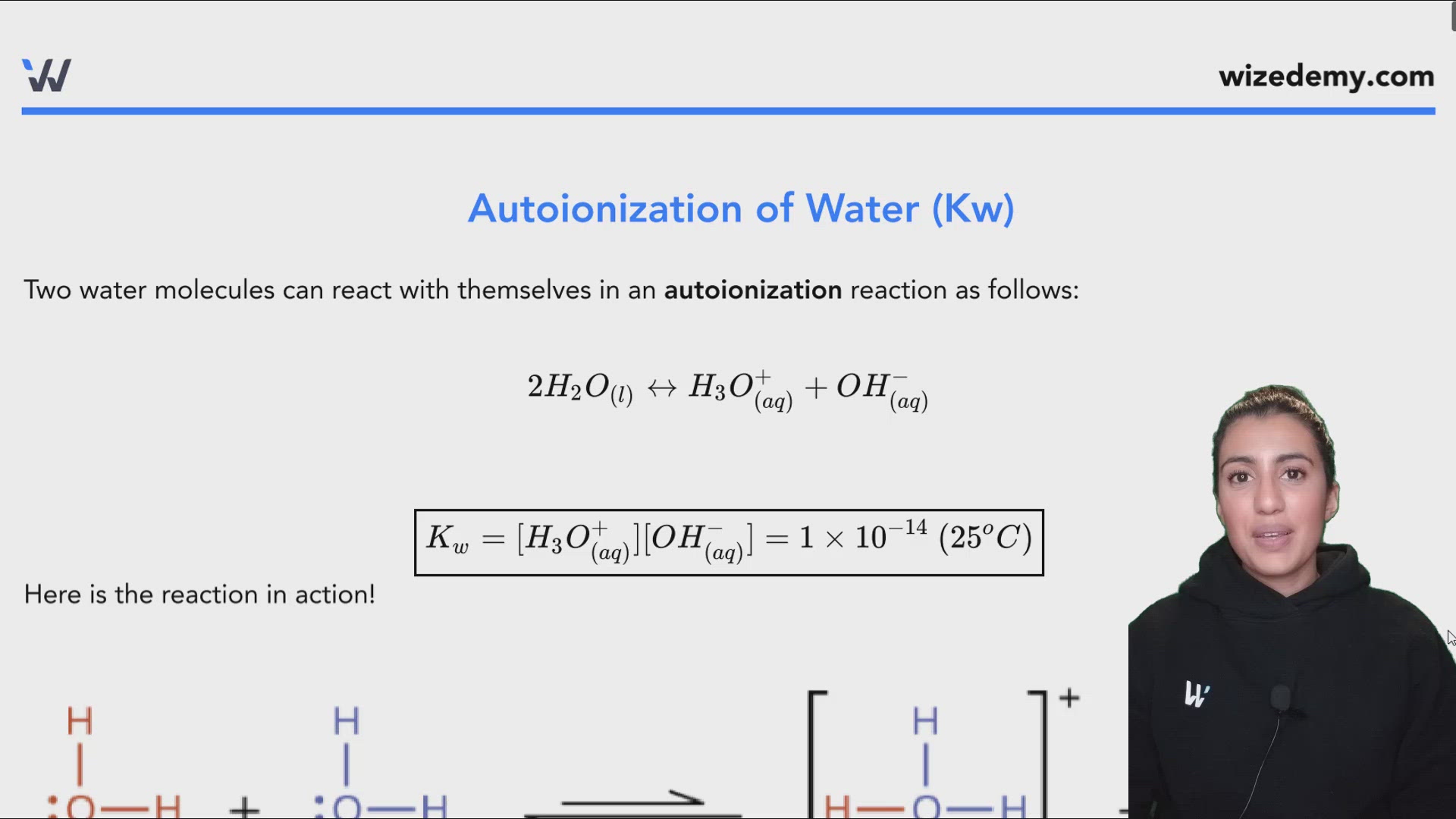
Autoionization of Water (Kw)
Two water molecules can react with themselves in an autoionization reaction as follows:
Here is the reaction in action!
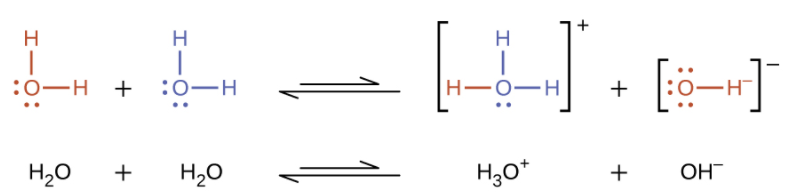
Label whether each reactant and product in the above reaction is acting as an acid/base or conjugate acid/conjugate base.
Water is amphoteric: it can act as an acid or a base!
Other Key Relationships
Kw = [H+][OH-] = 1x10-14, [H+]= 1x10⁻⁷M and [OH-]= 1x10⁻⁷M at 25oC
This is why the pH (and pOH) of neutral water is 7
*Ka and Kb have to be the K values for an acid and its conjugate base (or a base and its conjugate acid)
If [H+] goes higher, what do you think would happen to [OH–]? Goes higher/lower:
lower
Practice: Solve for [H+]
A solution of HBr has a pOH of 12.2, what is the [H+] concentration?
0:00 / 0:00
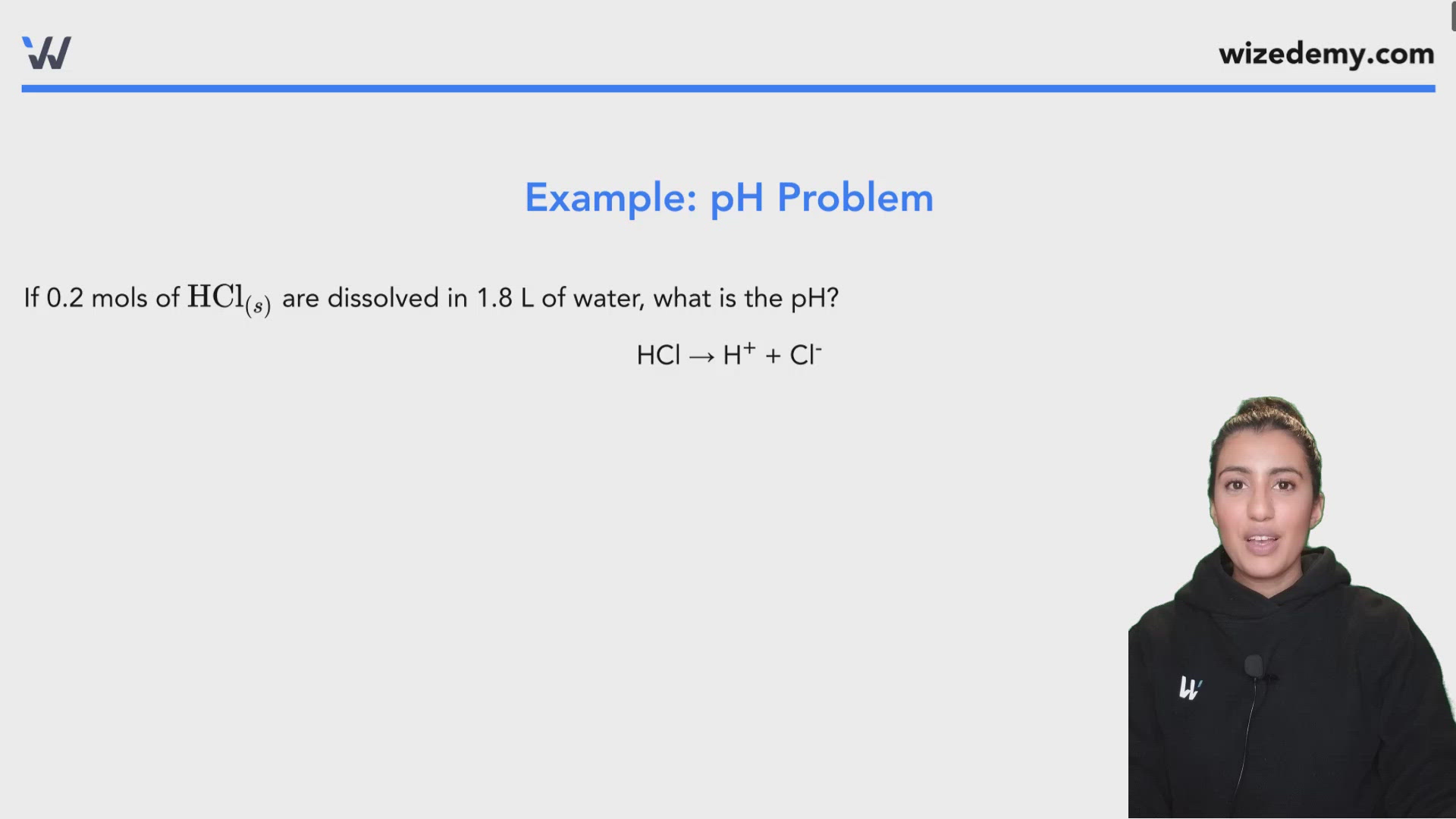
Example: pH Problem
If 0.2 mols of are dissolved in 1.8 L of water, what is the pH?
HCl → H+ + Cl-
Since is a strong acid, we will be adding 0.2 mols of to 1.8 L of water.
0:00 / 0:00
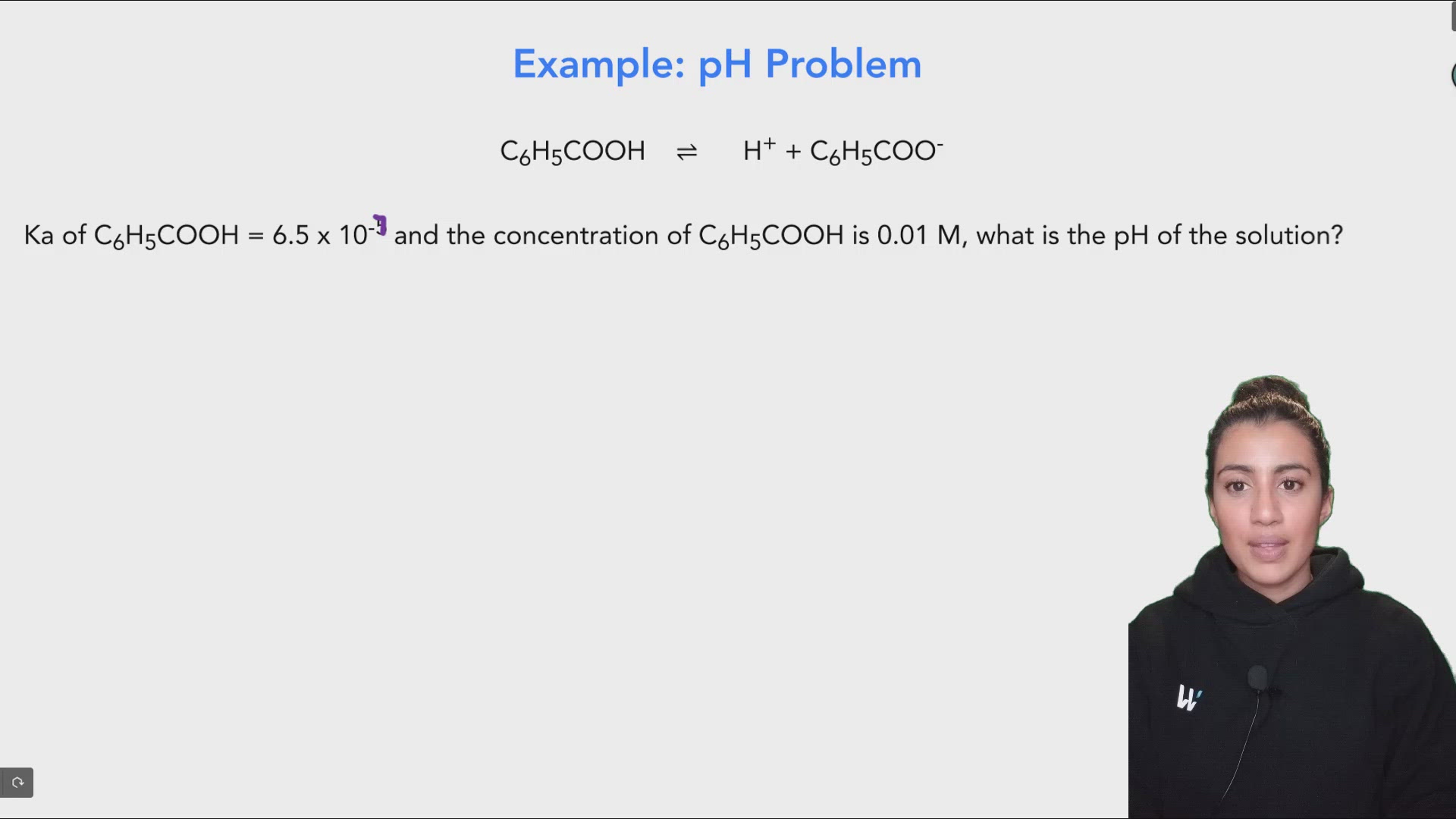
Example: pH Problem
C6H5COOH ⇌ H+ + C6H5COO-
The Ka of C6H5COOH = 6.5 x 10⁻⁷ and the concentration of C6H5COOH is 0.01 M. What is the pH of the solution?
Write Out an ICE Table
I 0.01M 0 0
C -x +x +x
E 0.01-x x x
Write a K expression and solve for x
Ka = x²/(0.01 - x)
Ka = x²/0.01
We can ignore the "-x" part since y/K > 400
x² = Ka·0.01
x² = (6.5 x 10⁻⁷)(0.01)
x² = 6.5 x 10⁻⁹
x = 8.06 x 10⁻⁵
x=[H+]
Find pH
pH = -log[H+]
pH = -log(8.06 x 10⁻⁵)
pH = 4.09
0:00 / 0:00
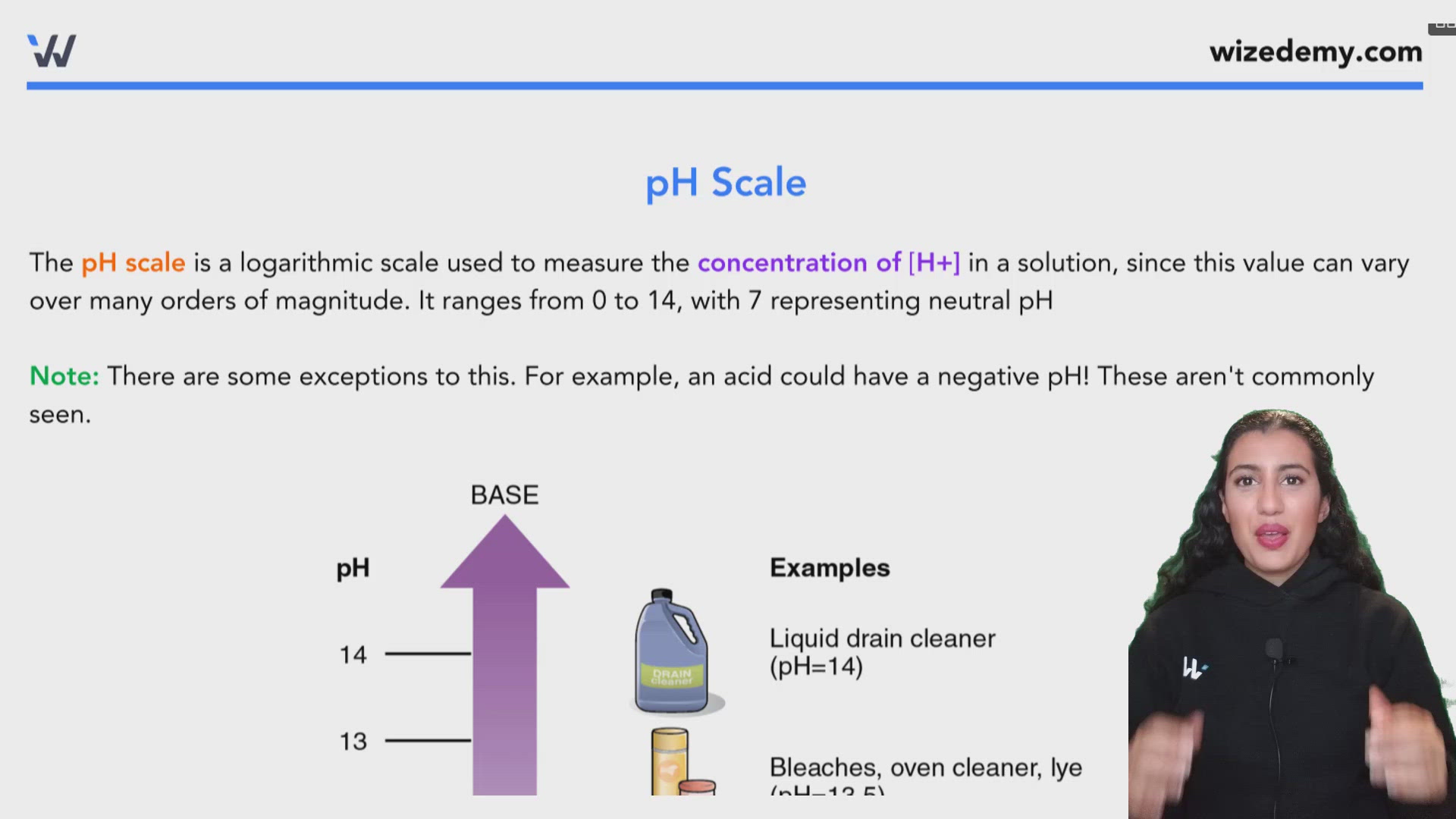
pH Scale
The pH scale is a logarithmic scale used to measure the concentration of [H+] in a solution, since this value can vary over many orders of magnitude. It ranges from 0 to 14, with 7 representing neutral pH
Note: There are some exceptions to this. For example, an acid could have a negative pH! These aren't commonly seen.

A lower pH indicates that a substance is more (acidic/basic)
acidic
and has a (higher/lower) higher
[H+] 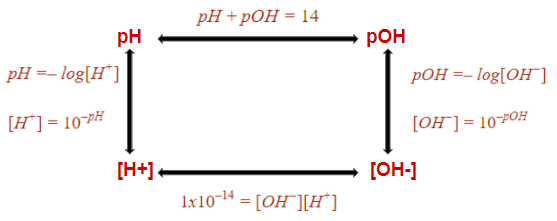
We also have Ka and pKa equations:
As well as Kb and pKb equations:
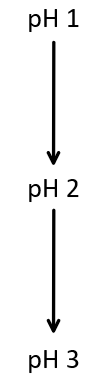
What does it mean to be a logarithmic scale?
How does the [H+] change as the pH goes from 1 to 2 or 1 to 3??
Wize Concept
Since pH is a logarithmic scale, each 1 unit change in pH corresponds to a 10-fold change in [H+]!