Wize University Chemistry Textbook > Acids and Bases
Applications of Acid and Base Equations
Popular Courses
MCAT
General Course
Grade 12 Chemistry
Ontario High School
Grade 12 Chemistry
Canada High School
CHEM 1302A/B
Western University
General Chemistry
University Study Guides
AP Chemistry Exam Prep Course
AP Exam Prep
CHEM 101
University of Alberta
CHEM 112
Queen's University
High School Chemistry
US High School
DAT
General Course
Chemistry
General Course
CHEM 1AA3
McMaster University
CHEM 103
University of Alberta
General Chemistry
University Study Guides
CHEM 1E03
McMaster University
ENGG 204
University of Calgary
Chemistry 12
British Columbia High School
CHM135H1
University of Toronto
CHEM 102
University of Alberta
CHY 102
Toronto Metropolitan University
Example: Ka and pKa Values
What is the strongest acid below? What is the weakest acid?
Strongest acid:
Cl3CCOOH
Weakest acid:
HCN
Standard Ka values

The strongest acid has the highest Ka value (and lowest pKa value)
The weakest acid has the lowest Ka value (and the highest pKa value)
What is the strongest base below? What is the weakest base?
Strongest base:
Dimethylamine
Weakest base:
Aniline
Standard Kb values

The strongest base has the highest Kb value (and the lowest pKb value).
The weakest base has the lowest Kb value (and the highest pKb value).
0:00 / 0:00
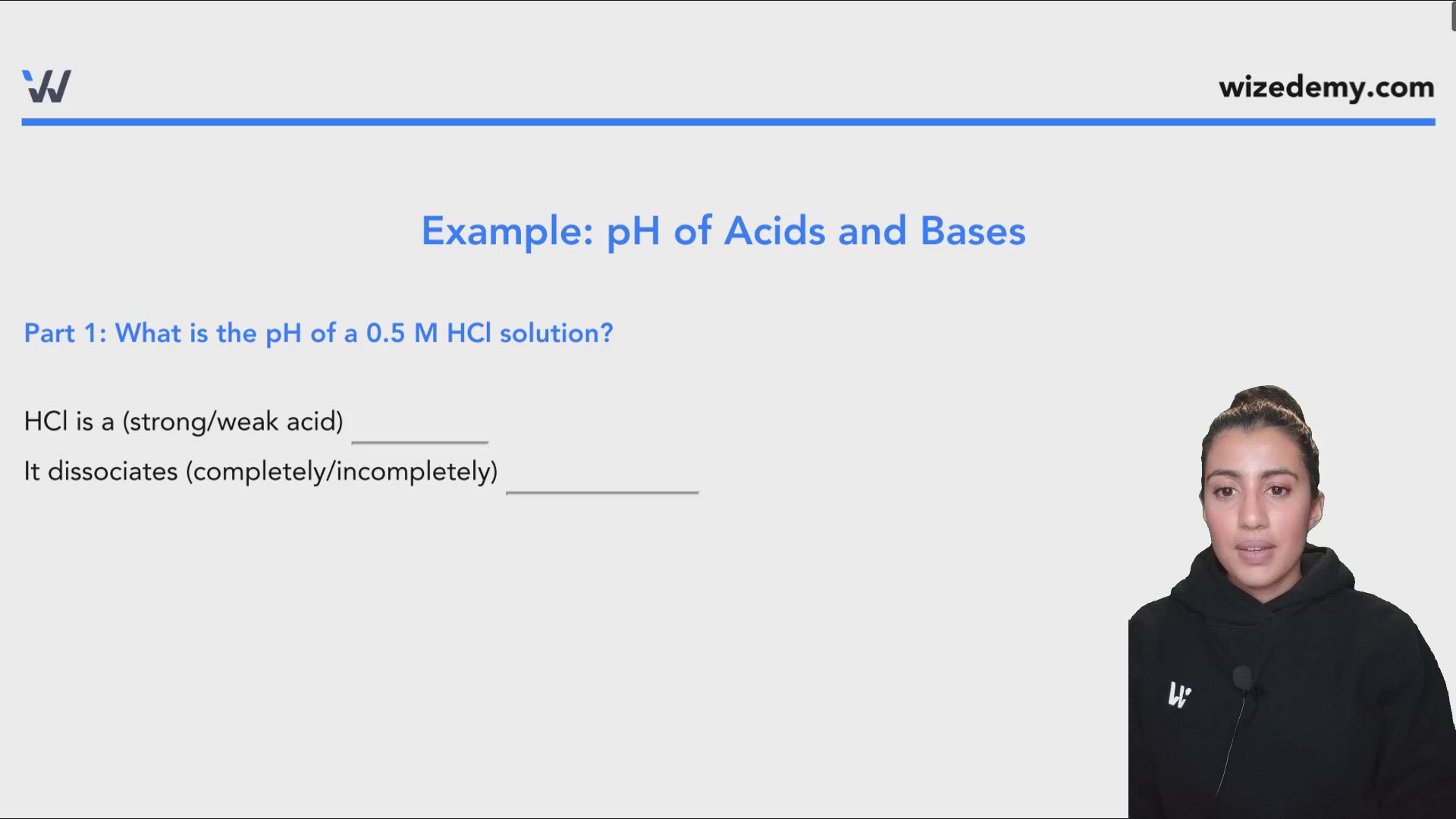
Example: pH of Acids and Bases
Part 1: What is the pH of a 0.5 M HCl solution?
HCl is a (strong/weak acid)
strong
It dissociates (completely/incompletely)
completely
Strong acids COMPLETELY dissociate so we can write the reaction:
HCl → H+ + Cl-
0.5M
Since the equation is balanced, we can see that there is a 1:1 molar ratio between HCl and H+ so the concentration of H+ will actually be the same!
[H+] =0.5M
plug that into the pH equation: pH=-log[H+]
pH=-log[0.5]
pH=0.30
Part 2: What is the pH of a 1.0 M CH3COOH solution? Ka = 1.8 x 10⁻⁵
This is an (acid/base)
acid
It is (weak/strong)
weak
Does this type of acid dissociate into ions completely/incompletely?
incompletely
CH3COOH is not one of the strong acids we had to memorize, so we automatically know that it is a weak acid!
Weak acids have INCOMPLETE dissociation, so we will see an equilibrium in the equation:
CH3COOH(aq) + H2O(l) ⇌ CH3COO- + H3O+(aq)
1.0M ? need this to find pH!
Write out an ICE Table:
I 1M / 0 0
C -x +x +x
E 1-x x x
Write out the Ka expression:
Plug in the Ka value we were given and plug in the equilibrium concentrations from our ICE table:
Let's check to see if the denomenator has to stay [1-x] (and we would have to use the quadratic equation) OR we might be able to simplify it to ~1.
When the denominator is in the form of y-x, we can check to see if y/K > 400 and if it is, then we can make the assumption and simplify.
Let's see.... 1/1.8x10-5= 55 555 which is much larger than 400! This means that our denominator was [1-x] but we can simplify it to [1] since y is so large and K is so small so the x won't make a difference.
Take the square root of both sides:
4.24x10-3=x
If we look back at our ICE table, x=[H+]
so now we can solve for pH:
pH=-log[H+]
pH=-log[4.24x10⁻³]
pH=2.37 !
Part 3: What is the pH of a solution prepared by dissolving 0.10 mol of Ba(OH)2 in 1.0 L of pure water?
Is this an acid or base?
base
Is this a strong one or weak one?
Strong
Complete/incomplete dissociation?
Complete
Since we know it's a strong base, that means we know it will COMPLETELY dissociate so we can write out the chemical reaction:
Ba(OH)2 → Ba2+ + 2OH- (Always double check your equation is balanced!!)
Here we are given n=0.10 mol, V=1L. We can use the equation n=cv to solve for c:
c=n/v
c=0.10mol/1L
c=0.1M
0.1M 0.2M
(Since Ba(OH)2 has a concentration of 0.1M, OH- must have a concentration of 0.2M since there is a 1:2 molar ratio!)
[OH-]=0.2M
pOH=-log[OH-]
pOH=-log[0.2]
pOH=0.70
We are asked to solve for pH so use the equation: pH + pOH = 14
pH=14-pOH
pH=14-0.70
pH=13.3 (This logically makes sense since we would expect a base to have a very high pH)
Part 4: Many liquid household cleaners contain ammonia. The concentration of ammonia (NH3) in these products is usually around 5.0 M. What is the pH of such a cleaning solution? (Kb NH3 = 1.8 x 10⁻⁵)
Is this an acid or a base?
Base
Is it strong or weak?
Weak
Complete or incomplete dissociation?
Incomplete
NH3 is a weak base so that means it INCOMPLETELY dissociates:
NH3 + H2O ⇌ NH4+ + OH-
5M
Here we will need to make an ICE table, so we can again plug in the equilibrium concentrations into our Ka expression, solve for [OH-] then pOH, then pH !
I 5M / 0 0
C -x +x +x
E 5-x x x
Now write the Kb expression out:
Plug in the Kb value we were given and the equilibrium values from our ICE Table:
Check to see if we can make the simplification of the denominator from [5-x] to ~5.
y/K >400
5/1.8x10-5=277 778. which is much greater than 400 so we can make the simplifcation!
1.8x10⁻⁵(5)=x2
9x10-5=x2
Take the square root of both sides:
9.49x10-3=x
x=[OH-] (see the ICE Table)
Solve for pOH:
pOH=-log[OH-]
pOH=-log[9.49x10⁻³]
pOH=2.02
The question is asking us to solve for pH so use pH + pOH=14
pH=14 - pOH
pH=14-2.02
pH=11.98 !
Types of Acid or Base Reactions and pH Calculations Summary
1. Strong Acid Alone
2. Strong Base Alone
3. Weak Acid Alone
Example: 2.0 mols of weak acid, HA, with a Ka = 2 x 10⁻⁴ in 1.0 L of solution.
Step 1: Make an ICE table
Step 2: Set up Ka equation and solve for [H3O+]
4. Weak Base Alone
Example: 2.0 moles of weak base, B, with a Kb of 7 x 10⁻⁷ in 1.0 L of solution.
Step 1: Make an ICE table
Step 2: Set up Kb equation and solve for [OH- ]
When can we make a simplifying assumption about x?
In K = x2/(y – x)
When y/K > 400 you can simplify and ignore "–x."