Wize University Chemistry Textbook > Acids and Bases
Base Equations (Kb, pKb)
Popular Courses
MCAT
General Course
Grade 12 Chemistry
Ontario High School
Grade 12 Chemistry
Canada High School
CHEM 1302A/B
Western University
General Chemistry
University Study Guides
AP Chemistry Exam Prep Course
AP Exam Prep
CHEM 101
University of Alberta
CHEM 112
Queen's University
High School Chemistry
US High School
DAT
General Course
Chemistry
General Course
CHEM 1AA3
McMaster University
General Chemistry
University Study Guides
CHEM 103
University of Alberta
CHEM 1E03
McMaster University
ENGG 204
University of Calgary
Chemistry 12
British Columbia High School
CHM135H1
University of Toronto
CHEM 102
University of Alberta
CHY 102
Toronto Metropolitan University
0:00 / 0:00
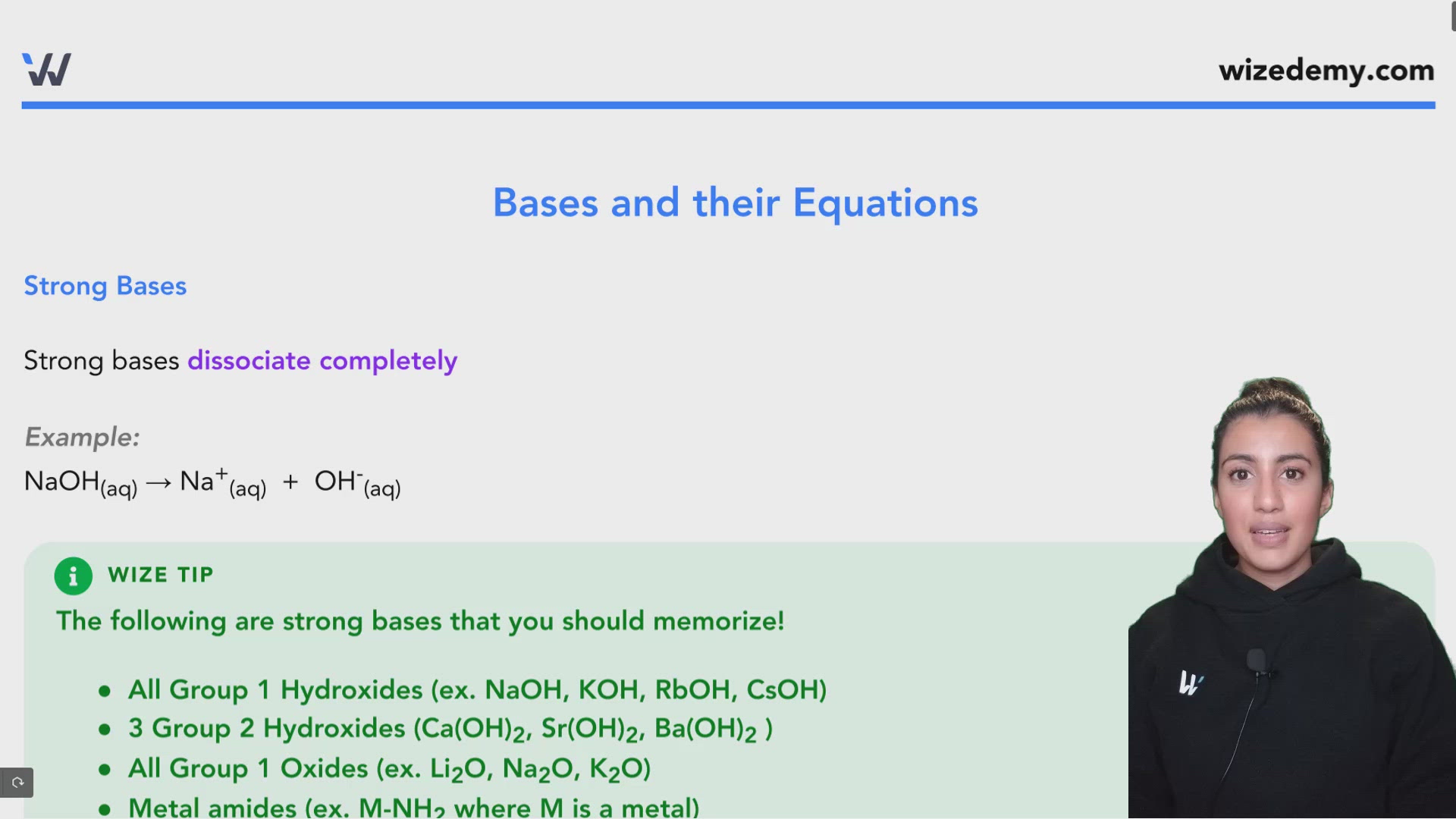
Bases and their Equations
Strong Bases
Strong bases dissociate completely
Example:
NaOH(aq) → Na+(aq) + OH-(aq)
Wize Tip
The following are strong bases that you should memorize!
- All Group 1 Hydroxides (ex. NaOH, KOH, RbOH, CsOH)
- 3 Group 2 Hydroxides (Ca(OH)2, Sr(OH)2, Ba(OH)2 )
- All Group 1 Oxides (ex. Li2O, Na2O, K2O)
- Metal amides (ex. M-NH2 where M is a metal)
Weak Bases
Weak bases dissociate incompletely so they have a Kb value (base dissociation constant)
Kb is defined as the equilibrium constant for the reaction below:
Wize Concept
Weak acids and weak bases both reach an equilibrium between the undissociated and dissociated ions.
Base strength follows the following trends:
- A weaker base will have a higher/lower Kb value?lower
- A weaker base will have a higher/lower pKb value?higher
- A weaker base will have a higher/lower pH?lower
- A stronger base will have a higher/lower Kb value?higher
- A stronger base will have a higher/lower pKb value?lower
- A stronger base will have a higher/lower pH value?higher
Wize Tip
If you see an acid or base that is not listed above (above we listed the strong acids and bases), assume you are dealing with a weak acid/base!