Wize University Chemistry Textbook > Acids and Bases
Acid Equations (Ka, pKa)
Popular Courses
MCAT
General Course
Grade 12 Chemistry
Ontario High School
Grade 12 Chemistry
Canada High School
CHEM 1302A/B
Western University
General Chemistry
University Study Guides
AP Chemistry Exam Prep Course
AP Exam Prep
CHEM 1A03
McMaster University
CHEM 101
University of Alberta
CHEM 112
Queen's University
CHEM 203
University of Calgary
High School Chemistry
US High School
DAT
General Course
CHM 1311
University of Ottawa
Chemistry
General Course
CHEM 1AA3
McMaster University
CHEM 103
University of Alberta
General Chemistry
University Study Guides
CHEM 1E03
McMaster University
ENGG 204
University of Calgary
Chemistry 12
British Columbia High School
0:00 / 0:00
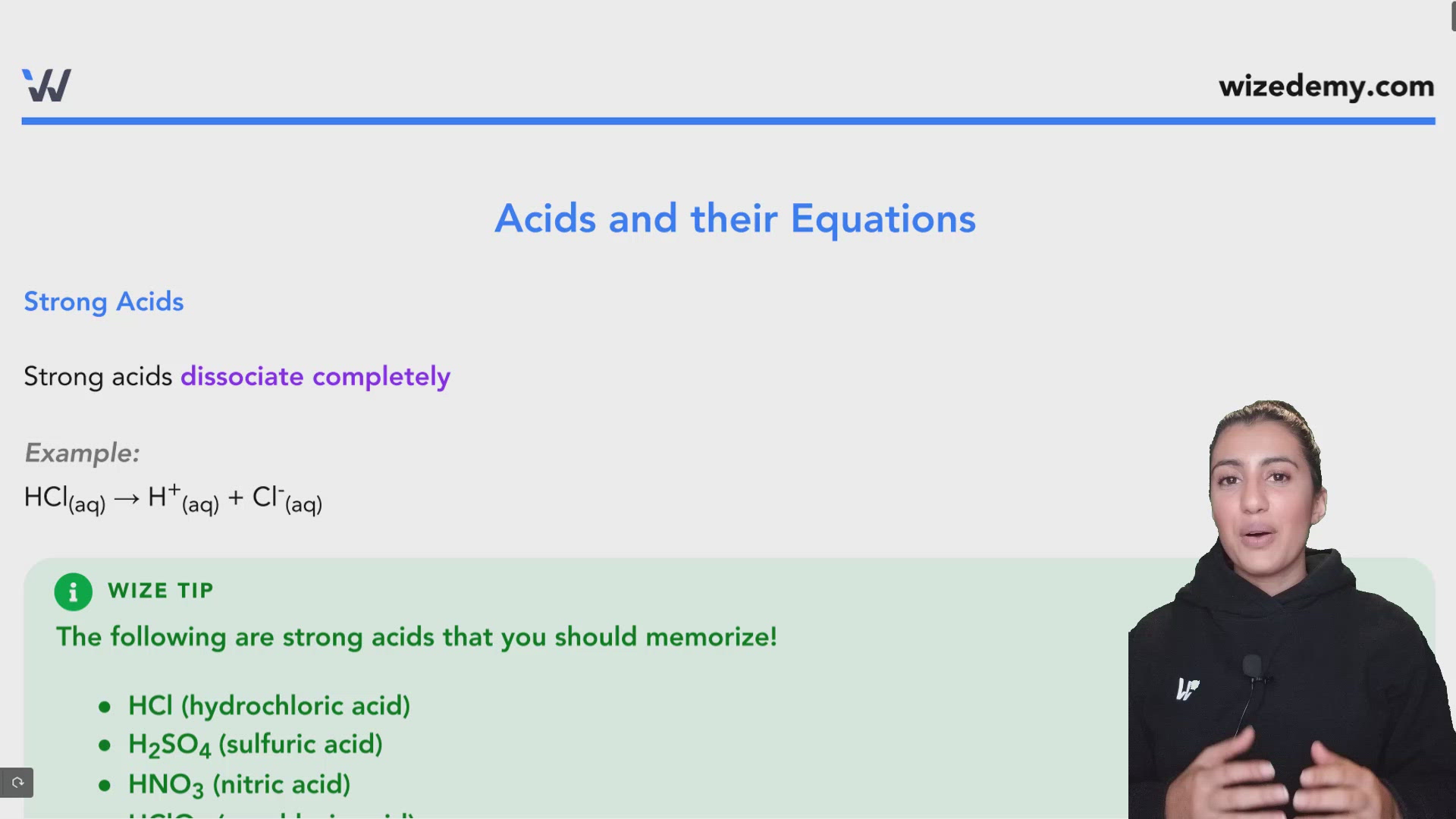
Acids and their Equations
Strong Acids
Strong acids dissociate completely
Example:
HCl(aq) → H+(aq) + Cl-(aq)
Wize Tip
The following are strong acids that you should memorize!
- HCl (hydrochloric acid)
- H2SO4 (sulfuric acid)
- HNO3 (nitric acid)
- HClO4 (perchloric acid)
- HBr (hydrobromic acid)
- HI (hydroiodic acid)
Weak Acids
Weak acids dissociate incompletely, so they have a Ka value (acid dissociation constant)
Ka is defined as the equilibrium constant for the reaction below:
Acid strength follows the following trends:
- A weaker acid would have a higher/lower Ka value?lower
- A weaker acid would have a higher/lower pKa value?higher
Wize Tip
Ka and pKa are like opposite trends.
The higher Ka goes, the lower pKa will go,
and the lower Ka goes, the higher pKa will go!
- A weaker acid will have a higher/lower pH value:higher
- A stronger acid will have a higher/lower Ka value?higher
- A stronger acid will have a higher/lower pKa value?lower
- A stronger acid will have a higher/lower pH value?lower
In general:
- If the Ka > 1, pKa < 0 the acid is strong/weak:strongand reactants/products:productsare favored
- If the Ka < 1, pKa > 0 the acid is strong/weak:weakand reactants/products:reactantsare favored
Practice: Strong Acids
Which one of the following statements about strong acids is true?
0:00 / 0:00
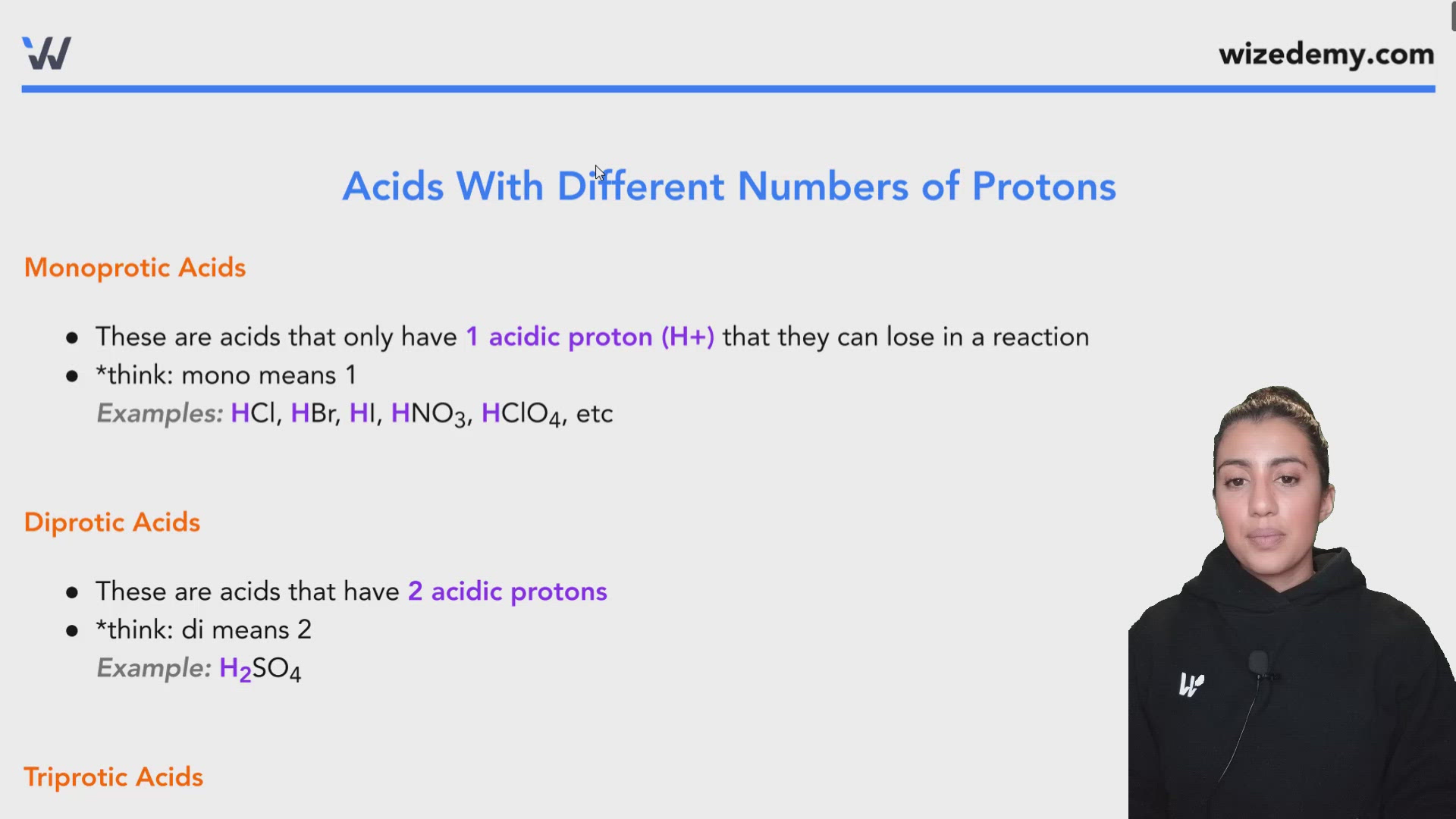
Acids With Different Numbers of Protons
Monoprotic Acids
- These are acids that only have 1 acidic proton (H+) that they can lose in a reaction
- *think: mono means 1 Examples: HCl, HBr, HI, HNO3, HClO4, etc
Diprotic Acids
- These are acids that have 2 acidic protons
- *think: di means 2 Example: H2SO4
Triprotic Acids
- These are acids that have 3 acidic protons
- *think: tri means 3 Example: H3PO4
Polyprotic Acids
- This term is just referring to any acid that has more than 1 proton
- *think: poly means many Example: H2SO4, H3BO3, H2C2O4

Wize Concept
The main concept to take away from this table is just that each ionization reaction has its own Ka value and Ka1>Ka2>Ka3.