Wize University Chemistry Textbook > Acids and Bases
Strength of Acids and Bases
Popular Courses
MCAT
General Course
Grade 12 Chemistry
Ontario High School
Grade 12 Chemistry
Canada High School
General Chemistry
University Study Guides
AP Chemistry Exam Prep Course
AP Exam Prep
CHEM 1A03
McMaster University
CHEM 101
University of Alberta
CHEM 112
Queen's University
CHEM 203
University of Calgary
High School Chemistry
US High School
CHEM 1AA3
McMaster University
Chemistry
General Course
DAT
General Course
General Chemistry
University Study Guides
CHEM 103
University of Alberta
CHEM 1E03
McMaster University
Chemistry 12
British Columbia High School
CHM135H1
University of Toronto
CHEM 102
University of Alberta
CHEM 120
McGill University

0:00 / 0:00
Relationships Between the Strength of an Acid/Base and its Conjugate Base/Acid
The stronger an acid is, the weaker its conjugate base will be.
- HCl is a strong acid; this tells us that Cl- will be a very weak/strong:weakbase.
- Cl- is so weak that it is actually a completely ineffective base.
- On the other hand, because HCN is a weak acid the conjugate CN- will be able to act as a weak base (has some basic properties, more on this later!)
The stronger a base is, the weaker its conjugate acid will be.
Wize Concept
If we have a strong acid that dissociates completely, that means the reaction is only going in the forward direction to produce ions:
HCl → H+ + Cl-
There is no reverse reaction. As a result, it makes sense that Cl- has no basic properties.
If we consider a weak acid instead, there is incomplete dissociation, and a reverse reaction is possible:
CH3COOH + H2O ⇌ CH3COO- + H3O+
Since a reverse reaction is possible, it makes sense that the conjugate base does have some basic properties!
Note: The conjugate base of a weak acid would still be a weak base, but if we took an even weaker acid, that means the conjugate base would be a stronger weak base!
There are 3 things I want you to look at this table and see:
1) See the list of strong acids again (remember to have these memorized!)
2) Notice that the stronger the acid, the weaker the conjugate base.
3) Notice that if we look at a row in this table, we can see an acid, and it's conjugate base. Try to cover up a few bases and guess the conjugate bases. For example, what is the conjugate base of NH3? It is NH2-!
Don't memorize the table!


0:00 / 0:00
How to Determine the Stronger Acid by Looking at Conjugate Bases
We just learned that the stronger an acid, the (stronger/weaker)
weaker
its conjugate base.For a strong acid, the conjugate base is so weak that it has no basic properties!
Weak conjugate bases (want to/don't want to)
don't want to
react. Therefore, it makes sense that weak conjugate bases are (more/less)
more
stable. Wize Concept
Stronger acids will always have the more stable conjugate base!
Example #1: If we consider HF vs HI, which of these is the stronger acid?
We can compare their conjugate bases:
F- vs I-
Now which of the conjugate bases is more stable?
Both conjugate bases have a negative charge, so do you think the more stable conjugate base would be the one with the negative charge spread over a smaller or larger distance?
Larger distance!
Therefore, the more stable conjugate base is
I-
(larger
Atomic Radius) and the stronger acid is HI
! Example #2: Order the following acids in order of increasing acidity:
HI, PhOH, and H2SO4
So first, let's consider the conjugate bases:
I-, PhO-, and HSO4-
Again all of the conjugate bases have a negative charge, so the most stable conjugate base will be the one that stabilizes that charge the most
- If we want our negative charge to be stabilized, do we want the charge to be spread over a large distance, or concentrated over a small distance?large distance!
- If we want our negative charge to be stabilized, would we want a more EN atom to have the charge or a less EN atom to have the charge?more EN!
Now let's draw out the conjugate bases to see what their structures look like:
I-, PhO-, and HSO4-
Do any of the structures have resonance?
yes!
If they do, which ones have resonance? (draw out resonance if they have it!)
Would resonance make the conjugate more or less stable?
More stable!
Therefore, our least stable conjugate base is:
I-
. This means that HI
is the weakest
acid. Now, out of the conjugate bases with resonance, what element has the charge initially?
O!
Do you think this is more or less stable than having the negative charge on C?
More Stable
If you consider the resonance structures, does the charge always stay on O? Yes or no and for which conjugate base?
For PhO- the charge goes to C atoms in the resonance structures
For HSO4- the charge goes on other O atoms in the resonance structures
Therefore, in order of increasing acidity (in order of least stable conjugate base to most stable conjugate base):
HI < PhOH < H2SO4
Do you think if we had more resonance that would make the conjugate base more or less stable?
more stable!
Summary
1) Resonance is the most important factor in determining conjugate base stability
More resonance present=more stable conjugate base
2) Having the negative charge on the most electronegative element is next most important.
Also pay attention to which atoms carry the negative charge in resonance structures.
The more stable conjugate base will have the negative charge on more electronegative elements.
3) Having other electronegative atoms present also help to stabilize the charge in the conjugate base (inductive effect)
4) When comparing atoms with negative charges, the larger the atomic radius, the more stable the conjugate base.
0:00 / 0:00
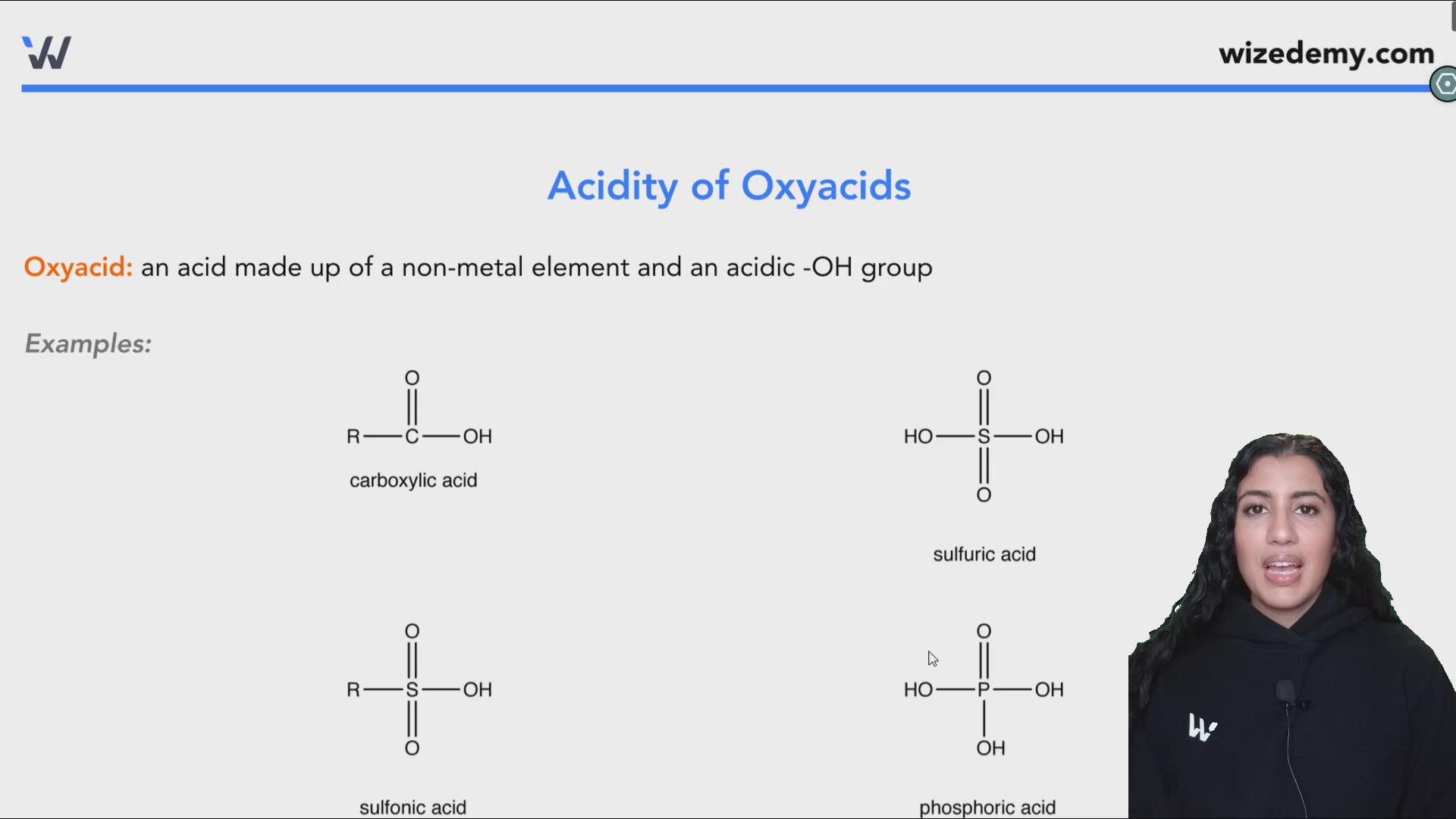
Acidity of Oxyacids
Oxyacid: an acid made up of a non-metal element and an acidic -OH group
Examples:

The strength of an oxyacid depends on two things:
1) The Number of O atoms
Think about the conjugate base of the acid.
- If we deprotonate the acid and there are many Os, those Os are quite electronegative and can help spread the negative charge so it is not concentrated in one area, thus stabilizing the conjugate base.
- An oxyacid with more Os is a stronger acid than an oxoacid with less Os
Example: Which one is more acidic? Carboxylic acid or sulphuric acid?
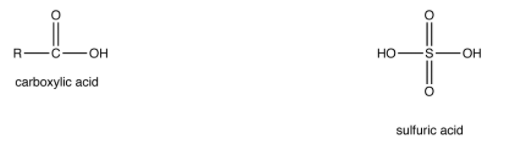
sulphuric acid! It has a lot more O atoms!
2) The EN of the central non-metal atom
If we are trying to determine the stronger oxyacid, consider their conjugate bases.
- The conjugate base that has a central non-metal atom that is more electronegative will be able to spread the charge on the conjugate base, stabilizing it.
- Therefore, the oxoacid with the more electronegative central atom will be the stronger acid (if we are dealing with 2 oxoacids with the same # of Os)
Example: Which is the stronger acid? Sulphuric acid or phosphoric acid?
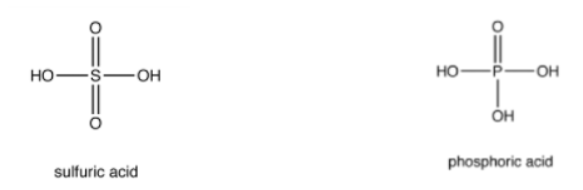
Sulphuric acid since S is more electronegative than P!
Summary
In general, for oxyacids with the same # of O atoms, we have increasing acid strength with (increasing/decreasing)
increasing
EN of central non-metal atomAnd for oxyacids with a different # of O atoms, the stronger oxyacid will be the one with (more/less)
more
O atoms